The First 'Dune: The Third' Trailer Is Excellent
The first trailer for Denis Villeneuve's final Dune film is here
The trailer opens quietly.
Just Paul and Chani in a tent, talking about baby names.
Chani asks what they'd name a girl. Paul says Ghanima — "she would need to be strong like her mother." Then Paul asks about a boy. Chani says Leto, after his grandfather. "So he would have the wisdom of his grandfather."
**
The day after the Oscars, and Warner Bros. has dropped the trailer for Dune: The Third.
And guess what? Chalamet may have lost the Oscars but Lisab al Gaib is so, so back.
Dune: Messiah — Frank Herbert's follow-up to the original novel, and the source material for the third film — is set twelve years after Dune. When Villeneuve finished Part Two, he assumed there would be a natural pause. A breath. Maybe even a decade before he needed to return to Arrakis. "Even me, I thought I would take more time," he said during the trailer reveal event. But then Part Two came out in 2024, and blew up the Internet. Villeneuve felt it. "When you make a series of movies, you are in a relationship with the audience," he said. "I felt a responsibility to finish this story."
And so here we are. Two years later, and the trailer is finally out.
Dune: Part Three is based on Dune: Messiah, Herbert's follow-up novel, and it picks up seventeen years after Part Two left off. Paul Atreides is Emperor now. The holy war he set in motion has been burning across the galaxy for nearly two decades. He has everything he wanted, and it has cost him almost everything that mattered.
Villeneuve described the tone shift simply: the first film was a boy exploring a new world, the second was a war movie, and this one is a thriller. "More action-packed, more tense, more muscular," he said. He also called it his most personal film to date, which is a notable thing to say about a $200 million sci-fi epic.
The Book, Briefly
It's worth understanding what Dune: Messiah actually is before you walk into this film, because it's genuinely unusual source material for a blockbuster.
Herbert wrote it as a corrective. The original Dune had, perhaps accidentally, made Paul Atreides into a hero — readers loved him, rooted for him, wanted him to win. And he did win. Spectacularly. And Herbert spent the rest of his career explaining that this was not supposed to feel good. Messiah is the bill coming due. It's a short, claustrophobic, deliberately uncomfortable novel about a man who can see the future, knows he's trapped in it, and cannot find the exit.
Villeneuve has called it his favorite in the series. "A very dark, beautiful book," he said. That tracks. It's the kind of book that rewards people who are willing to sit with a protagonist they can no longer fully root for — which, increasingly, describes the best prestige filmmaking of the last decade. Paul Atreides in Messiah is closer to a Greek tragedy than a hero's journey, and Villeneuve clearly relishes that.
There's also a wrinkle the internet is currently arguing about. The trailer is being marketed as "The Epic Conclusion," which is technically accurate but also a bit of a stretch — Paul's story doesn't truly end in Messiah but in Children of Dune, Herbert's third book. More tellingly, the trailer shows Alia, Leto II, and Ghanima as teenagers, but in the novel they're newborns at Messiah's close. This strongly suggests Villeneuve is folding material from Children of Dune into this film — compressing two books into one finale. Whether that's elegant economy or a betrayal of the source material is, predictably, the argument consuming every corner of the Internet right now.
Breaking Down The Trailer
As the trailer starts, Chani is wearing her Nezhoni scarf. In Fremen culture, this is worn by a woman who has fallen in love. She was not wearing it at the end of Part Two, when she rode off on a sandworm in disgust at what Paul was becoming. The fact that she's wearing it now means somewhere they reunited with each other.
They’re talking in a tent, they seem happy.
Then the trailer shifts.
The Holy War that Paul set in motion at the end of Part Two — that vast, terrible thing he saw in his visions and chose anyway — is now seventeen years old, and it has consumed the galaxy. The trailer shows Stilgar leading a planetary assault on a world that refused to submit to the Emperor. It's not presented as triumph though. The Fremen fight with the terrifying efficiency of people who have been doing this long enough that it no longer feels like anything. Some of these battle sequences, fans believe, are flashbacks to specific conflicts named in Dune Messiah — Sembou, Molitor, Naraj — planets reduced to footnotes in the history of Paul's empire. The scale is staggering and the whole mood is closer to tragedy.
There's a brief, strange shot of what appears to be a sarcophagus floating in darkness — and inside it, barely visible, a figure that is no longer quite human. This is Edric, a Spacing Guild Navigator: a being so mutated by decades of spice gas consumption that he exists in a state of permanent prescience, folding space for the Guild's ships. Book readers have been waiting to see a Navigator rendered on screen since Part One. The shot lasts maybe three seconds and it's already one of the most discussed frames in the trailer.
Chani appears standing on the back of a sandworm, facing two other Fremen — not in shared purpose, but in confrontation. In Dune Messiah, conspirators attempt to smuggle a living sandworm off Arrakis to start their own independent spice trade, which would be an act of economic war against the Emperor. Fans believe this sequence is Villeneuve expanding that plot point into something physical and cinematic, a fight scene built around an idea that exists as a single paragraph in Herbert's novel.
And then Paul — buzzed head, hollow-eyed, wearing the weight of an empire says the line the trailer ends on: "I'm not afraid to die. But I must not die yet."
The New Faces
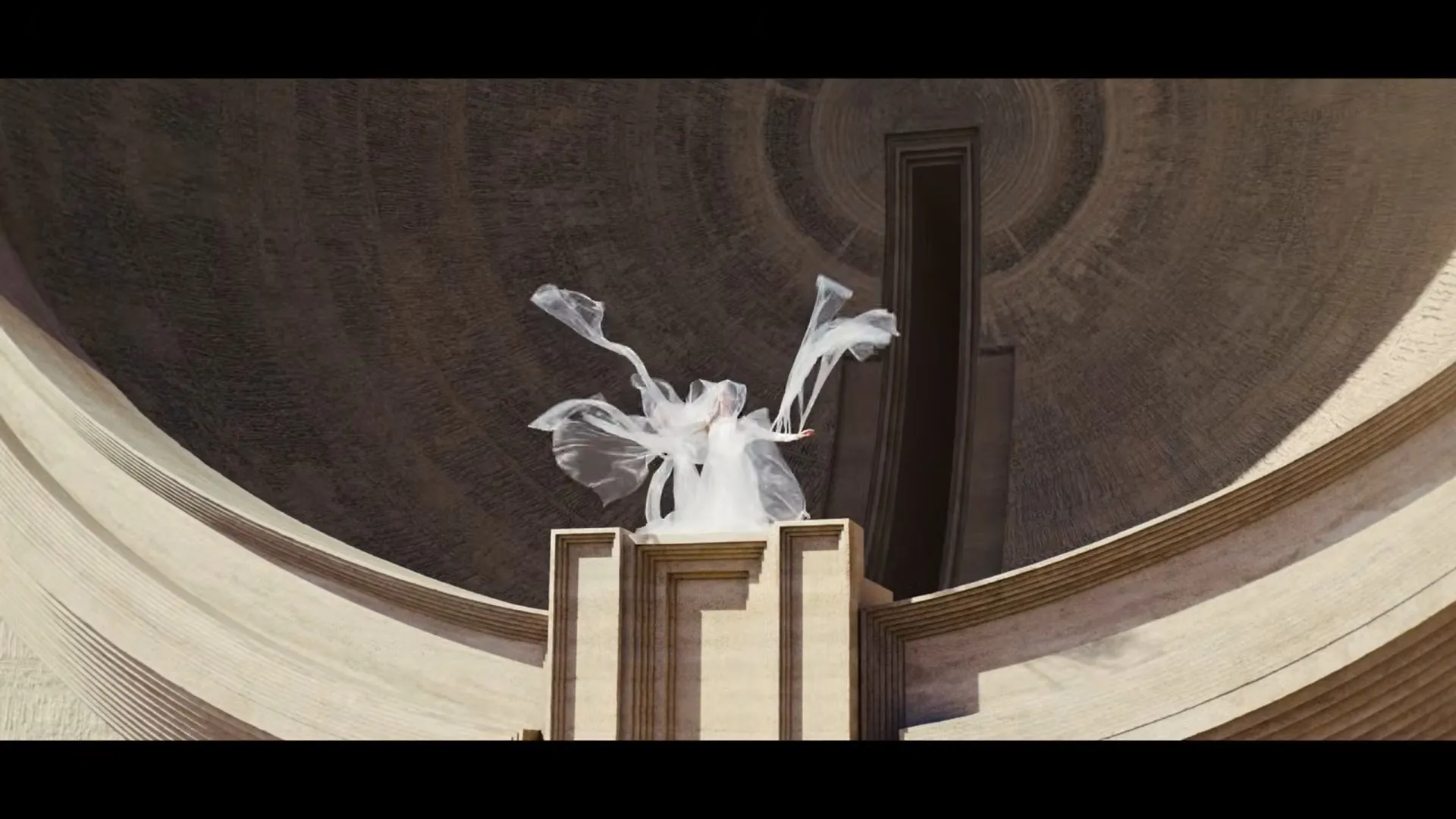
Anya Taylor-Joy plays Alia — Paul's sister, who was born with the full weight of her ancestors' memories already inside her, before she'd taken a breath. Taylor-Joy described it as "everything everywhere, all at once." The only person who has ever made Alia feel like herself, she said, is Paul. She will do anything for him — "to various degrees of insanity." The trailer shows her praying alongside her brother, addressing crowds of followers. She looks certain in a way that should make you nervous.
Robert Pattinson shows up as Scytale, the film's primary antagonist, with bleached hair and a look that one critic described as "delightfully deranged." He plays a Face Dancer — someone who can physically alter their appearance at will. And then there's Jason Momoa, back from the dead. His character Duncan Idaho died in the first film, but in Messiah he returns as Hayt — a clone, resurrected by Paul's enemies as part of a psychological plot against the Emperor. Villeneuve was clearly emotional about it: "Our heart was broken seeing him fall. And he comes back just at the right moment."
The Cinematography
The film also looks different, in ways that matter. Greig Fraser, who won an Oscar for the first Dune and whose cold, digital precision defined the visual language of both previous films, has been replaced by Linus Sandgren — La La Land, No Time to Die — and most of Part Three was shot on 65mm film, including 15-perf 65mm IMAX. Real photochemical film.
Villeneuve kept the desert sequences digital — "I liked the brutality," he said — but wanted new eyes for the new worlds, the new chapters of a story he's now spent years living inside. The difference is visible even in a trailer. There's a warmth and a grain that the previous films deliberately withheld, as if Arrakis is no longer a place being seen for the first time, but a place on the brink of destruction.
Release Date
Dune: Part Three opens December 18, 2026. So does Avengers: Doomsday. The internet has christened this collision "Dunesday" and is very much picking sides. For context: Part One made $400 million worldwide, Part Two made $700 million. The trajectory is there. Early industry tracking already has both films chasing $200 million opening weekends domestically, which would make December 18 one of the biggest box office days in years.
Dune: Part Three releases December 18, 2026.