To The Women Who Led Us Here
It took a village of determined women to build women’s cricket into what it is today. One of them reflects on that journey, in the wake of India’s historic World Cup win
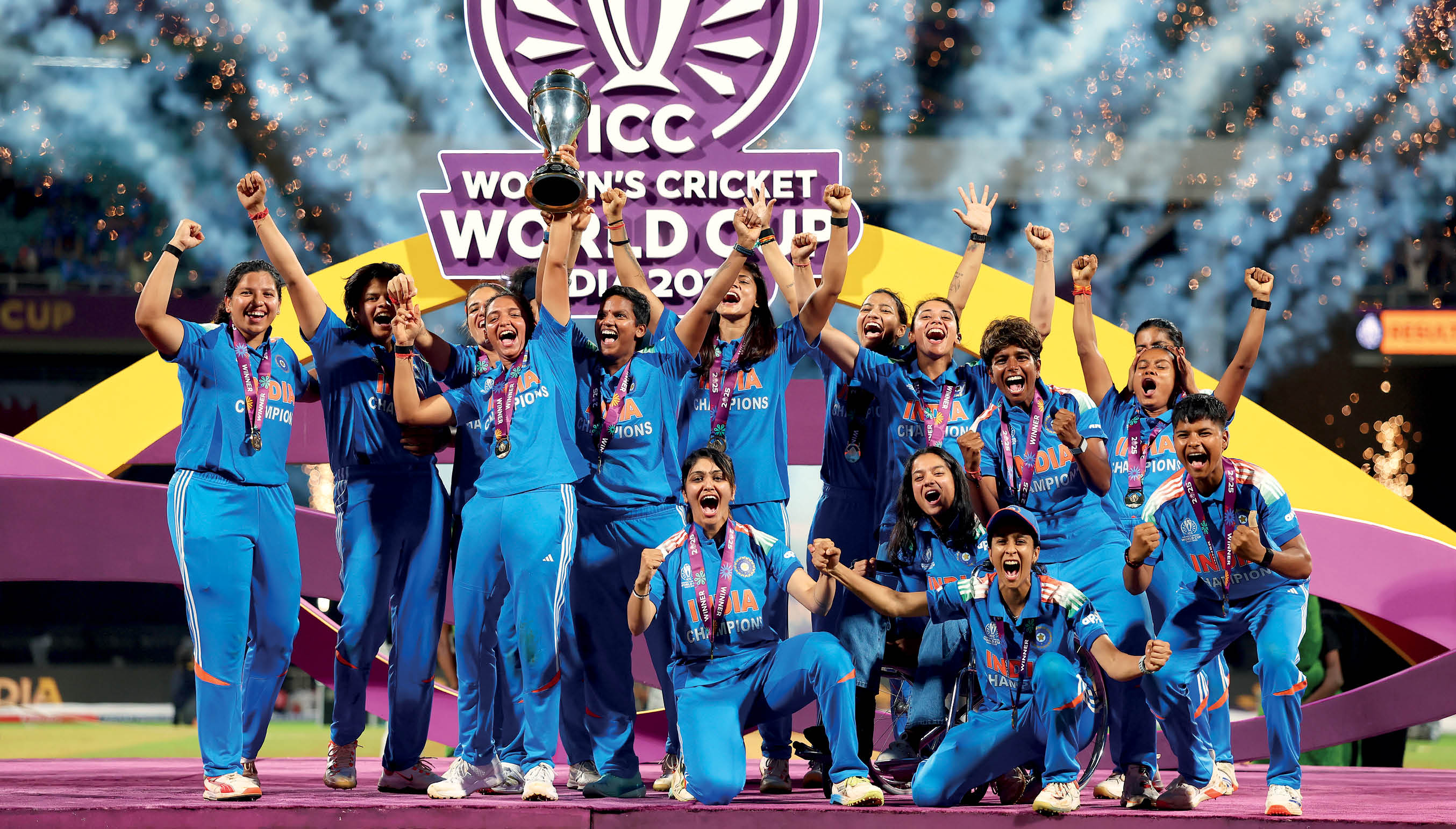
IT IS MORE THAN TWO MONTHS SINCE THE INDIAN WOMEN’S CRICKET TEAM GAVE US A NIGHT OF laughter, tears, fireworks and golden confetti. They didn’t just win a sporting event, which was pretty darn fabulous in itself. Along with the runs and wickets and everything else—the Harmanpreet catch, the Deepti multi-tasking, the Shafali smorgasbord, the Jemi-final magic box, the Richa fly-pasts, the Shree Charani whirlers—their victory also triggered a shattering. Of whole damn glass boxes, ceilings, floors, doors et al. Rendering to rubble walls that had enclosed and restricted, turning all manner of gates, barriers, boundaries into dust.
That win has stayed with us because imagine what would have happened had the team lost? Never mind social media
condemnation. The snubbing, sidelining and patronising of the women’s game would be doubly strengthened, the Indian cricket establishment’s template of keeping women and their game in their place reinforced.
But now, the genie is out of the bottle. With the World Cup in her hands, she is here to reshape destinies and histories. Women world champions from cricket’s biggest country, with its largest audience and playing community, can only trigger recalibrations across sport, society and business.
Indian women kept their game alive on love, willpower and talent through the dark ages that followed their 2006 integration
with the BCCI, for nearly a decade. As the IPL exploded, the first sign of genuine ownership of the women’s game came only in October 2015 with the first BCCI contracts for senior women cricketers. The women team’s 2017 breakout, which carried them all the way to their 50-over World Cup final at Lord’s, finally grabbed public attention.
After that 2017 final, the women made the semis at the 2018 T20 World Cup and, in early 2020, pulled 86,174 into the Melbourne Cricket Ground for the T20 World Cup final. Since then, though, for more than five years India’s women faltered, failing to qualify for the knockouts at any ICC major—the 2022 World Cup and 2024 T20 World Cup.
So when the most prestigious piece of ICC silverware was finally theirs at the DY Patil Stadium, no one would have been surprised had the women responded like cricketers do—pumped fists, tight huddles, support staff and families on their side, spot interviews and a lap of honour.
Instead, in their finest hour and greatest moment of triumph, Harmanpreet Kaur’s team held their arms wide open and drew the world into their winners’ circle. The world champions reached out to their wider community, the lineage of women who came before them. Among the many brilliant things she did and shared, Jemimah Rodrigues said, “this is for those who began playing and those didn’t stop playing no matter what.” Everyone owned their win.
Nine former India internationals from an older generation watched that final, one of them, Shubhangi Kulkarni, confirming
the complete tally to me: Diana Eduljee, Sudha Shah, Trupti Bhattacharya, Shobha Mundkur, Nilima Joglekar, Anjali Pendharkar, Vrinda Bhagat, Behroze Edulji and Shubhangi herself. She said there were at least ten more state-level players in the stands too. On the field, there were former captains Anjum Chopra, Jhulan Goswami and Mithali Raj and another 21st century international, commentator Reemaa Malhotra. There are photographs of the older generation cricketers with the trophy, video footage of the players gathering around Anjum, Jhulan, Mitali and Reena. Social media has videos and posts of players before fan groups, of reporters in the media room posing with the trophy. It’s yours, they were told. It’s yours, we heard. The Guardian’s India correspondent Hannah Ellis-Petersen, amazed hearing about these scenes, said to me, “That’s
what happens when you get women winning things.”
Why the Indian World Cup victory has acquired a special resonance is not that it is Indian. But that it is female Indian. Which
looks different, sounds different and knows how to do different from Indian cricket’s familiar role as the game’s giant gorilla. Which now promotes itself as female cricket’s saviour but chooses to give its female 50-over-World Cup champions sixty percent less cash as an award when compared to the men’s 20-over World Cup winners. With no open-top bus rides or grand, public in-stadia celebrations either. (No Indian woman cricketer has complained of this, too delighted at what has happened, but it must be noted. As must the fact that there is no woman on the ICC Board, following the departure of Indra Nooyi, its first independent female director, in August 2024.)
It is not only Indian cricket women who find themselves included in the afterglow, but Indian women in sport are celebrating too. Hockey coach Pritam Rani Siwach told Sportstar that she didn’t carry the same grudges as the men of other sport did against cricket. “I am happy, very happy they [women’s cricketers] are doing so well.” Parents wanting their daughters to play cricket is “not a loss for hockey. I see it as one more girl getting the chance to play any sport”.
FOR EVERY CONGRATULATORY MESSAGE SENT TO ANYONE I knew personally, the replies came ‘Congratulations to you, as well’, ‘You have been part of our journey.’ Indian cricket women have been reaching out to fellow travellers. Like Aarti Dabas who called recently. TV reporter-producer turned ICC official turned media-rights-guru turned sports administrator, Aarti has just been appointed Chief Revenue Officer for the England and Wales Cricket Board. After our gleeful chatter, Aarti wrote a long and thoughtful email. She had wanted India to win, “because I am Indian, and an Indian woman, a woman in cricket, a woman cricket administrator who had to push for greater coverage and visibility of women’s cricket.” In the business since 1999, as a “commercial sports executive”, she believes this Indian women’s World Cup will “unlock commercial wins” for “women’s sport in India and women’s cricket globally.”
Back in the 1980s, along with the women cricketers, I noted other women in cricket—Chandra Nayudu, commentator in her own right, daughter of the great CK, Sportsweek writer Kavita Chhibber, Pakistani cricket journalist Fareshteh Gati Aslam, English scorerstatistician Wendy Wimbush, later West Indian commentator Donna Symmonds. As the solitary female in press boxes for a few years, I welcomed the sight of a few other women working games. Starting with scorer-statistician Joanne King, photographer Emma Levine and TV exec Trishna Bose, who worked with production teams during the early days of satellite TV.
As more women entered the press box or television news and production, the toilets got better, some bosses more forwardthinking, the misogynists and creeps maybe a tad smarter but our numbers kept growing, particularly in India. Whether you are old tribe or new, the mutual recognition of other women in the cricketosphere remains constant. When women in cricket pass each other at work, there will always be a fleeting exchange of acknowledgement. The Look, a visual fist-bump. I see ya, sister, hang in there. Many years ago, when I received an award at a CEAT ratings event, I remember many cricketers’ wives, young and old, coming over to offer their heartfelt congratulations.
In her email, Aarti talked about working on previous women’s World Cups. As she writes beautifully, it has “taken a village of determined women and a few good men to get women’s cricket where it is today.” She too is one of them—in the 2017 World Cup, she played a leading role in getting the ICC to increase their budget and put every single match live on TV, not just the ten-odd originally planned. Her email names many more. Women whose names I had not heard, whose work I did not know.
Like Eugenie Buckley, tournament director at the 2009 women’s World Cup, the first under the ICC—this is your win, too. And, here’s to you Gayatri Yadav, head of marketing at Star Sports whose team’s creative campaign for 2013 focused on the many cricket firsts—including a World Cup—born out of women’s cricket. Beth Barrett- Wild and Zarah Al-Kudcy, on the local organising committee for the 2017 World Cup, deserve a huge hat tip from India for pushing to get the final played at Lords.
How can this World Cup not also be for the indefatigable cricketer-broadcaster Mel Jones who reminds us that women in
cricket look out for each other. Quietly, sans fuss or noise. Four years ago, Jones responded to my WhatsApp message asking her to speak to a teenage women’s cricketer from Afghanistan. She set off a chain of events that led to the evacuation and resettlement of the women cricketers and their families, more than 200 people. I would not have known of the Afghan teenager Benafsha Hashimi had it not been for ICC media head Claire Furlong, who championed the ICC’s 100% Cricket Future Leaders Programme for women, where I was involved for a few years.
In the past, women in cricket have always been outsiders—whether they played, coached, reported, talked, broadcast,
managed, produced, officiated. The male game was context, working space, reference point, for what is done and how it must be done. What the Indian women’s cricket team did with this World Cup win is not stake claim over game territory. What they have done is widen the game’s horizon and set us free onto our patch of sky