
- Entertainment
- Style
- Lifestyle
- Food & Drinks
- Tech & Auto
- Culture

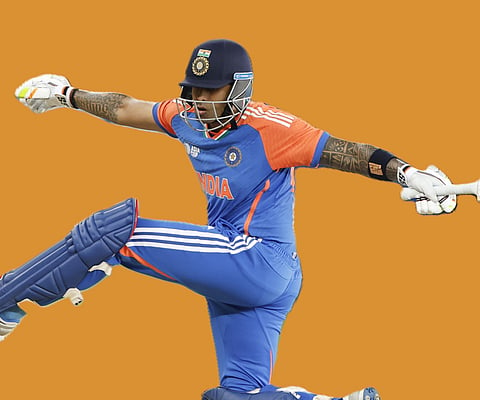
The legend of Suryakumar Yadav is a multi-splendored one. After leading the ‘villains of the 2023 ODI World Cup’ walk, he bagged the single biggest clincher in the 2024 T20 World Cup. Running in from deep extra cover in the final over of the game, he pocketed a catch that closed out South Africa’s historic charge towards a World Cup. All was forgotten, Sky was a hero again.
From being a perennial watcher from the sidelines to one of India’s two white-ball captains, Yadav has received the flowers due to him. Known as Mr 360 on the Indian T20 circuit (AB de Villiers is the OG), Yadav is a prolific run-scorer all around the ground, though the runs have dried up a bit of late. Between October 2022 and June 2024, he was ranked No. 1 in the ICC T20 rankings. Yadav, as I said, can play shots all around the ground, from scoops over fine leg to acrobatic shimmies inside out and really well-timed flicks off the front foot.
Lately, however, Yadav has been making fresh progress with his Mr 360 moniker. As India’s T20 captain in the recent Asia Cup, the 34-year-old debuted a new side to him that those of us who knew him as the affable Surya dada wouldn’t have imagined. Leading an aggressive, abrasive New India refusal to consort with the nation’s political enemy and not shake hands with Pakistani cricketers after either of their three games with the enemy nation. Late cut over third man for six.
After India beat Pakistan in the first of these clashes, Surya dada made the statement of his career—dismissing the suggestion of any existing rivalry between the perennial cricketing giants. His reasoning? That India’s 11-0 or 13-1 (real track record) win record against Pakistan in T20 World Cups doesn’t make it a rivalry any more. Down the pitch, flat-batted over extra cover. Another maximum.
A few days after India won the tournament final despite a spirited Pakistan show, the Honourable Prime Minister Narendra Modi congratulated the boys on the landmark victory, a crucial brick in the wall that New India’s building to keep enemies out. “#OperationSindoor on the games field. Outcome is the same - India wins! Congrats to our cricketers. (sic)” the Honourable PM’s post on X read (interestingly, Minister of Parliamentary Affairs and Minister of Minority Affairs Kiren Rijiju’s comment on the PM’s post is a collage of Haris Rauf’s dismissal and Jasprit Bumrah’s crashing jet celebration when he rattled Rauf’s sticks in the final. It is captioned “Pakistan deserves such treatment”).
A few hours later (or it could have been sooner, that’s beside the point), another video started doing the rounds on social media. It was Surya dada again, laughing charmingly and telling an ANI reporter that it “feels good when the country’s leader himself bats on the front foot”. Down on one knee, scooped up and into the stands, as the fielder watches it sail into the crowd.
Dada, a word used in many Indian languages, could mean either grandfather, elder brother, or street ruffian depending on geography. In Yadav’s case, it surely must mean elder brother, because the journey to grandfather is still a long one. Also, the only true Indian ‘dada’ when it comes to performing against Pakistan is Sourav Ganguly—Yadav averages under 20 against the neighbours. As for the third description, this new Indian team is full of feisty characters that can fit it. Coach Gautam Gambhir loves statements—in his playing days as well, he loved a confrontation as much as the next guy. Coach GG, whose first assignment with the Indian team resulted in a 3-0 whitewash at home against New Zealand, recently brawled with a pitch curator in England during India’s summer tour.
Months ago, when Nitish Kumar Reddy scored a historic Border-Gavaskar Trophy hundred in Melbourne, he credited Gambhir for a tectonic mindset shift. The youngster brightly told reporters in the press conference that coach Gambhir told him to think of every body blow during that innings as “taking a bullet for your country”. It does become extremely exciting and gut-wrenching to watch an athlete put their body on the line to achieve a seemingly unsurmountable goal, but this was a tad dramatic even by Gambhir’s standards.
Last week, after stand-in wicketkeeper Dhruv Jurel headlined India’s win over West Indies in the most inconsequential test series of the decade, he dedicated his maiden hundred in the format to the Indian Army. Now, Jurel’s father served in the force, but it’s a little difficult to separate it from the trend of cricketers comparing their feats on the field to soldiers putting their life on the line for national security.
Harmanpreet Kaur, captain of the Women’s national cricket team who’s been involved in quite a few controversies, backed the men up with no handshakes in their T20 World Cup tie versus Pakistan very recently. A video of her mouthing expletives while batting as a Pakistani opponent glared at her circulated online, adding her own chapter of dominance to the increasingly flammable India-Pakistan cultural fissure. It was a far cry from not too many years ago, when India Women’s team cheerily welcomed Pakistan captain Bismah Mahroof’s baby.
The two teams have largely enjoyed a pleasant equation, but now, the national stance on cross-border relations is crossing out the occasional escape of amity that cricket has historically provided. Rahul Dravid’s gratitude speech over two decades ago when Pakistan hosted India in a bilateral series after a big gap, MS Dhoni’s banter with the neighbour’s then PM Pervez Musharraf, more recently, Virat Kohli and Jasprit Bumrah’s cordial public exchanges with their Pakistani counterparts… will quickly get lost in oblivion.