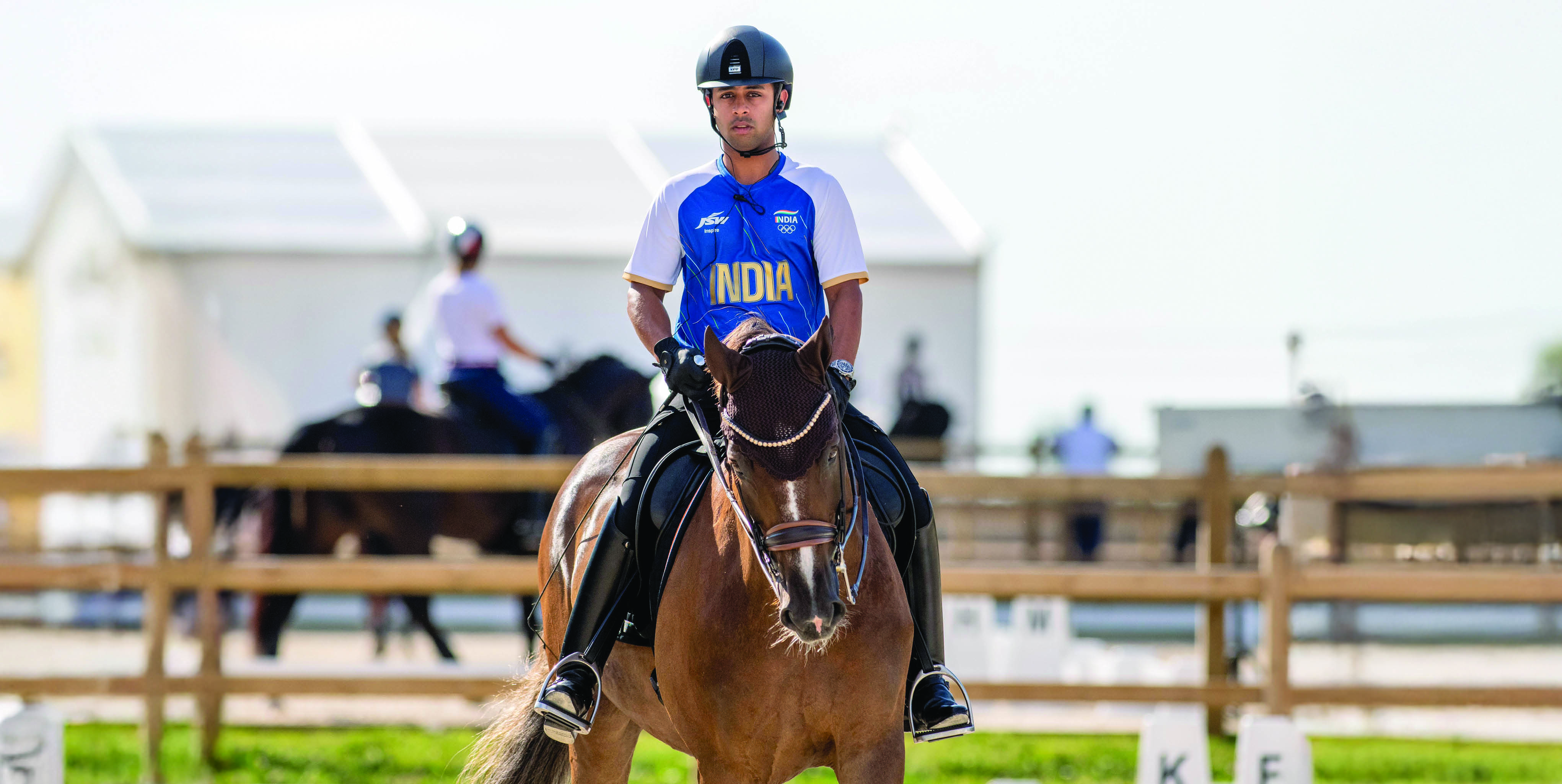
Inside The Mind Of India's First Dressage Equestrian: Anush Agarwalla
At first glance, Anush Agarwalla's simple and friendly demeanor might blend him into a crowd, appearing like any ordinary face. But his achievements are extraordinary for a 25-year-old boy from Kolkata.
For a sport that for many years has felt exclusive for the West, as India's first-ever individual dressage bronze medalist and gold medalist in Team dressage event at Asian Games 2022, Anush is rewriting the playbook. In fact, he is India's first Olympic dressage rider and Arjuna Award recipient.
You May Also Like: Neeraj Chopra Aims For A New Challenge: Ninety Metres
"Most people think it's all roses and red carpets," says Anush, who is on a short visit to Mumbai out of his 7 nights a year in India. Many, except his coach, German Olympian Hubertus Schmidt and his horses, don't see him up at 5:30 A.M ready to grind even in the cold German weather. This unglamourous reality of being a rider often hides behind the pristine competition appearances and the effortlessly performed piaffes and passages. Behind-the-scenes it all about the manual labour, dedicating large chunks of the day bonding and training with his horses, Etro and Caramello, and literally dealing with horse shit. It is this rawness that makes Anush who he is today- a world class athlete!
For a country that offers little to no scope to its athletes in dressage, the Paris Olympics qualifier has no hard feelings. His hard work and consistent performance are the facts that he bets on. "I started training at a very low level in India, nothing to do with what I was watching on television, but that somehow subconsciously stayed in my brain," he explains.
Moreover, having started riding at the age of three in his hometown, Kolkata, Anush recognizes that some sports are household names, while others don't enjoy the fanfare. However, he firmly believes, "India is on its way of becoming a powerhouse in sports" as evident in Paris Olympics 2024. He hopes it will create more awareness and appreciation for diverse sports and athletes. As a matter of fact, it was the 2012 London Olympics that planted a shared dream in him and his parents to have him represent India at the world's highest sporting platform.
You May Also Like: Meet the Game-Changers: 5 Athletes Who Aced More Than One Sport
The Indian equestrian star, who was only 12 years old then, now adorns a tattoo of the Olympic rings on his forearm, having secured a spot. The other one that he is quick to reveal is the footprint of his horse Etro with the lines 'Believe, Repeat, Achieve'. It's obvious he is undeniably passionate about his horses and the sport!
'A rider's hands are not to control the horse but to feel him'- Nuno Oliviera
Perhaps most revealing about Anush as a sportsman is his bond with his horse. Also, a reason he has been able to master the art of letting go. Control is an illusion with trust, especially in dressage for an equestrian. A rider cannot force, push or dominate the horse. So, the ultimate response is surrendering, physically and mentally.
For the Arjuna Award recipient, who is supported by Reliance Foundation, this has become second nature. "Horses have taught me patience," he says. This through perfecting the synchronicity rather than micro-management brings out the elegance and effortlessness. While this may sound simple, it is years of practice and allowing the horse to move with freedom and grace while still commanding the fluidity, that is evaluated in the competition. It's a high-wire act of trust-one misstep, and the harmony collapses.
So, what helps Anush Agarwalla disguise complexity behind effortlessly refined elegance?
“You have to trust your horse. It’s exactly like in football- a winger making cross has to trust their teammate will be there to put it in the net. You can’t run and score the goal yourself.”
While pre-game jitters aren't exclusive to humans- they also affect the horse and vis-a-vis in equestrian sports, it's the connection that borderline feels telepathic that enables the young Indian equestrian and his horse go in sync and in stride. Moreover, drawing inspiration from Michael Phelps, Anush has long relied on visualization as a mental technique. "I visualize everything. I visualize entering the arena. I visualized, you know, winning Asian Games. I visualized being an Olympian."
It is also the daily interaction with the horse during training hours that makes a huge difference to his approach. "Horses have a very great feeling of time, for example, then they know when it's 7:30 like I normally arrive at stable, 7:30 I arrive, they're already waiting. And if it's 7:35 then they get a little restless, because they're like, 'Hey, where are you?';' Are you showing up today'?"
Know Read: Could Abhishek Really Be The Next Yuvraj?
For Anush, his relationship with horses goes beyond mere partnerships. When he recently parted ways with Mani -with whom he shared many firsts- it was like bidding farewell to a friend.
“He gave me everything he had to offer. He gave me so many happy moments, so much happiness in my life." Anush fondly shares that Manni, now a retired steed, is named after the mammoth from 2002 film Ice Age due to their uncanny resemblance.
"This is the least I can do for him, to make him happy… I did not want to push him over the limits. That's something you have to respect, and that is something which has to also do with the bond that you share with your horse.”
Anush Agarwalla represents something rare in modern sports- an athlete who respects the soul of his sport and his horses. For a world that thrives on speed and instant results, his philosophy is refreshingly old-school. “If you rush it, it will not work.”