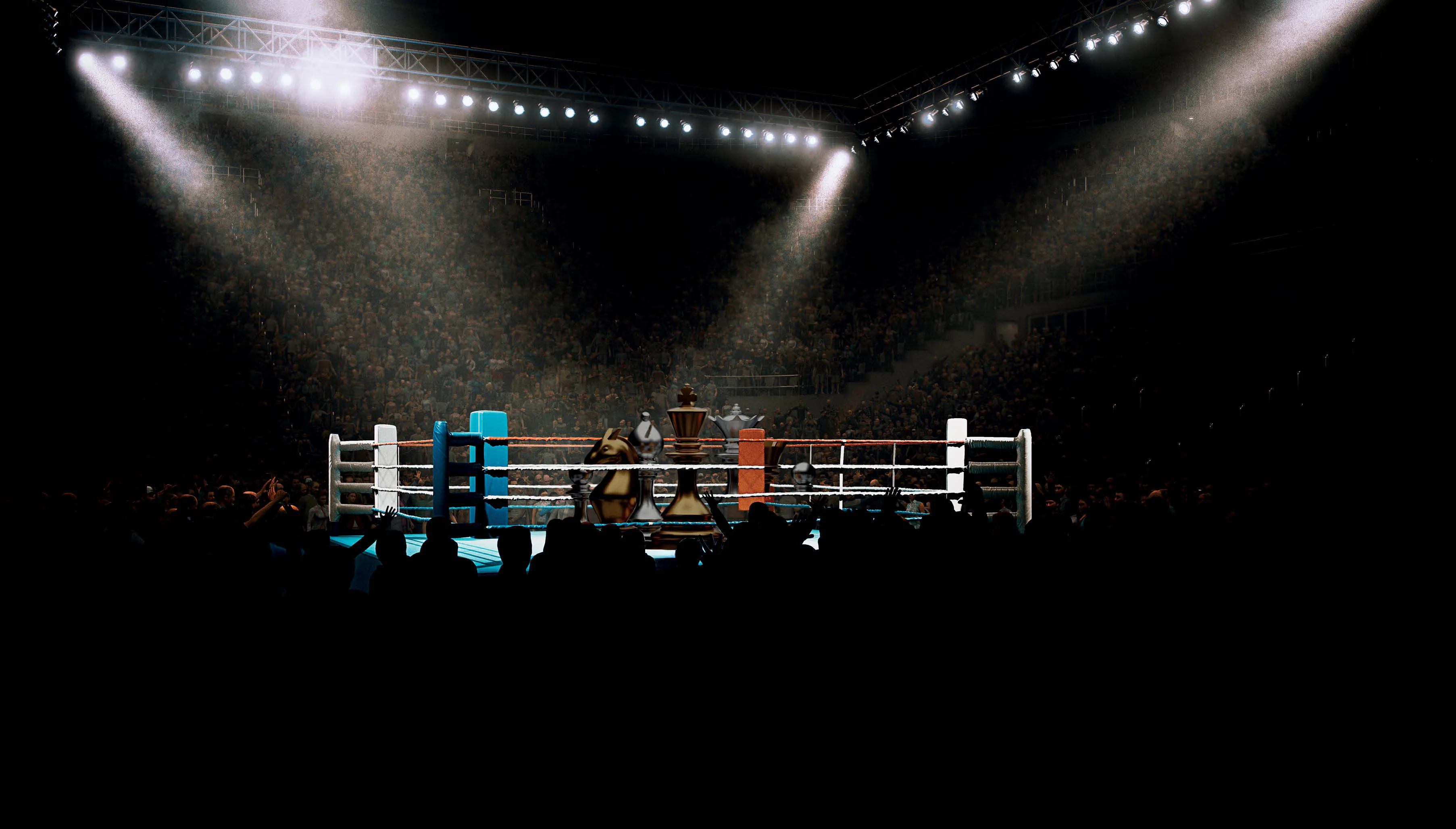
How Chess Became The Real Deal
When did a solitary game become a spectator sport —and what's fuelling its unchecked rise? Esquire India follows the moves
When American grandmaster Hikaru Nakamura flung his opponent’s king into the crowd after a win at The Checkmate: USA vs India exhibition event in October 2025, the chess world erupted. Purists were outraged, while calmer voices reasoned that a little exhibitionism was par for the course, perhaps even welcome.
Seen in the context of the wider sporting world, it was a fairly vanilla move. International athletes take off shirts, bite opponents’ ears or head butt them, shoot imaginary guns, cry, fall, do somersaults. Nakamura’s minor display of flamboyance, however, captured something essential about where chess is headed: a once docile, cerebral sport straining against convention and edging toward the mainstream.
That shift is not merely anecdotal. Chess has undergone a cultural renaissance over the last few years, moving from park benches and classrooms to creator streams, esports stages and global platforms, says Akshat Rathee, co-founder and managing director of NODWIN Gaming, which co-created the Chess Super League in 2021 and brought chess onto gaming festival Dream-Hack India in 2022.
The recent spike in numbers, Rathee elaborates, bears this out. Chess.com, an online platform for the sport, recorded over 7.6 billion games played globally in 2024—India contributed more than nine million monthly active players. Events like the World Chess Championship drew over 24 million views in India alone. The Esports World Cup (EWC) 2025 had a $1.5 million prize pool, where India’s Nihal Sarin reached the top eight.
India has an astonishing eight players in the top 50 rankings (open category, standard format) of the International Chess Federation (FIDE) as of January 2026—four in the women’s top 20. The world champion is Gukesh, while 19-year-old Divya Deshmukh won the FIDE Women’s World Cup in July 2025 beating another Indian, Koneru Humpy, in the final. The men’s World Cup was held in Goa in November, with 24 Indians participating, 14 more than the previous edition in 2023.
FROM BOARDS TO BROWSERS
Part of the sport’s transformation has been driven by the rise of online chess, especially during the 2020 lockdown, when the internet became the only window to the outside world. The Netflix series The Queen’s Gambit, which dropped in October 2020, made the sport sexy while chess streamers, like Nakamura, across platforms like Chess.com, Twitch and YouTube, propelled the game into mainstream pop culture.
Tournament series like PogChamps, launched by Chess.com in 2020, featured popular streamers and celebrities, each mentored by Grandmasters, pulling millions of first-time viewers into the game. Adding to this momentum were leading streaming personalities like Levy Rozman, known as GothamChess and the Botez sisters (Alexandra and Andrea), who have over three million followers on both Twitch and YouTube.
Predating them was Eric Rossen, an American International Master (IM, just below GM) who was among the early streamers. Croatian Antonio Radic, better known as Agadmator, has 1.34 million subscribers to his YouTube channel. David Howell, a British GM and commentator, has made chess relatable to global audiences. Closer to home, India’s IM Tania Sachdev has played a similar role in making the game accessible to Indian viewers.
“He [Howell] is so good as a commentator, as good as any sport in general,” says Joel Dsouza, a comedian and amateur player, to Esquire India. “I was watching chess for the first time in 2020 and he explained the sport so well. I improved a lot seeing how his brain understood it.”
Grandmasters such as Qiyu Zhou, Nakamura and Andrew Tang joined esports organisations like Counter Logic Gaming, Team SoloMid (TSM) and Cloud9, blending chess tradition with the energy of competitive gaming. Since then, online chess has surged beyond gameplay alone, clocking up to 925 million organic views last year—a 640 per cent year-on-year rise, according to a gaming press release. FIDE included chess in the inaugural Olympic Esports Week in 2023 in Singapore. Chess then became part of the EWC 2025 in Riyadh, with the sport’s greatest ever player, Magnus Carlsen, serving as the tournament’s ambassador.
“Chess is timeless,” says Rathee. “But its recent surge in India has been fuelled by how comedians and online content creators made it entertaining and relatable during the pandemic.” Comedians like Samay Raina and popular streamers turned chess into fun, watchable content and made it more audience-friendly.
IT’S NOT A JOKE, REALLY
Vaibhav Sethia, a stand-up comedian and writer, was on a chess stream once when he teamed up with three other comedians. Playing against them was Polish GM Judit Polgar, the 49-year-old trailblazing Hungarian who became a GM at age 16.
“There came a point,” recalls Sethia over a call, “when [we felt] there was no point playing more and decided not to embarrass ourselves.” The comedians thought there was no way they could win from that position. “For fun, someone suggested we switch sides. She [Polgar] thought about it for three seconds and said sure. Six or seven moves later, we were back in the same position. From a point of helplessness to this, it was beautiful [to watch].”
Sethia mentions this as a way of explaining the gulf between professionals (even retired ones) and amateurs. He started playing chess about a decade ago, when he was bedridden with dengue, initially because he wanted to write about it. After a month of recuperation, he was hooked.
By 2018, he, Raina and another comedian, Biswa Kalyan, had started playing regularly. Raina, widely considered one of the key catalysts for the sport, along with Sagar Shah, cofounder of ChessBase India, a leading online chess platform, launched an online tournament in March 2020 called Comedians on Board (CoB), which held three editions that year. As the name suggests, some of the country’s leading comedians participated, with the event streamed on YouTube and Chess.com. The last edition featured 32 participants and prize money of `5 lakh.
Sethia points to the tournament’s reach: “Magnus was once playing some important tournament and was in the final. The viewership for that was some 5,000-odd. CoB had viewership of 75,000—more than 10-fold,” he says, emphasising its impact.
There is no single explanation for why comedians became major proponents of the sport in the country, beyond Raina’s enthusiasm and Shah’s participation. But their impact extended beyond the CoB, for instance. In April 2024, Dsouza, winner of CoB-3, got a cold email from a German journalist who wanted to organise a chess-themed comedy show during the 45th FIDE Chess Olympiad in Budapest in September.
“I do feel humour is cerebral,” says Dsouza. “Stand-up is such an isolated profession. Chess is similar, one person doing everything. Like spending eight hours on a four-minute set [for a comedian] or on a single opening [for a chess player]. Comedians are comfortable spending a lot of time on one thing, and being in that state of mind, there is an overlap of how it feels.”
Vidit Gujrathi, one of India’s leading GMs, ranked 28th, began streaming during the pandemic. He discovered the “cross connection with the comedic world” and realised that the attention to the game brought more sponsors and interest. He went on Raina’s channel to play against a team of comedians, including Sethia, Kalyan and Abhishek Upmanyu. Recalling the match, Sethia says, “He [Gujrathi] doesn’t give you breathing space—even when he is playing casually. Our pieces were jammed. You feel so suffocated playing with them, like you know nothing.”
THE ANAND EFFECT
Even as chess was becoming accessible and entertaining online, efforts to cultivate India’s next generation of champions were emerging. Towards the end of 2020, WestBridge Capital and Viswanathan Anand, a five-time world champion, formed the WestBridge Anand Chess Academy (WACA) to create a platform that would mentor both established and upcoming players. The experience was “motivating and inspiring,” says Nihal Sarin, who worked with Anand for a week at his place. The WACA was, in many ways, a logical evolution for Anand. The best-known and most celebrated Indian chess player for about three decades, Anand inspired a generation of players who are now in the reckoning for the biggest titles. Though not competitively active anymore, the 57-year-old is still the fourth highest ranked Indian at No. 13.
What he also did was legitimise, in some ways, the pursuit of chess in a country where parents long prioritised academics and did not see sports as a career option. These parents also became more likely to encourage their children to play chess because they no longer saw it as time taken away from studies but as a mind-positive activity that complemented academics.
Besides Anand, now a new wave of prodigies, many of them still teenagers like Rameshbabu Praggnanandhaa (world No 8), Arjun Erigaisi (No 5), Gukesh (No 9) and Sarin (No 25), have made chess aspirational. Short, high-intensity formats like Blitz and Rapid suit modern attention spans without sacrificing depth, says Rathee, who sees online chess emerging as one of India’s leading eSports.
What has emerged alongside this visibility is a more robust ecosystem. “I think India has an advantage in terms of the growing talent pool and the collaborative spirit among players,” says GM Rameshbabu Praggnanandhaa over a text message. “Many of us train together, share ideas and analyse games collectively. Online platforms also provide tools and databases that make preparation easier. Like the Soviet model, having a strong peer group and competitive environment pushes everyone to improve, and I feel India has that ecosystem now.”
SARIN, WHO JOINED ESPORTS AND GAMING CONTENT company S8UL for EWC 2025, points out that while the number of online events has increased, existing tournaments have also grown more serious, with higher stakes. “One revolutionary thing was Magnus’ online group. That maybe was the start of hybrid format in chess,” he says, referring to the decade-old Play Magnus Group, which offered e-learning and entertainment services to encourage more people to play and earn from chess.
The company was acquired by Chess.com in 2022. “What has changed in last 10-15 years is the internet,” adds Gujrathi. “Those who could not afford coaches used the internet to learn. It has levelled the playing field.” He adds: “Modern chess is entirely different to how people played in the 1970s or ’80s or ’90s. You can’t consume the computer’s moves without reflection. The art is to balance human intuition with how a computer would play. Use it as a tool and not as a crutch.”
THE HYBRID MOVE
For Sarin, the EWC was a first-time experience, one he sees as a sign of things to come. Played in a hybrid format that gained traction after the pandemic, the tournament combined the atmosphere of a live event with the efficiencies of online play.
Players competed from a supervised venue, but against opponents located elsewhere, making the format more economical while capitalising on chess’s unique ability to exist seamlessly online. “There was a live audience,” says Sarin, describing the event, “and both the crowd and the players had noise cancellation headphones.”
At NODWIN Gaming, Rathee says chess has long been part of the company’s multi-game IPs, but today the firm sees an even bigger role for itself in shaping the sport’s esports future. Their focus is on taking chess from heritage to hype, creating world-class productions, premium IPs and grassroots tournaments while regionalizing broadcasts so fans can connect in their own languages.
The sport’s commercial potential, which encourages gaming companies among others, is fairly promising as well. In October, Anand played another former world champion, Garry Kasparov, in Clutch Chess: The Legends in St Luis where the winner took home $70,000. The World Cup in Goa has a prize fund of $2 million, while Gukesh made `11.45 crore for winning the World Championship in December. For instance, Carlsen, who earned a little over half a million dollars in prize money in 2022, took that to $1.5 million in 2025 despite not participating in the world championships.
That commercial upside is also drawing in professional player managers and corporate-backed sports firms. “Our interest in chess was sparked by the sport’s growing popularity and India’s rich legacy in the game,” says Sanjay Adesara, the chief business officer of Adani Sportsline which manages Praggnanandhaa.
“His remarkable achievements, including his silver medal at the 2023 FIDE World Cup and victories over top-ranked players in global tournaments such as the 2024 Chess Olympiad, demonstrated his immense potential and determination.” Does that make chess an Indian thing now, like cricket has become?
Gujrathi believes Indians have an advantage because parents here value education and discipline, which translates well when a child plays chess. “We are known for our intelligence and that spills over in chess. It encourages reflection and patience.”
The fundamental difference between Indian players and the others is the hunger, says the 32-year-old. “I have seen kids who are 8-10 years old have the hunger to succeed. They are driven from a young age.”
Sarin does not agree completely but does aver to a notion that Indian players are underrated, especially those in the IM range.
Anand may have been the singular lodestar for Indian chess for decades, but the influx of talent onto the world stage has widened the field. “When you have one role model [Anand], you can aspire but not compare,” says Gujrathi. “When many competitors get to the top, others start to believe it’s possible to be world class. It feels like achievable and will bring in more players in the future.”