- Entertainment
- Style
- Lifestyle
- Food & Drinks
- Tech & Auto
- Culture

AI generated summary, newsroom reviewed
I suppose when I was a child, my father was sometimes out of his depth as a girl dad. He wouldn’t really understand the charm of the fairy tales I loved in junior school, and so his way of introducing me to the habit of reading was to buy me very simplified, illustrated versions of classic science fiction books - Journey to the Centre of the Earth, The War of the Worlds, the Foundation books, you name it. Over the course of time I would go on to develop my own taste in books, but the soft spot for a good science fiction story, especially speculative sci-fi, always lingered.
As a kid I always found it fascinating how accurately these authors would predict technology decades before it came into existence. Sometimes, I wished I could time-travel to the future to when some of these stories were set and see how well they held up. The future always seemed so far away.
Now, as an adult, I’m not too keen on the idea. The century in which the most famous of these books were written has lapsed, and now that some of the dates in these stories sound like ones I would live to see myself, these stories feel like a grim reminder of how, day after day, we are only setting ourselves up for doom.
Take, for example, Ray Douglas Bradbury’s short story, There Will Come Soft Rains. Set in a dystopian future, the five-page tale from The Martian Chronicles tells the story of a single day in Allendale, California. Bradbury describes a fully automated house: at eight in the morning, an alarm clock wakes you up, tells you your to-do list for the day, and as you set about your day, your fully automated house makes you breakfast, hands you your umbrella if the weather report predicts rain, takes the car out and sets you off. Automatic sprinklers water the lawn. Mouse-like devices, no unlike the robot cleaners of today, come out of their nooks to clean the house should there be even a spec of dust. At night, the house makes a warm bath, a hearty dinner, and, as you go to sleep, reads you your favourite poem.
You’re probably thinking here, most of this can already be done today. A few modifications here and there, all connected to Alexa, should be enough. And you’d be right: Bradbury’s story is set to take place on August 4, 2026 (see? Speculative fiction is fun).
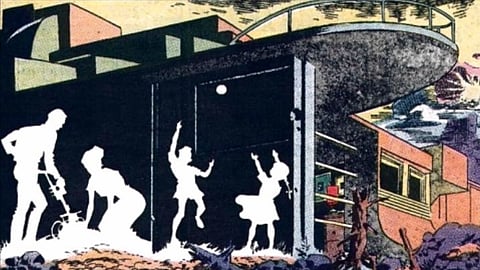
What I haven’t told you till now is that there is no “you” left in this house to serve anymore. All that remains are the burnt silhouettes of the family that lived here till a few days back, all turned to ash in seconds by the nuclear bomb that exploded in this town. The house Bradbury describes miraculously survived the bomb, and its machines, with no code written into them to identify nuclear warfare, just assume that the humans are late at whatever they are doing. Until, of course, its resources run out, and a fire is enough to turn the house into rubble.
The heart of the story is in just how unsettling it is. Bradbury isn’t overly descriptive the way Verne used to be. But just the faux-ingratiating nature of the AI voices and the apathy with which this house just goes on and on gets under your skin. The sole surviving member of the family, a blistered, wasted dog, is welcomed home. It has already lost its mind in the blast, and the smell of fresh pancakes on the stove with no way to get it makes it lose the last bits of its sanity. When it dies, it only takes fifteen minutes for the mouse vacuum cleaners to detect bacterial breakdown and clean the floors of the rotting mess, once a family member.
In the 90’s, I am told, this story used to be a part of the English literature syllabus in ICSE schools- a didactic tale of the world we are heading into. An attempt to teach children to look out for signs of a dystopian future and hopefully stop it. I suppose thirty years seemed like a long time to them to turn things around, just like how ten years seemed like a good distance to be reading a story like this when I first read The Martian Chronicles.
But once this distance is closed, the “speculative” in speculative fiction disappears. On the surface, August 4th is a date like any other. I went to the office, came back, made dinner, called my parents, spoke to my friends… nothing out of the ordinary. Yet, something in that “distant dystopian future” being just another day to you prompts you to sit back and introspect. Sure, neither am I turned to ash, nor did an atomic bomb go off anywhere in the world. But a nuclear weapon not going off is no measure of peace, and the only thing ensuring that my August 4th wasn’t like the characters in the story is plain geographical luck.
In that sense, nothing much has changed since the kids in school first read the story. You could even argue nothing much has changed since Bradbury first wrote the story for Collier’s Magazine in 1950. Or since Sara Teasdale wrote the antiwar poem that inspired this story, back in 1918.
In the end, the dates and devices of speculative fiction are just random numbers and fantastical machines. Orwell famously chose his book to be set in 1984 by flipping the final two digits of 1948, the year he finished writing it. The “fiction” in science fiction is just a tool to dress the criticisms that these writers had of the society they lived in. The body, through time and geography, is all but the same.