- Entertainment
- Style
- Lifestyle
- Food & Drinks
- Tech & Auto
- Culture

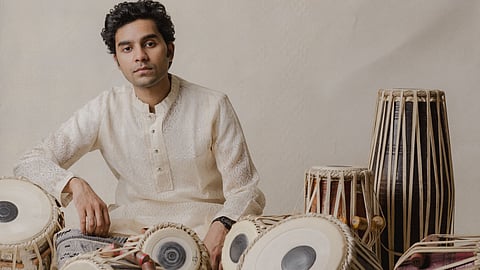
Ishaan Ghosh, at 24, is here to set the record straight: the tabla is cool, damn cool.
Son of the revered Pandit Nayan Ghosh, grandson of the legendary Nikhil Ghosh, and grand-nephew of the iconic Pannalal Ghosh, he's a walking, breathing testament to a tradition that's as much about blood as it is about beats.
But Ishaan isn’t just living in the shadow of his forefathers. He’s the guy who’ll effortlessly jam with flamenco guitarists in a Parisian basement, then drop a thought about collaborating with Larnell Lewis. He’s a walking contradiction, a paradox of tradition and innovation, a young maestro who respects the past while fearlessly forging the future.
He speaks of the tabla as a 'twin,' a 'best friend,' a living entity. Not a relic, but a force of nature he’s mastered, understood, and transformed into something that speaks far beyond the classical world. For Ishaan, tabla is a bridge—connecting him with Afro-Cuban percussionists in Brazil or with melodic techno producers in Europe. He's also now launching the Rasa Experience, a multi-sensory collision of classical and contemporary, designed to dismantle the barriers between performer and audience, and prove that this music isn't just for the purists.
You May Also Like: What I've Learnt: Robbie Williams
However, perhaps the most fascinating thing about speaking with Ishaan is the calm. The poise. There’s a quietness to Ishaan that belies the fire of his craft. At just 24, he speaks with the confidence of someone who understands his place in this vast musical world and is already making it his own. He embodies the paradox of being both a product of centuries-old tradition and a harbinger of its evolution.
In this exclusive conversation with Esquire India, Ishaan Ghosh discusses his unique upbringing, his deep connection to the tabla, and his philosophy on respecting tradition while forging his own path.
When did you know you wanted to play the tabla? Do you feel like it was an inherited path, or were there moments of doubt?
I mean, as everybody already knows, I was born into such an illustrious family of musicians— classical musicians. And of course, later I realised how big a deal that actually was. But at the time, you just kind of slide right into it—you’re surrounded by that music, breathing the air that is music.
I was about one and a half years old when I actually started playing tabla. So I don’t think there was ever a point where that question came to my mind—about doing anything else. And it still hasn’t. I’m really happy about that. And tabla drew me in. I had this very strong rhythmic inclination—not just towards tabla, but I found tabla to be the coolest thing. I still do, because it is.
But of course, I remember—growing up in the time that we did, we were exposed to so much around us. For example, while growing up, my friends in school would ask, “Why don’t you pick up the drums or play something else?” But eventually, when we used to have those high school jams, and they heard me play tabla, they were like, “Oh man, you should be doing that!” So I think it was just that. There’s this very special connection I feel with this instrument—it’s hard to put into words. It’s like... It’s my twin. You could call it my best friend.
You May Also Like: Paresh Pahuja on Music, Movies, and Manifestation
What have been some of the biggest learnings from growing up with your father and grandfather?
I never met my grandfather—he passed away five years before I was born. But I’ve learned so much about him through my father that it feels like I’ve lived with him. He was larger-than-life: dynamic, versatile, unforgettable. I wish I could’ve learned from him directly, but his teachings have come to me through my dad.
The biggest lesson I’ve learned, especially from my father, is humility. That’s so integral to the art form we’re in. We’ve always believed that the art is greater than the artist. You could’ve played 5,000 concerts—but every time you step on the stage, it’s a clean slate. It’s about surrendering to the art. I’ve also learned the importance of staying rooted. We’re living in a fast-moving world, constantly exploring new ideas—but as Indian classical musicians, we carry a tradition that’s centuries old. To innovate meaningfully, you have to first understand where you come from.
On the flip side—did you ever feel the pressure of the legacy?
I try to, but I don’t. laughs
Again, going back—I was so young, I didn’t realise the magnanimity of the whole situation. I was just so passionate about tabla. I’d play for hours. People had to pull me away to do anything else.
At around the age of seven, my father started taking me on international tours. Then, suddenly, I was playing these big concerts with him. I think that really helped me overcome things like stage fright or performance anxiety—I didn’t even know those things existed in the first place. I was just having a great time!
As for pressure—I’d say it’s more of a responsibility. And I’ve always tried, and will continue to try, to take this forward in whatever way I can. But I also feel that if you overthink the responsibility, it can turn into pressure. And then that takes away from the joy of it. So the main thing—and I know I keep repeating myself—but really, it’s about enjoying the music and truly loving it.
How has the journey been for you?
The journey has been exhilarating. It’s thrilling. It honestly feels like I’m on a rollercoaster ride all the time—travelling to different places, meeting new people, playing music, sharing music with people I may have never known otherwise—musicians, audiences, everyone. It’s just so much fun, you know? You’re never in one place for more than a couple of days, and there’s always something new. I hope it remains that way.
How did the idea of blending tabla with techno come about?
It actually started back in high school, during the big wave of international DJs coming to India. We were obsessed—lining up for passes, chasing wristbands. I remember watching those sets and thinking, Wow. Until then, I didn’t even know what a proper DJ setup looked like.
That visual stayed with me. I didn’t act on it right away, but over the years, the idea kept brewing—what if these two seemingly opposite worlds could speak to each other?
Eventually, I created Euphoria. It began in the most abstract way—I walked into a studio with 20 tabla players, all students of my father, with no fixed plan. We recorded layers and layers of rhythm. Those recordings sat with me for a while before I teamed up with this amazing producer and added the techno textures.
You May Also Like: Up, Close And Personal With Prateek Kuhad
What’s something you wish more people in India knew or appreciated about Indian classical music?
You know, I really feel Indian classical music has this innate strength. It’s been around for centuries—longer than any of us—and it has withstood the test of time. There’s something timeless about it, and that’s why every generation has had a loyal audience for it.
But if we’re talking about right now, especially in the post-COVID world, I think something really interesting has happened. There’s been this surge of interest from younger people—our generation—who’ve really started tuning in. And I think it’s because classical music speaks to something deeper in us. On one hand, it’s incredibly healing. It calms you, grounds you. But at the same time, it can be so thrilling and energetic—it’s not all slow or meditative. It has this high-octane, almost electrifying side that people often don’t expect.
Tell me more about the Rasa experience.
That’s also one of the reasons I started working on something called The Rasa Experience. It’s an immersive, inclusive way of experiencing Indian classical music—not just through traditional concerts, but through multi-genre, multi-city collaborations that really focus on building a community. It’s about bringing audiences and artists—both legends and young talents—together on one platform.
It’s actually a three-pillar initiative that we’re working on through Sangit Mahabharati, the institution my grandfather founded, which is now in its 70th year. Over the decades, we’ve done some landmark work in Indian classical music, but this feels like a fresh new chapter—a kind of second wave of the Sangit legacy. A lot is happening with Rasa right now, and it’s a very exciting space to be in.
You’ve already broken so many barriers at 24—what’s next? Anything on the bucket list?
Musically, there’s a lot I’m exploring—new projects, new blends, though these things take time to truly take shape. One that’s especially close to my heart is Araj, a neoclassical quintet I’ve been part of for a while now. It’s rooted in tradition but has a certain edge, and I think that’s why it’s clicked with younger audiences.
I’ve always believed rhythm is a universal language. I’ve jammed with Afro-Cuban percussionists in Brazil without speaking a word. But the magic multiplies when you know the person—their story, their quirks. That’s what I’m chasing now: building bridges across cultures, while staying deeply rooted in Indian classical music.