
- Entertainment
- Style
- Lifestyle
- Food & Drinks
- Tech & Auto
- Culture
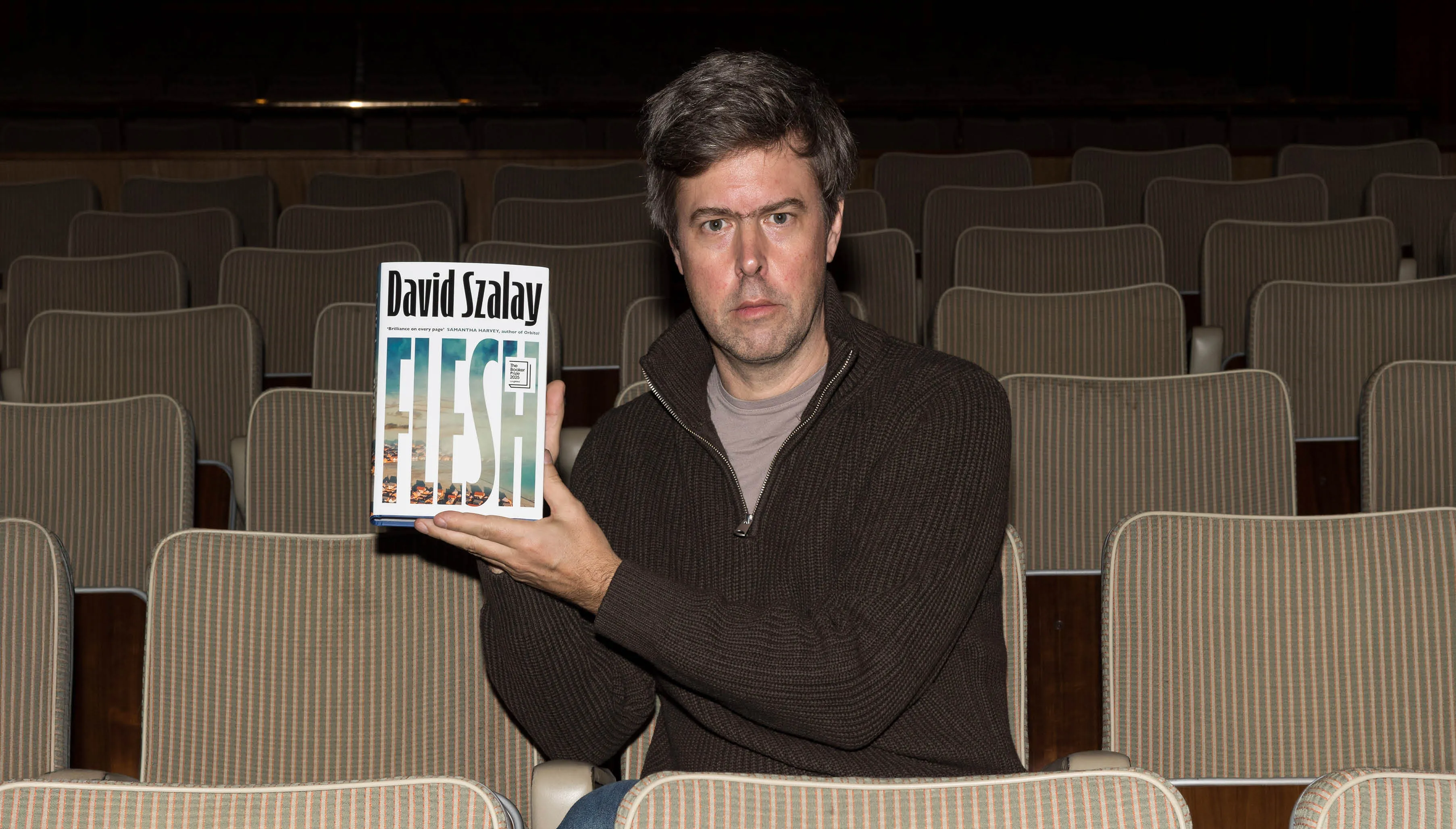
The British writer David Szalay’s (pronounced “sol-oy”) sixth novel, Flesh, which won the 2025 Man Booker Prize recently, is among other things a truly fascinating experiment in developing a character’s interiority. The novel follows a young Hungarian man called István across ten chapters set at different points in his life—his sexual coming-of-age, his time at a juvenile detention facility, his military career, how he comes to enter London’s elite social circles and so on. The catch is, for the first half of the novel, we know almost nothing of how István feels about everything happening to him—his dialogue in this first half is marked by extreme minimalism, with responses like “Yes”, “Okay”, “Good” and “Alright” being the staples. As the name of the novel suggests, he exists primarily as a physical being up until this stage. It is only much later in the novel that we see observe István’s interior dialogue developing gradually, increasing in length as well as intricacy, culminating in a bravura inner-monologue near the 300-page mark where his son’s impending puberty forces István to confront his childhood and youth, as well as the physicality that was shaped by these experiences.
Talking about the novel during a video interview, Szalay spoke about how he developed the character of István, including a very tricky conversation he has with his married lover Helen, near the novel’s halfway mark. Helen says that while she doesn’t love her terminally ill husband any more, there are lingering feelings (responsibility, guilt et al) that amount to a kind of love, prompting István to reply, “Does it matter what words we use?” — a highly significant reply in the context of the novel’s engagement with interiority. Szalay said, “I think that’s definitely a through-line in the book, the limitations of words, the limitations of what language can achieve. And the conversation between István and Helen that you’re referring to, they are talking about whether it matters what words we use to describe our physical experiences, whether the experience itself takes precedence over the words. I don’t think it’s a question that they end up resolving at all, but the question itself is worth asking.”

Throughout the novel, we see István sort of stumbling his way through life, following his basest impulses rather than thinking things through for himself. As a teenager, when his older married neighbour seduces him, the novel lets the ambiguity sit with the reader: is it a straightforward case of grooming, or is it merely a consensual though ill-advised affair? We don’t know because at this point in the novel, István has seemingly no agency, and not much of an inner life. But at the same time, he is also a man who is helpless to fight larger societal forces—towards the beginning of his life, it’s poverty that guides his decisions. In his youth, after getting discharged from the army, he moves to London on a whim, joining a private security business. This happens around the same time Hungary joins the European Union in the mid-2000s, and István becomes one among the hordes of Europeans who suddenly find themselves forming a migrant community in the UK. What can we end up becoming but ourselves, Szalay seems to suggest here in a burst of rhetoric flourish (Szalay himself was born to a Hungarian father and grew up in the UK).
“It’s an example of how István’s life is shaped by large events that he has no control over,” said Szalay. “I think Britain was one of only two Western European countries to allow the free movement of people from the beginning; Sweden was the other. The UK was therefore one of the top destinations for people from Eastern Europe in the mid-2000s, especially if they were looking for economic opportunities. This migratory movement was a huge moment in the history of Europe, I think, and it ended up creating a large community of people within the UK, several millions. I have friends and family members who moved (to the UK) around that time and continue to live here today.”
Flesh, therefore, is a pointed retort to the way we typically view and consume the Bildungsroman, the coming-of-age story. It is also a novel that’s deep in conversation with existentialism—the most striking example of this is in a chapter written like a classic existential trope, the journey to nowhere (example: the seemingly interminable elevator ride in Kazuo Ishiguro’s The Unconsoled, which spans dozens of pages). István and his fellow soldiers are returning to Hungary via Kuwait, only the journey keeps running into unforeseen delays, adding to the PTSD-fuelled anxiety and ennui pervading the psyches of these young men. It’s a harrowing chapter, by no means an easy read, but a deeply rewarding experience nevertheless.
“In the preceding chapter, we see István joining the army, and I wanted him to take part in the Iraq War,” Szalay explained. “When I was researching Iraq I learned that soldiers from Hungary would never be flown directly there, they would always be flown to Kuwait, and from there they would enter Iraq by land—the exact opposite sequence while returning to Hungary, of course. So this discovery was the starting point for the chapter, and my imagination took over from there.”
Since its release and especially since it was awarded the Booker, a number of critics have located Flesh as part of an ersatz ‘masculinity canon’, alongside novels like A Good Man by Mary Gaitskill or Selection Day by Aravind Adiga. And while Szalay did not have masculinity on his mind as a central concern while writing Flesh, it’s understandable why the book has been framed that way. The protagonist’s taciturn nature, his emotionally stunted behaviour and his eventual character growth—all of it do make it a very instructive read for say, the gender studies major, or simply young men looking to feel a little less alone in their experiences.
“I mean, I frequently read novels by female writers talking about female experiences, so I hope that Flesh is read by all kinds of people, not just young men,” said Szalay. “But yes, today we know that young men are reading much less than young women, and there’s absolutely no reason why that should be the case. So my hope is that Flesh can become one of those books that entice young men who’re not habitual readers. It’s a novel about the evolution of a man’s character, and it says what it has to say in a rather direct manner, so if you’re someone who isn’t accustomed to reading novels for pleasure, hopefully Flesh can bring you to the table.”