For William Dalrymple, India is the Gift that Keeps on Giving
Having made India home, the historian is now telling the story of how Indians transformed the world
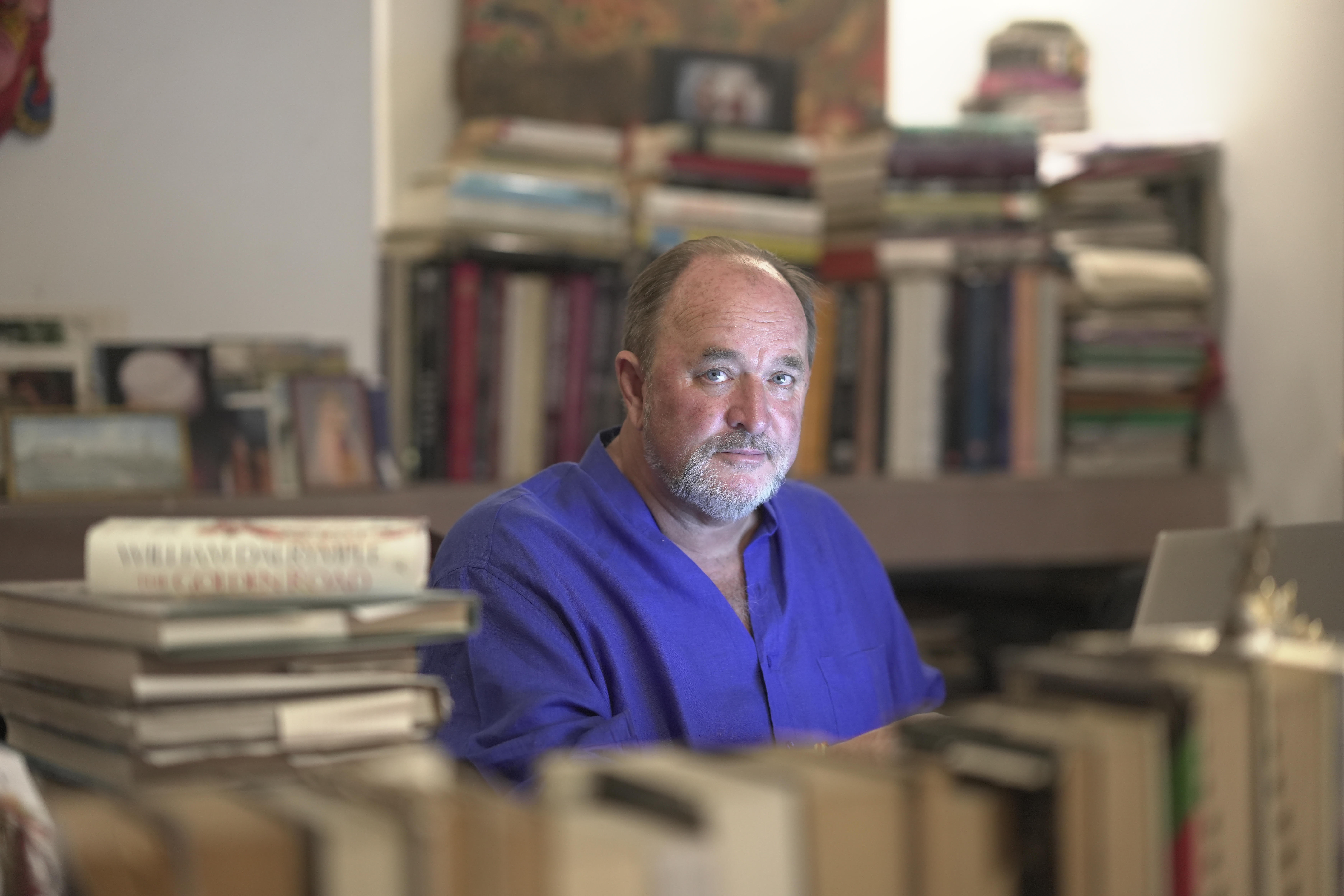
William Dalrymple opens his latest book, The Golden Road: How Ancient India Transformed the World, with a story of discovery and desecration. Leading a hunting party through a thick forest near Aurangabad in the summer of 1819, Captain John Smith chanced upon one of the great wonders of the ancient world—the Ajanta caves. In the dim light of a makeshift torch, Smith could only make out the outline of murals he saw on the walls and pillars. Eager to mark the spot he had just discovered, the young cavalry officer brought out his hunting knife and carved his signature over the image of a Buddhist deity: “JOHN SMITH, 28TH CAVALRY, 28 APRIL 1819.”
Ajanta is where many of Dalrymple’s stories start. When the historian first came to India in 1984, he made sure he visited the ancient sites of Sanchi, Ajanta and Ellora. After several subsequent trips, Dalrymple felt he knew well most of Ajanta’s frescoes, but in 2014, he was in for a surprise. “Without telling anybody, the Archaeological Survey of India had, in its own inimitable manner, cleaned the murals of caves 9 and 10. They had uncovered one of the most important finds in Indian art history, and not alerted anyone,” Dalrymple tells Esquire India.
Though many of Ajanta’s 30 rock-cut cave monuments were completed around 650 CE, the murals of caves 9 and 10 date back to 150 BCE, making them the oldest expressions of Buddhist art in the world. Blanked out by batshit since the 1870s, no one in modern times had ever seen these frescoes. “Not often are you offered a gift like that. It is a major discovery.” Before shifting focus to his next book, The Anarchy (2019), Dalrymple wrote a series of articles about what he had seen in Ajanta. Five years later, in the winter or 2019-2020, he returned to the notes he had scribbled in 2014, and the skeletal plan of a book about ancient India soon began to take shape.
Dalrymple, 59, was leaving his comfort zone by grappling with “a new period of history”. His last four history bestsellers—White Mughals (2002), The Last Mughal (2006), Return of a King (2012) and The Anarchy (2019)—collectively known as The Company Quartet, were all mostly set in the 18th century. The fall of the Mughals and the rise of the East India Company gave Dalrymple the drama and suspense he needed to ensure his dense non-fiction books were all page-turners. Though he seemed to have hit upon a gift that keeps on giving, his family saw things differently. They teased him and said he had written the same book four times over. His children urged him it was time he took on something different.
Delving into an era predating The Company was undoubtedly a departure for Dalrymple, but he says The Golden Road also marks a crucial return. He has always loved ancient history. “I wanted to be an archaeologist growing up. I spent my childhood holidays on archaeological digs. I think my teenage self would have been surprised, and possibly horrified, that I ended up writing about such a modern period as the 18th century. This new book helped me go back to stuff I’ve always been interested in, but stuff I never had any sort of authority about.” The gamble seems to have paid off. Not only has The Golden Road ranked high on bestseller lists in India and the UK, it has also received several glowing reviews in the British press.
Compared to most authors, Dalrymple, one would think, is accustomed to success—the Anarchy hardback sold over 200,000 copies worldwide—but he makes it clear that he never lets complacency settle in. A writer, he says, needs a constant supply of positive feedback and robust book sales. “It takes five years to write a book. You put everything into it, and you’re only ever as good as your last one. I always feel like a politician standing for election. He might have got a massive majority in his constituency one year, but if he has f**ked up in some way, he is voted out. That’s very much the same with a writer.” One bestseller, says Dalrymple, only affords resources of five years from a publisher to write another book properly. This is why he think it’s a “catastrophe” if one of his books isn’t a big success. “So far, I’ve been very lucky. I’m nearly 60 and I haven’t yet had a flop.”
***
Spanning a millennium and a half, from 250 BC to 1200 CE, The Golden Road speaks of how some Indian merchants, sculptors, astronomers and mathematicians were at the peak of their powers during this time, but it also tells us the second, rarer story of how India exported its diverse civilisation to far-flung corners of the world, building an “empire of ideas” in the manner of the Greeks. Dalrymple writes, “What Greece was first to Rome, then to the rest of the Mediterranean and European world, so at this period India was to South-east and Central Asia and even to China, radiating out and diffusing its philosophies, political ideas and architectural forms out over an entire region, not by conquest but instead by sheer cultural allure and sophistication.”
Dalrymple shows how India spread its beliefs and culture on the back of trade. With the monsoon winds in their favour, early Indian traders travelled west between Gujarat and the Red Sea in only 40 days. When Egypt became a Roman province in 30 BCE, India became Rome’s greatest trading partner, supplying the Empire with products ranging from pepper, spices and ivory, to cotton, sandalwood and wild circus animals. After the fall of Rome in 476 CE, Indians looked to Suvarnabhumi, the ‘Land of Gold’ in the east, to replenish their reserves. As the summer monsoon winds blew them eastwards, Indian merchants began doing business with Sri Lanka, Myanmar, Malaysia, Thailand, Laos, Vietnam and Cambodia. This maritime trade route then became the eastern half of a “Golden Road” that Indian religions, literature and mathematics travelled to reach Bali and China. “Where trade led, ideas and the arts followed.”
In The Golden Road, India turns up in the unlikeliest of places: A Buddha head is unearthed in Berenike, Egypt. Kushan sculpture is excavated in Mes Aynak, Afghanistan. Idols of Vishnu and Durga are found in Cambodia, while chess, an Indian invention, takes root in the Spanish town of Toledo. India’s sphere of influence—what Dalrymple calls the “Indosphere”—stretches far and wide, all the way from nations lining the Red Sea to countries in the Pacific. “Over half the world’s population today lives in areas where Indian ideas of religion and culture are, or once were, dominant,” writes Dalrymple. Seeing how his neologisms—“Golden Road” and “Indosphere”—compete with China-centric terms like “Silk Road” and “Sinosphere” for primacy, Dalrymple laughs when asked if his final success hinges on the future popularity of his coinage. He says, “I’ll be pleased if they get taken up. Every writer should leave behind a couple of words or phrases in the language when they have gone, even if everyone forgets it’s their invention.”
In recent years, the story of the Silk Road has come to monopolise the imagination of the zeitgeist, but Dalrymple contends that the “great East-West story of commerce and civilisation” first unfolded on the sea roads that linked India and Egypt, not on overland trade routes that are said to have connected China and Turkey. “India has always dominated the maritime story,” says Dalrymple. “Pepper, not silk, was the principal product that the East traded with the West.”
By appropriating the stories of Buddhism’s spread as its own, the Silk Road “has sort of eaten into the conception of India as an area which radiated out its ideas”, but, according to Dalrymple, there can be no doubt that in the early centuries, India was the cultural lodestar that China followed. Xuanzang, a Chinese Buddhist monk, risked life and limb during a 17-year-long journey that brought him to the great Indian centres of learning: “No fresher arriving at Harvard for their first term has ever been more impressed by his future university than Xuanzang turning up in Nalanda in early 7th century CE.” The scriptures Xuanzang translates help him later ally with Wu Zetian, China’s only woman Emperor. Together, scholar and queen transform Buddhism into Chinese state religion.
Dalrymple’s Golden Road is gripping all the way through, but it is unputdownable when he sandwiches historical fact between layers of biographical detail. We relate more to Xuanzang when we read of his trials and tribulations in the desert. There is much riveting intrigue in Wu Zetian’s court as her ambition pushes up her fate, from pretty concubine to ruthless Empress. Dalrymple says, “Narrative and biography are the methodologies through which I tell my history. You secrete economic, art and philosophical history inside these stories. Everyone likes to read about a wicked, sexy Empress or a heroic, scholarly monk, but I try to use the narrative structure of such lives to tell other complicated truths. A spoonful of sugar helps the medicine go down.”
For much of the period that Dalrymple covers, biographies were, sadly, hard to find. “You could pass through 500 years of Indian history and not have a single clear biography,” he says. In the absence of juicy biographical trivia, Dalrymple relies on his training as art historian and his experience as travel writer to flesh out details about the different historical epochs he describes: “I studied art history, as well as history, at Cambridge. I published my first bit of art history [writing] in a scholarly magazine at the age of 14. Art history is especially useful when you’re dealing with a period of history where epigraphic and textual evidence is often fragmentary. So, where art historian ends and travel writer begins, I am not sure, but having the ability to describe the art and the monuments I have seen was certainly an essential tool for this book.”
There is a comforting assuredness with which Dalrymple writes about the Hindu reliefs at Angkor Wat and the Buddhist mandalas at Borobudur. After visiting South-east Asia in 1927, Rabindranath Tagore had written, “Everywhere I could see India, yet I could not recognise it.” Seeing how Ayutthaya, the ancient capital of Thailand, gets its name from Ayodhya, and how “Ma Ganga” becomes “Mekong” in Khmer, Dalrymple, too, came away feeling something similar. India, he says, was born again in a slightly different form in South-east Asia: “It’s very odd when you take a six-hour flight to Cambodia and suddenly find images of Kurukshetra, which is practically an hour from your house. You see images of Krishna and the Gopis—scenes which took place in Mathura. I was struck by how I could find all this stuff around my home in Delhi.”
In Dalrymple’s estimation, temples and monasteries are only two of the several things the world needs to thank India for. With Nalanda, India gave future generations the first model of a residential college, and by allowing any number up to infinity to be expressed with just 10 distinct symbols—the 9 Indian numbers plus 0—mathematicians like Brahmagupta gave the human race the nearest thing it has to a universal language. “Almost everybody uses those figures. These are major contributions. So why we in the West don't learn about Aryabhata and Brahmagupta, but do instead learn about Pythagoras and Archimedes is an interesting question. The lingering shadow of colonial attitudes might have something to do with it,” says Dalrymple.
In his introduction, Dalrymple makes mention of a celebrated Goodness Gracious Me sketch that British comedian Sanjeev Bhaskar had once performed. Stretching the post-colonial idea of reappropriation to a point where it begins to feel ridiculous, Bhaskar employs the character of a proud Indian uncle to suggest that Da Vinci, Christianity and the British royal family all had Indian origins. There are moments when Dalrymple’s project with The Golden Road seems to be running through a more believable checklist—Buddhism, the zero and chess. “Sanjeev Bhaskar's joke is based on the frustration that so many in the diaspora feel. They know about Aryabhata and Brahmagupta, but their neighbour in Southhall doesn’t. So, you get this proud uncle who feels a bit muddled about his history. In a sense, this book is partly written for him.”
Hindu revivalists and hyper-nationalists have, in recent times, attempted to hijack the conversation about ancient India by making claims that are too fantastical and far-fetched to be true. Ganesha’s elephant head, they say, is proof that Indians had mastered plastic surgery several thousand centuries ago, and the flying chariots in our Sanskrit epics are evidence of aircrafts and drones in ancient India. “There’s a feeling ancient India was appropriated by the Right, and often in a kind of nutty way, whereby you had flying saucers and nuclear weapons at Kurukshetra. In this book, I'm trying to parse fact from fiction and mythology. This is not a tub-thumping nationalist rant.” Though Dalrymple identifies as an “Indophile”—“I have lived here for 40 years not because I have to, but because I love it”—he emphasises that he is neither Indian nor is he an Indian nationalist. “I am a Scotsman,” he says, “and it seemed to me there was room for a neutral foreign voice to tell this story in a rational, sober, straightforward and factual manner.”
***
British historian, poet and politician Thomas Babington Macaulay once declared that “a single shelf of a good European library was worth the whole native literature of India and Arabia”. Dalrymple proudly says that his ancestor, the orientalist scholar James Prinsep, would take on Macaulay in public debates that were held in the Calcutta Town Hall. “He had translated the Kharosthi [scripts] of Ashoka, and was the great enemy of Macaulay. I sometimes like to feel I am continuing his work.” Prinsep wasn’t Dalrymple’s only ancestor with an Indian connect. Stair Dalrymple, the family’s first company recruit, died in Calcutta in 1756, and Sophia, Dalrymple’s Franco-Bengali great-grandmother, was muse to the pre-Raphaelites and an aunt to Virginia Woolf. “It is no secret that I have got two dollops of Indian blood—a little Bengali blood and a little Mughal blood—in my veins. That’s in my DNA. I think that must explain why I settled here in India, not in Greece or Turkey.”
Dalrymple’s historian son, Sam, seems to now be taking forward his family’s India legacy. His first book—Shattered Lands: The Five Partitions of India 1937-71—will be published next year. “I’ve always been a proud father, but I had no idea that Sam was capable of the book he’s written. I’m very relieved The Golden Road has been a success, because I kind of suspect that for the rest of my life, people will know me as ‘Sam’s dad’. This book might well be my last one hurrah before I turn into a Kingsley Amis figure, with Martin Amis as a son.”