
- Entertainment
- Style
- Lifestyle
- Food & Drinks
- Tech & Auto
- Culture

AI generated summary, newsroom reviewed
To read unforgettable stories of loss, migration, resilience, and human survival, one shouldn't have to wait for India's Independence Day celebrations.
Partition literature captures one of history's most profound human tragedies, offering visceral perspectives on the 1947 division of the Indian subcontinent. Since 1947, writers and historians have written accounts of the deeply human experiences during the division of the country in three countries. Ranging from gut-wrenching fiction to oral histories and non-fiction, the essential reading spans multiple languages including English.
One may wonder when the violence of the Partition seldom stopped in 1947, then why it is still important to know the story or to read Partition literature years later.
With over a million dead, 15 million resultant migrants, and more than 75,000 brutalised women, the Partition passages are psycho-geographic and speak of the profound nostalgia, loss, displacement, and destabilised identity, that has had continued effect on the interrelations between India, Pakistan and Bangladesh. They present as common threads which sow their roots in recurring depictions of subsequent Naxalite uprisings in 60s India, 1971’s Bangladesh Liberation War, and generational emigration to Britain and America during the late-20th century and raise concerns about post-Partition identities.
The stories and historical records account not only for the ultimate fate of the nation, the violence and the estrangement that followed, but also shed light on what such a large scale migration and violence can affect the self-identity, idea of home and homelands and psychological and physical trauma and more.
While novelists whose work have capture the deftness of the horrific chronicle of 1947, these stories are not averse to humour, humanity, and beauty.
Esquire India's reading list charts Partition literature that one must read as a way to preserve the lived experiences of everyday people whose voices were often sidelined in official political histories:
Brothers Udayan and Subhash’s upbringing in post-Partition Calcutta is marked by the presence of refugee camps and firmly delineated restrictive class lines, a formative detail, which defines both characters’ childhoods, and their coming of age arcs through the 60s and beyond in The Lowlands.
The 1947 Partition of India is the backdrop for this powerful novel, narrated by a precocious child who describes the brutal transition with chilling veracity. Young Lenny Sethi is kept out of school because she suffers from polio. She spends her days with Ayah, her beautiful nanny, visiting with the large group of admirers that Ayah draws.
At the centre of the novel is Deepali Sarkar, a young Hindu attracted to the extreme left wing of the nationalist movement, and Rehan Ahmed, a Muslim radical of Marxist inclinations who introduces her to the life of the rural deprived. Their common political engagement draws them into a quietly doomed love affair. Through their relationship, Hyder explores the growth of tension between Bengalis, Hindus, and Muslims who had once shared a culture and a history as they try to come to terms with Bengalis and India's shifting fortune.
A winner of Booker Prize Tombs of Sands is about an eighty-year-old woman who slips into a deep depression after the death of her husband, and then resurfaces to gain a new lease on life.
Anjali Enjeti's The Parted Earth is a love story and family saga, with both the direct actions and distant legacy of Partition as a backdrop.
Tamas is a prophetic warning against the use of religion as a weapon to gain and perpetuate political power. Originally written in Hindi, it is the most thought-provoking and powerful novels written about the Partition and is set in a small-town frontier province in 1947, just before Partition. Tamas tells the story of a sweeper named Nathu who is bribed and deceived by a local Muslim politician to kill a pig.
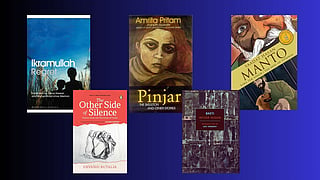
Regret brilliantly recreates a childhood shattered by the Partition of India in 1947. Two lifelong friends, Ehsan and Saeed, reminisce about idyllic summer days spent bunking school, swimming in the canal and relishing the thrills of first love-before the division of the subcontinent changed things forever.
Train to Pakistan is the story of this isolated village that is plunged into the abyss of religious hate. It is also the story of a Sikh boy and a Muslim girl.
Though Intizar Husain would have protested the grouping of his novels Basti (Habitation), Aagey Samandar Hai (The Sea Lies Ahead), and Naya Ghar (The New House) as a trilogy, they can be thought of as cyclical, with each picking up where the other left off in terms of theme and socio-political consciousness. Taken as a whole, the three reflect Partition not as an isolated event, but as one which burdens each character’s ability to create a home across almost five decades of upheaval in Pakistan. Basti begins in pre-Partition India before shifting to an unnamed ‘City’, more or less identifiable as Lahore.
Written in a very simple and spare style, Pinjar is a 1950 Punjabi-language novel written by notable Indian poet and novelist Amrita Pritam. The novel depicts the conditions and nature of the Indian society during the partition of India in 1947 and was translated by Khushwant Singh in English n 2009.
A short story about inmates in a Lahore asylum, some of whom are to be transferred to India following the 1947 Partition, Toba Tek Singh is about the aftermath of the Indo-Pak Partition.
The seminal work by Urvashi Butalia, The Other Side of Silence is a unified, groundbreaking work of oral history that weaves together personal testimonies, memoirs, and archival records to document the untold, lived experiences of the 1947 Partition.
The Booker Prize winning author Anita Desai's Clear Light of Day is a rich, Chekhovian novel about a family and forgiveness. It portrays the effects of national history through the domestic lives of the Das family, whose decaying Old Delhi home makes the aftermath of Partition a spectre which haunts their emotional decisions, rather than a catalyst to immediate physical violence.