Who Is The Artist Behind The Viral Banksy Paintings?
A new report claims to have revealed the identity of British artist, Banksy, after 30 years of secrecy. But was it really necessary?
For the past three decades, one artist who has managed to keep his identity under wraps is Banksy. The elusive street artist whose works have gone from street walls to museum but never once attributed to the man who created the pseudonym. It seems the quest to keep things anonymous may have finally come to an end.
An investigative report recently published by Reuters claims to have uncovered the real identity of the artist who first popped up in the art world from Bristol, England as a freehand graffiti artist in 1993. Known for his acerbic and antiauthoritarian art, Banksy who has also anonymously directed political films quickly became synonymous with protest art and social commentary. His 2003 exhibition titled Turf Wars saw the artist paint on the bodies of live pigs while his 2005 exhibition in London that featured altered replicas of works by Claude Monet, Vincent Van Gogh and Edward Hopper saw 200 live rats being released in the gallery.
Since then, Banksy has not only used his platform to create cultural commentary around injustices and war across the world but has also quickly become popular amongst young generation for antiauthoritarian messaging through his distinctive iconography (stencils art), wry wit and stealth.
Over the years, several of Banksy's installations have emerged out of nowhere to pass on poignant message about capitalism, humanity and society and have made millions in sales are often marred with dark humour and subversion.
Now, with Reuters claiming the man behind the name Banksy to be a 53-year-old Brit Robin Gunningham- who has spent years operating under a common name, David Jones to evade detection- leaves one wondering if an identity reveal is at all necessary?
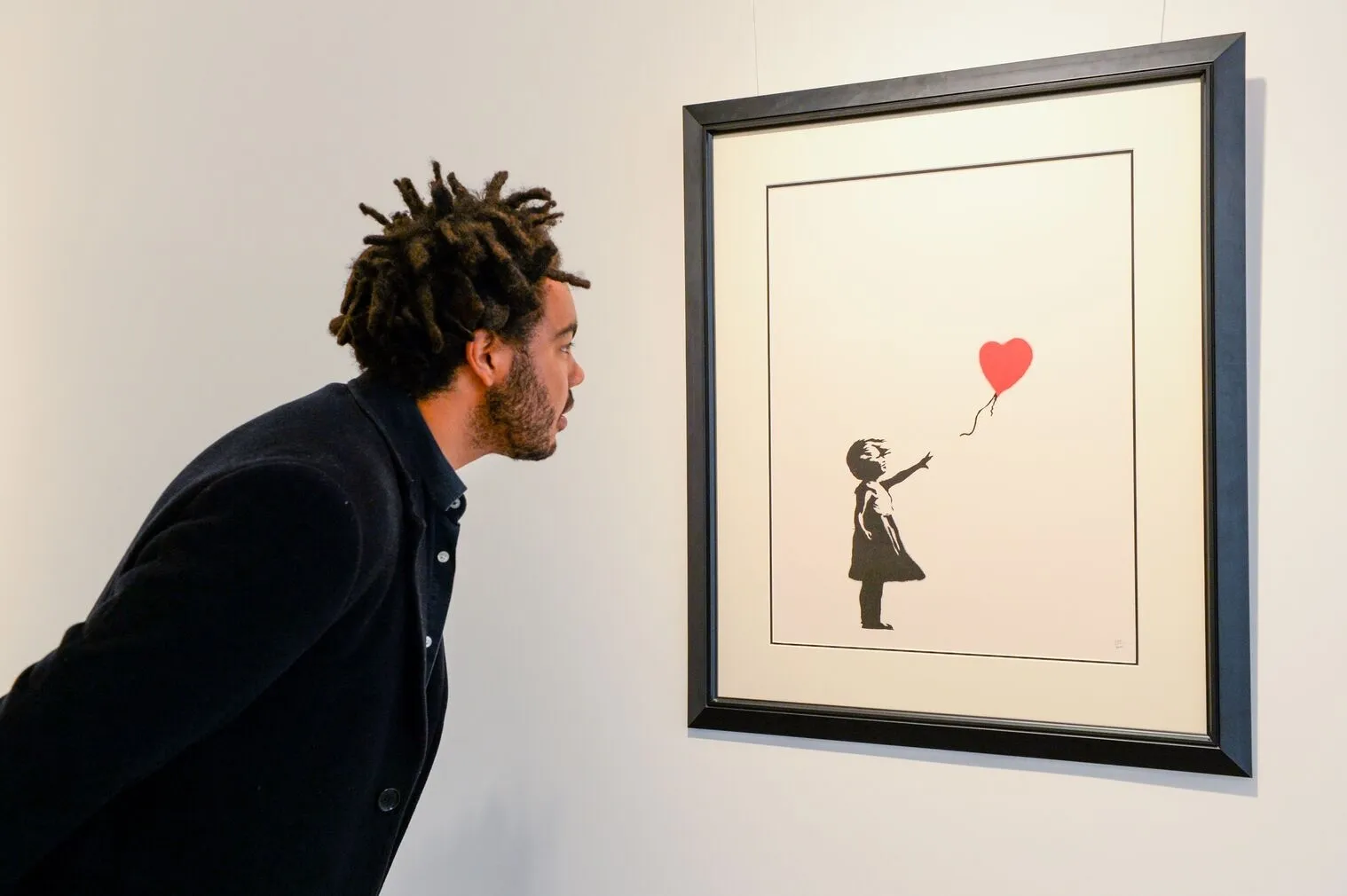
According to the authors of the investigative report Simon Gardner, James Pearson, and Blake Morrison who worked on the investigation, "Once an annoyance to authorities who viewed him as a vandal, he has become a British national treasure. In one survey, Brits rated him more popular than Rembrandt and Monet. In another poll, his 'Girl with Balloon' painting was voted the favorite piece of artwork Britain has produced."
The report also explains why the team decided to dig into the matter given there's so much intrigued and speculation around the artist whose identity has been guarded well despite a U.S. court record that charged Banksy for misdemeanor charge of disorderly conduct.
"Reuters took into account Banksy’s privacy claims – and the fact that many of his fans wish for him to remain anonymous. Yet we concluded that the public has a deep interest in understanding the identity and career of a figure with his profound and enduring influence on culture, the art industry and international political discourse. In so doing, we applied the same principle Reuters uses everywhere. The people and institutions who seek to shape social and political discourse are subject to scrutiny, accountability, and, sometimes, unmasking. Banksy’s anonymity – a deliberate, public-facing, and profitable feature of his work – has enabled him to operate without such transparency." wrote Reuters.
However, this is not the first time that people have speculated who the man behind the mask is. In 2008, Mail On Sunday outed Banksy's real identity though like the 2026 report, it has never been confirmed by the artist or his lawyer Mark Stephens.
Should We Disclose The Identity of Anonymous Artists?
Few figures in contemporary art have provoked as much fascination and frustration as Banksy. Known for politically charged street art that appears overnight on public walls from London to Bethlehem to Kyiv, Banksy has built a global reputation all while keeping his identity hidden. And it is very much central to his artistic persona.
Yet with the recent Reuters investigation and many other including Mail On Sunday, Vice, the debate has sparked an enduring controversy: Should the identity if such an influential figure be revealed?
As many have rightfully pointed out transparency and accountability are important for public personas and Banksy's works frequently appear on public walls (include on the British Parliament recently) without permission, placing them in a legal grey zone that often qualifies as vandalism. Moreover, most jurisdictions across the world charge hefty fines to graffiti artists - even imprisonment- for this. Yet Banksy continues to be guarded from the law in this case.
Over the years, critics have argued that anonymity gives Banksy an unfair shield from consequences that less famous artists would not escape.
Furthermore, the commercialisation of his work complicates matters. Pieces attributed to Banksy have sold for millions at major auction houses raising the questions about authenticity, provenance and even financial accountability. So, knowing the artist's identity is just due diligence.
Not only that but given Banksy's popularity worldwide and his influence in shaping public discourse on politics, human rights, freedom of expression and surveillance calls for the view that anonymity appears less of an artistic choice and more like a strategic evasion of scrutiny.
However, that's where the irony strikes the hardest. The case of preserving Banksy's anonymity is equalling compelling and arguably stronger. It is not only married to his work as an artist making it almost impossible to separate one from the other. The right to privacy that has been exercised by many over centuries enables freer, more honest commentary and is particularly poignant for underground political artists and writers as it helps them avoid the risk of turning the focus from the message to personality. Moreover, it reflects a broader tension between transparency and artistic freedom. Banksy's identity is deliberately absent from the public to mould how the art is experienced and understood.
The message is the medium as Marshall McLuhan, the Canadian media theorist wrote in his 1964 book Understanding Media: The Extensions of Man. For McLuhan, the medium itself shapes how people think, act, and perceive information, regardless of the message itself. And the netizens and doomscrollers know it to be a reality. We are constantly overly scrutinising each other, exposing our lives where anonymity is no longer a default and hardly a choice that must be constantly defended. Audiences today expect access into the lives of public figures blurring the line between public interest and personal intrusion. In that sense, Banksy's refusal to reveal his identity disrupts those expectations and inadvertently amplifies the message.