Inside Suren Joshi’s Bachelor Pad, Where Batman, Coffee, and the Terrace Rule
Entrepreneur Suren Joshi’s bachelor pad is a city-dwelling green-seeker’s envy
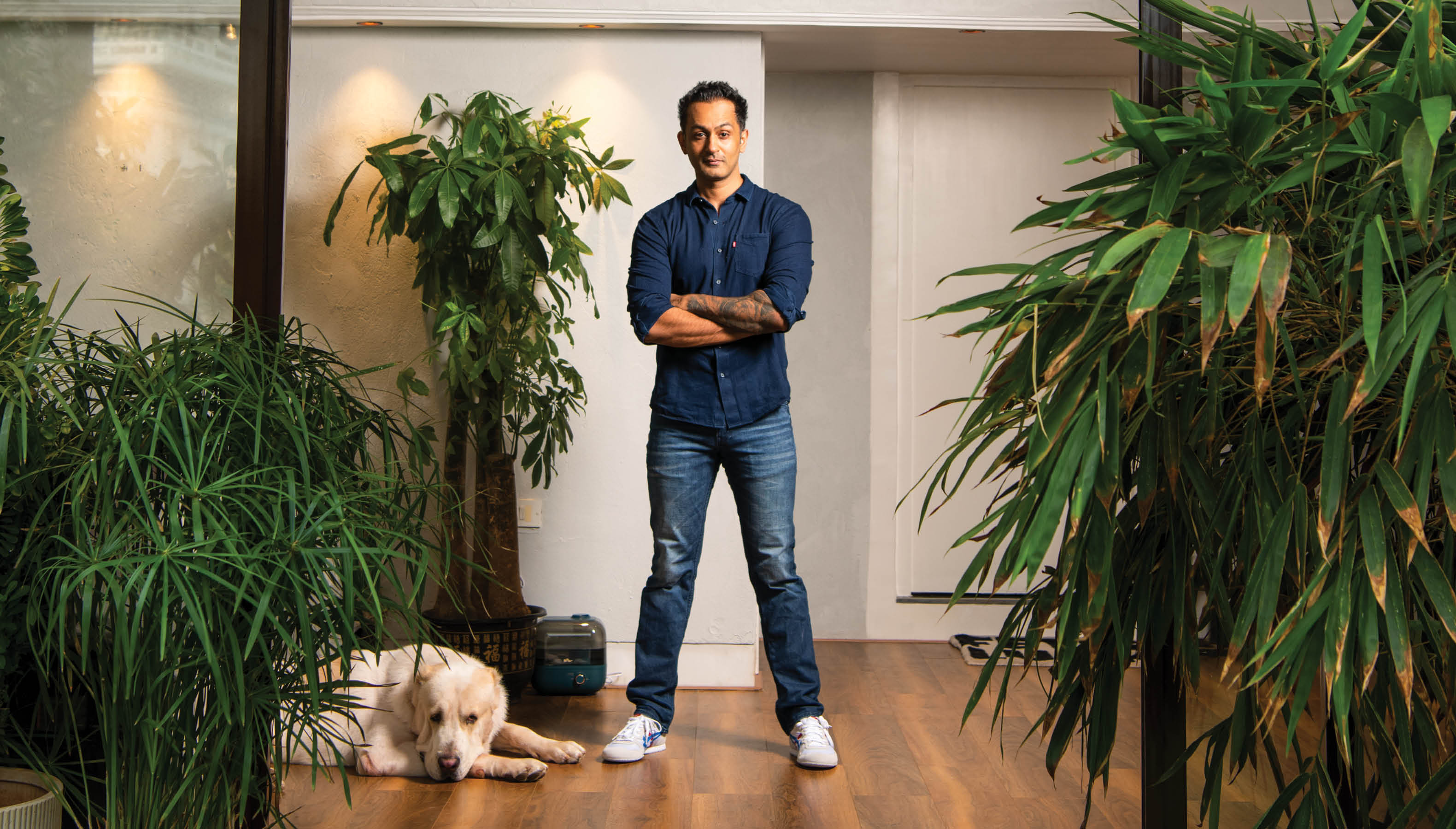
YOU STEP INTO SUREN JOSHI’S BANDRA APARTMENT, AND you feel it. The sunlight spilling across the floor, bouncing off the greenery of his cosy terrace. The low hum of the city far below. The space is small—one-bedroom, hall, kitchen—but it doesn’t feel constrained. A Bandra aerie with more terrace than indoor square footage, it’s the sort of place that makes you wonder whether he built it or it built him.
Joshi’s dogs—an Alabay named Stoner and a pit bull named Cora—pad around and flop down like they own the place (which, in a way, they do). A couch begs to be sunk into, while a projector promises a 300-inch cinematic escape. It’s a bachelor pad in the truest sense: relaxed, unapologetically tailored to the man who lives here. “Do the dogs even know I got this place for them? I wonder what they think of me,” Joshi says with a laugh, as he leads us through the house.
The owner of Joshi House and Shelter Café, among many other F&B ventures, Joshi perches on that couch—half-sitting, half-lying, phone in hand, coffee at his side, his dogs weaving around him. He calls the space “a 10 out of 10.” “I like small houses,” he explains. “Simplicity can also be rich. This is my rich.”
He grew up in the city, in a room “without posters on the walls,” too geeky to put them up in the first place. He remembers an earlier top-floor sea-view apartment: glamorous, vast, but ultimately uninspiring. “You stop looking at the sea after a point. It gets boring. Greenery never gets boring,” he says with an easy smile, the kind that makes you feel instantly at home. His current pad, though, was meant to be. “Nothing was non-negotiable. It’s magical. Very rare,” he says. After looking at countless apartments, he finally found exactly what he wanted—a large terrace, a compact one-bedroom, a
living room with plenty of windows, and sunlight streaming in.
It's a home of small nooks and crannies, reflecting the practical, logical approach he brings to work. “I’m not a very creative person,” he quips. “I’m extremely lazy and I use my laziness to my advantage.” His apartment is designed for comfort, reflection and controlled chaos. Nothing here feels showroom-new, and, according to him, it’s deliberate. Hospitality design elements have been stripped of pretence and repurposed for the man who created them: the terrace flooring was salvaged from a restaurant project that didn’t like it; the ceiling was recycled from his Juhu restaurant The Conservatory after the BMC made him tear it down; the cane chairs came from his old vegetarian restaurant, Sukoon; the big dining table is from Joshi House, his flagship restaurant in Bandra (which has recently reopened in Worli). Even the speakers and bed came from his close friend, actress Jacqueline Fernandez. “One person’s garbage is my gold,” Joshi says.
It feels like a logical extension when he tells us he loves collecting vintage items—computers, vinyl records, anything to tinker with. Among the eccentric touches that punctuate the apartment, some visible, some more private, is a life-sized Batman, standing silently in the bathroom. Impossibly tall, impossibly calm, he’s a presence that makes you pause.
“Yeah, I have a Batman, a Hulk, a Deadpool,” Joshi says casually, like it’s nothing. “Deadpool was taking up too much space, so he’s gone. Batman’s holding this spot until I install red-light therapy and a sauna.” It’s a glimpse into his world: unexpected, playful, undoubtedly his own.
The living room is a curated clutter of more vintage picks and essentials. A massive TV anchors the space. Shelves hold a Captain America shield, an iPhone 3 with batteries and vintage Sharp GS 777 music systems. A beautiful Sanremo You coffee machine takes centre stage, catching the midday light, a nod to Javaphile, his coffee brand making waves in Mumbai’s caffeine scene.
But coffee is only one thread in Joshi’s varied career. Long before Joshi House—a Mediterranean-inspired retreat in Bandra with its whitewashed walls, bougainvillaea and effortless elegance—he was shaping Mumbai’s restaurant scene with spaces like Pali Village Café, Keiba and Su Casa.
His collector’s passion extends to his garage as well. “When I was 17 or 18, I had a 1971 Mustang Mach 1, a 1948 Studebaker Champion, a Jaguar XJS V12. I have always been into antiques.” Each piece carries a memory, a story, but he isn’t sentimental. “Nothing really. My phone—that’s all I need.”
The real hero of the space is the terrace—larger than the apartment itself, lush with tall plants, scattered with couches and recliners, and anchored by a Weber barbecue grill, which he fires up for us. In the corner sits an Ooni pizza oven, though he admits it would take three hours to get going, since he insists on making his dough from scratch. “I love to entertain people in my house, and I usually do it here. I’ll fire up the grill, crack open a few beers, and just chill,” he says.
“I watch movies outside. Depends on the weather. Sometimes, I just sit here, coffee in hand,” he says. The dogs patrol the greenery, darting between the furniture. “In Mumbai, open spaces are harder to get than closed ones,” he says. “This open space is heaven for me… and for my dogs.”
The intersection of work and home is subtle but unmistakable. From restaurants to cafés, Joshi has always shaped experiences. That instinct for aesthetics—what draws people in, what makes a space come alive—is mirrored here. His home, too, reflects his personality: open yet selective. “Everyone’s welcome with good vibes and positivity. I just don’t like people who are annoying or judgmental,” he adds.
By the time we leave, it’s clear the house is Suren Joshi in bricks and mortar: witty, practical, a touch indulgent, but ultimately at ease with itself. You don’t need the Batman to spell it out (though he certainly adds character!) You just need to sink into that couch, watch the dogs race across the terrace, sip the coffee, and let the sunlight fall just right. That’s when it all makes sense.