My Hero: The Mahatma Who Shaped My Art and Life
Of all the ways to define himself, the Mahatma chose one unexpected title: artist of non-violence. In October, Gandhi’s birth month, Atul Dodiya reflects on the enduring inspiration he provides
MAHATMA GANDHI HAS BEEN MY CHILDHOOD hero. I was born 11 years after his death but my generation was lucky to have what one might call a spartan Gandhian upbringing. Both at school and at home, we were taught Gandhian ideals from an early age—for example, sustainability, self-discipline, truth, compassion and non-violence. We were told to never harm anyone, love everyone and live frugally, not wasting food or discarding clothes until they were completely worn. Every morning, we passed Gandhiji’s statue at the entrance of my school on our way to class. Actually, in this country, you cannot escape Bapu. A framed picture of Gandhi alongside Pandit Jawaharlal Nehru, Sardar Vallabhbhai Patel and Maulana Abul Kalam Azad used to hang in our home as well.
It was only when I grew older that I began to understand and truly appreciate Gandhi’s teachings. I have fond memories of reading his memoir, My Experiments with Truth, in Gujarati at 16. Though I was just a teenager, the book left a lasting impression on my young mind. In fact, I was both moved and scared by the courage and strength of this great little man who walked to his own tune and carried the world with him. Gandhi has been a strong presence in both my life and my art. While he has informed my work, he has also profoundly shaped my personal life and worldview. Art and life are inextricably linked, and when someone touches your heart, it’s inevitable that they will find a way into your work.
How the Mahatma became my muse is an interesting story. He entered my work somewhere around 1988 when I made a self-portrait titled Distant Thunder, which depicted a figure like me standing quietly at Sabarmati Ashram battling stormy weather.
But the real story began a decade later when India was commemorating its 50 years of Independence in 1997. Many artists —including myself—were invited to reflect on freedom and unity and celebrate our democratic values. In the early 1990s, I had just returned from Paris, my mind brimming with ideas inspired by Henri Matisse, Pablo Picasso and the Impressionists and Post-Impressionists. But ironically, the city of Bombay, my home, had changed. It felt broken and vulnerable, still bearing the deep scars of the 1992 communal riots.
So, even though the exhibition was meant to be a celebration, I chose to present a work titled Lamentation, in which we see Gandhi as an old man walking on an empty railway platform accompanied by a young boy. Half of the canvas features an image of Picasso’s painting First Steps, which depicts a girl learning to walk while holding her mother’s hand—a work Picasso created during World War II. My piece also includes flying, lamenting angels, inspired by a beautiful fresco on the cycle of life of Jesus Christ in Padua, near Venice, by the great pre-Renaissance Italian master Giotto. In Lamentation, I conjured all these symbolisms, reflecting my love for art history.
SINCE THEN, GANDHI HAS BECOME AN IMPORTANT MOTIF in my work. Over the years, I have tried to evoke him in different ways and in a variety of mediums, always holding on to the hope that Gandhian wisdom can serve as an antidote to the widespread violence and growing intolerance in the world.
One of Gandhi’s own statements that made an impact on me and probably, the reason that made it easier for me to appropriate him in my art, was, “I am not a seer, a rishi, or a philosopher of non-violence. I’m an artist of non-violence, and I try to develop the art of non-violence in the realm of resistance.” I came across this line in one of the books published by the Sabarmati Ashram. Reading it, I felt, ‘Well, if Gandhiji is happy to describe himself as an artist, then who am I to argue otherwise.’
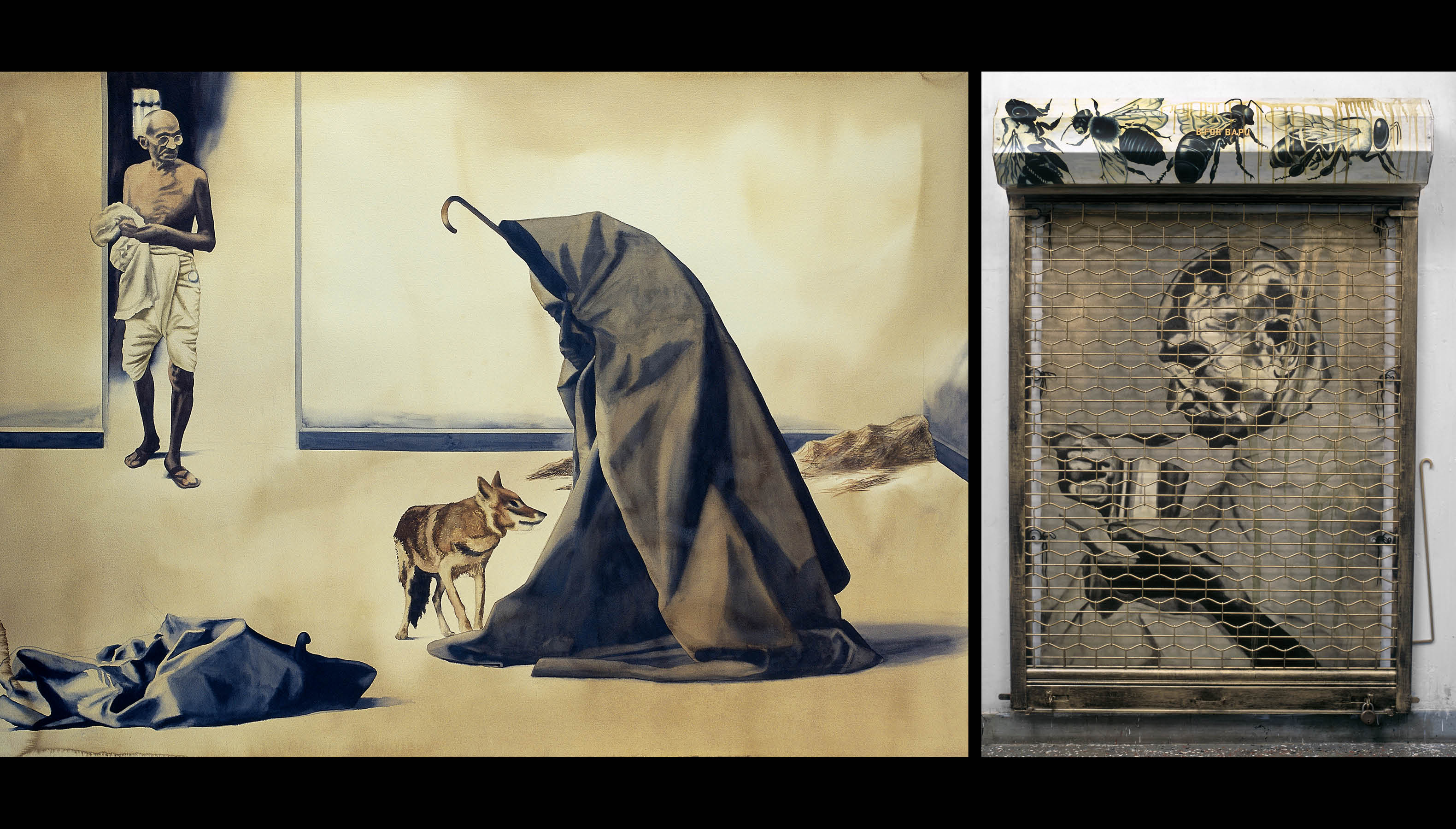
Gandhi was the ultimate political artist, so in 1998, I painted a series of large watercolours called An Artist of Non-Violence. I wanted a medium that embodied simplicity to capture a man who was known for his humble, minimal and almost a saintly lifestyle. There was a particular work called Bapu at Rene Block Gallery, New York 1974 in which I placed Gandhi next to an iconic performance by the German conceptual artist Joseph Beuys—it was a playful juxtaposition where two different artists and schools of thought meet and Beuys was a natural choice alongside Bapu because he believed that everyone was an artist.
Then, in 2002 there came a series of cabinet installations called Broken Branches where I found myself reflecting on Gandhi again. Later exhibited at the Venice Biennale in 2019, it was inspired by my visit to Kirti Mandir, Gandhi’s Porbandar home, which is a memorial museum today. In this work, I used photographs along with prosthetic limbs, human bones and other found objects in glass-fronted wooden cabinets to denote passion and love on one hand, and brutality and violence on the other. It was a commentary on 2002 Gujarat riots. The work was called Broken Branches because I thought that we are so proud of our country and its 4,000-year history. And yet, all this ancient culture does not stop us from breaking branches of this huge banyan tree called India. Where’s the humanity that Gandhi symbolised and laid down his life for?
Beneath the simple exterior was a shrewd politician who understood the importance of symbolism, weaving it into the heart of his political strategy and mass campaigns. Whether it was his use of khadi, the Dandi March and salt as instruments of resistance, the charkha, or the non-cooperation movement, a wonderful and fine aesthetic runs through all his acts, gestures and performances.
Gandhi was a great soul. We need him today, maybe more than ever before. Amidst rising fundamentalism and spectres of war, his message of love, humanity, diversity, non-violence and brotherhood resonates and reminds us that there once lived a man who respected others as much as he did himself.
It was Gandhi who once famously said, “I want the culture of all lands to be blown about my house as freely as possible. But I refuse to be blown off my feet by any.”
As told to Shaikh Ayaz
To read more stories from Esquire India's October 2025 issue, pick up a copy of the magazine from your nearest newspaper stand or bookstore. Or click here to subscribe to the magazine.