In the Quiet of Colaba, Christie’s and Nishad Avari Tell a Bigger Story
From Souza to Gaitonde to Krishen Khanna, Christie’s Mumbai brings home works of staggering legacy—just as a new generation begins to pay attention
Ask any Bombay local where the city hums loudest, and they’ll point you to Colaba—where the old bungalows still smell of sea salt and history, and every second art gallery is a portal into our collective history and culture.
Hidden amidst, is Christie’s Bombay—the local outpost of the storied British auction house, known globally for selling everything from Picasso to Husain to tiaras. Here, in a discreet, sea-facing bungalow, the walls are hung with centuries of provenance. It’s part salon, part shrine – where Indian masters like Raza and Krishen Khanna and Tyebb Mehta are brokered over espressos.
On a sun-drenched August afternoon, I walked into Christie’s. In the room stands: a Souza, a Raza, a Husain, a Krishen Khanna. And in between these giants of modern Indian art stands Nishad Avari, Christie’s Head of Department for Indian Art in New York.
We are at Christie’s Mumbai preview—for five days, this Colaba house will hold millions of dollars in Indian modern and contemporary art. Headlined by a 1995 canvas by Krishen Khanna—Bandwallas in Procession—a vivid, rhythmic homage to Indian street brands, it’s on show in a quiet celebration of the artist’s hundredth birthday.
There is also Gaitonde’s Untitled from 1984—pure abstraction, meditative, moody—as well as Souza’s 1957 Girl in a Dressing Gown.
Come September 17, these works will go under the hammer at Christie’s South Asian Modern + Contemporary Art sale in New York—where bidders, phones in hand, will compete not just for canvas and pigment, but for a slice of the region’s evolving art history.
And Avari is not here to play gatekeeper. He believes India is a burgeoning art market with much more interest in art than before – among all demographics – and he’s here to only further that interest. And he’s not wrong.
India’s art market is in the midst of a decisive shift. In 2024, public art sales reached $174 million (around ₹1,450 crore), and just months into 2025, auction sales are already halfway there. SaffronArt alone has broken 26 auction records in the last four months, and the broader art market—once crawling at ₹20 crore—now sits over ₹3,000 crore.
“Infrastructure is catching up. Institutions are coming up. The energy is real,” Avari tells me. “We’re building something.”
A Market in Motion
The timing of this preview wasn’t incidental. Earlier this year, Christie’s New York sold M.F. Husain’s Untitled (Gram Yatra) for $13.75 million—the highest price ever paid for a work of modern Indian art. It was the kind of sale that repositions a country on the global art map. But to hear Avari tell it, this wasn’t just about a single canvas. “We had a feeling,” he says. “The painting was electric—probably once in a lifetime. But we didn’t imagine it would go that far.”
“In the 50s and 60s, there wasn’t really a collecting culture in India,” Avari says. “Almost all of it was driven by diplomats and industrial houses—the Tatas, the Godrejs, the Birlas.” As a result, many seminal works by Indian modernists like Souza, Raza and Hebbar were bought by foreigners and left the country with them. “So the Raza comes to us from Norway, the Souza from France, an early Hebbar from Switzerland—it’s globally sourced, this art.”
It’s a paradox that’s now turning on its head. The global demand remains, but the interest from within India is steadily rising. “Since the 70s, Indian galleries—Chemould, Kumar Gallery, Jehangir—began actively nurturing local collectors. But it was really in the 90s when things blossomed,” Avari explains. “That’s when NRIs started buying more aggressively. They wanted a piece of home. Our whole demographic has evolved since.”
Today’s Indian collector isn’t just the art historian or the blue-chip investor. “We’re seeing people in their late 20s and 30s making their first purchases. And museums are actively collecting as well,” Avari tells me. “Even within one auction, there are works priced at a couple of thousand dollars and others in the millions. It’s more democratic now.”
Collectors under 40 now make up a significant chunk of the market—especially at lower price points where contemporary and digital art have made entry easier. Add to that the rise of digital platforms, e-commerce models, even NFTs, and it’s clear: the Indian art world isn’t just growing, it’s evolving.
The Investment Question
But are they buying with their eyes or their wallets?
“There are always people who ask—will this go up in value?” Avari smiles. “But we always say—buy what you love. You’re going to wake up to it every day. That has to be the first filter.”
That doesn’t mean money isn’t part of the conversation. “At a certain level, investment has to be considered. It’s a major purchase. Like real estate. You can’t avoid it. But no one can promise 2x or 3x in five years.”
Still, for blue-chip names—Mehta, Raza, Gaitonde—the supply is shrinking, demand is rising, and prices are only going one way. Tyeb Mehta’s Kali recently sold for ₹61.8 crore—another global record. “It’s harder and harder to find great works from that first generation of modernists,” Avari admits. “So yes, it’s trending upward.”
Bringing Art Home
For all its international footprint, Christie’s roots in India run deep. Its first auction in the country took place at Mumbai’s Taj Mahal Hotel in 1987. “We’ve had a permanent presence here since the early 90’s,” Avari notes. “And while we aren’t doing auctions in India right now, we preview every major sale here.”
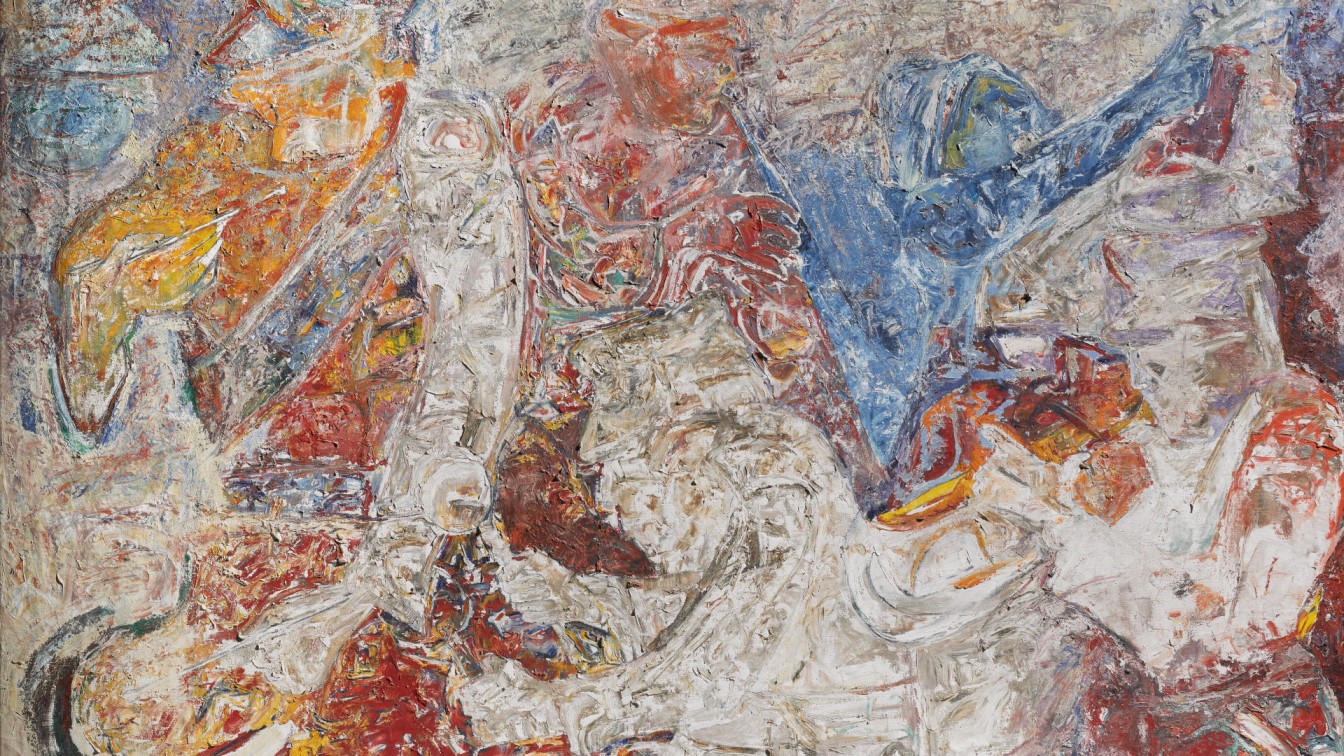
This season’s preview is especially poignant: Krishen Khanna’s Bandwallas in Procession. Alongside it is Tyeb Mehta’s Trussed Bull, Gaitonde’s 1984 abstract, and rarely seen works by Jehangir Sabavala, Jamini Roy, and Francis Newton Souza.
“There’s definitely more interest now from the West,” Avari confirms. “But hunger for collecting comes after interest. Institutions like MoMA pulling out their Gaitonde, or Arpita Singh having a solo show at Serpentine—those are the early signs. Once curiosity builds, the market follows.”
When I ask which piece he’s most excited about, Avari laughs.
“It’s like asking me to choose a favourite child,” he says. “But to have both the Tyeb and the Gaitonde in one sale—neither of them were prolific artists. We don’t see their work that often. It’s incredibly rare.”
Avari, who grew up in Bombay and now lives in New York, is uniquely positioned to compare the two markets. “New York is saturated. There’s not a lot of flexibility in the big institutions. But you do have access—to a Rothko, a Basquiat, a Pollock. It’s all there.”
In India, though, it’s the sense of becoming that excites him. “We’re still building. When KNMA opens its new space, it’ll be a game changer. We’ll finally have a destination for modern and contemporary South Asian art. This is a very exciting time to be here.”
“The work is ongoing,” Avari tells me, almost as a mantra. “There’s always more to do.” But with every new collector, every curious museumgoer, and every Raza that finds its way back into an Indian home, the language of legacy grows just a little stronger. And in this language, India is finally learning to speak fluently again.
As I step out of the quiet sanctuary of Christie’s Mumbai, the city seems to roar a little louder. But I carry something different now—a deepened sense of what Indian modern art means today. It’s no longer just the legacy of a few brilliant men on canvas. It’s the story of a country that is learning to look, to question, to value, and to remember.