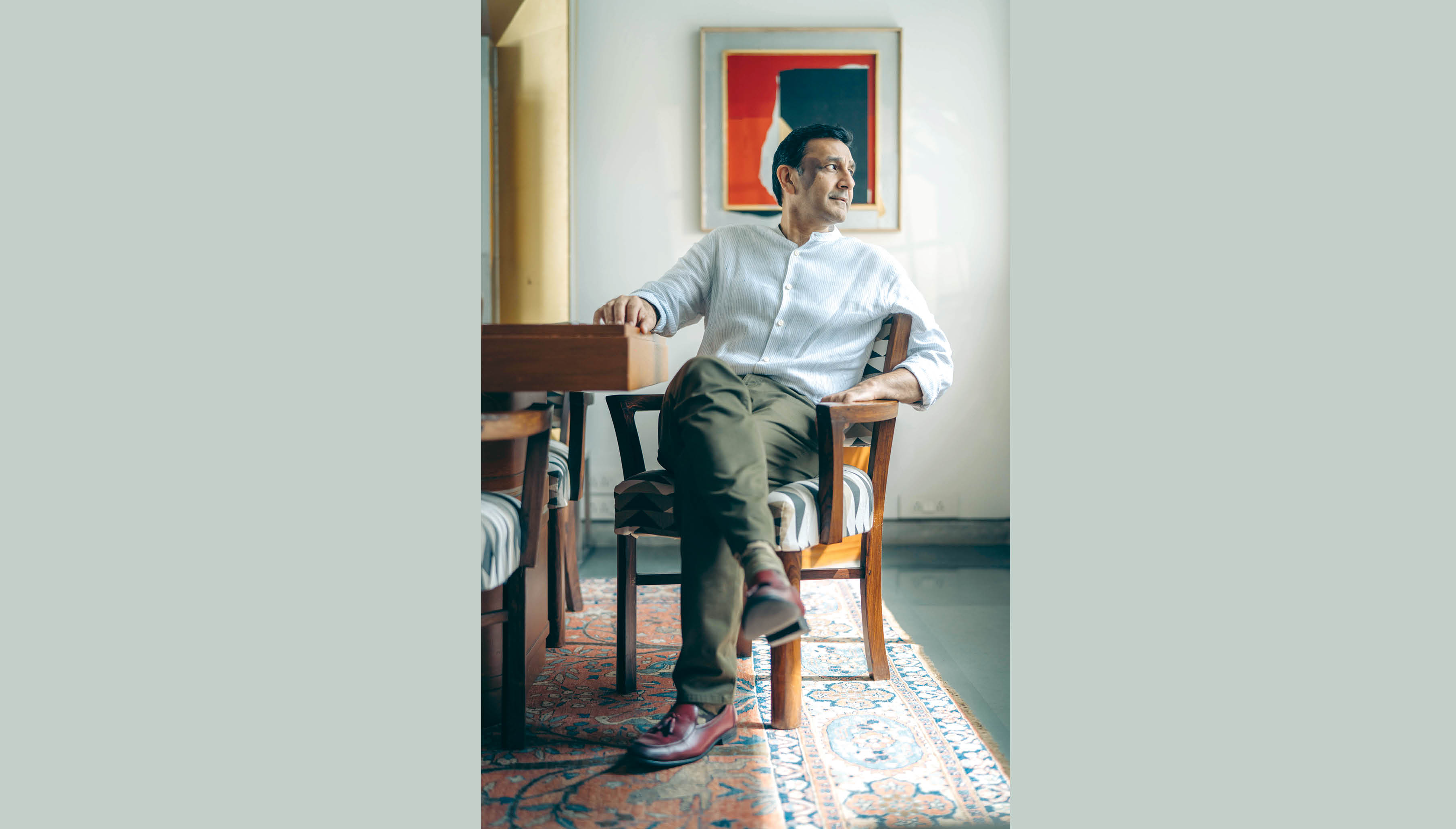
Industrialist Abhishek Poddar Reflects On Art That Moves Him
Abhishek poddar’s art trove is a world of its own, so vast it has its own private museum. The industrialist, philanthropist and collector reflects on art and the distinctly indian aesthetic behind it
INDUSTRIALIST AND COLLECTOR, ABHISHEK PODDAR HAS A PASSION FOR ART— both for collecting it and making it accessible to one and all.
Poddar’s earliest memories of fine art are from his childhood visits to the home of his relative, industrialist Suresh Neotia. Poddar recalls, “There would invariably be historians or scholars or collectors of art huddled together, having a conversation over a painting or an exquisite textile.” This early education may have been the subconscious catalyst behind his decision to start an art magazine when studying at The Doon School in Dehradun, away from his family home in Kolkata.
His interest in art only grew from there. As a teenager in the ’80s, Poddar invested in his first art works while browsing through the Calcutta Art Gallery, established by actor Victor Banerjee. He chose a drawing by Jatin Das and a painting by Anjolie Ela Menon. Decades later, with a collection spanning thousands of works, Poddar has made a name for himself as a collector with a discerning eye, and the magnanimous vision of bringing art to the masses through his ambitious project in Bengaluru—MAP (the Museum of Art and Photography).
Having access to fine art which would otherwise be locked up in the tasteful drawing rooms of billionaire collectors or ensconced behind glass boxes in museums in far flung cities around the world, is a supreme luxury for most people—one that Poddar was uniquely placed to facilitate. He explains, “I had a simple objective in mind about getting people excited about the great art of the country.”
This objective was achieved with the opening of a state-of-the-art private museum, built by acclaimed architects Matthew & Ghosh in the heart of the city, spread across five floors. In it, there are more than 7,000 pieces from his family’s personal collection, as well as thousands of others displayed through a variety of rolling exhibits. Apart from showcasing physical art, the museum also has a robust digital offering, organises talks, film screenings and other programmes. Free entry days once a week attract the largest possible audience. The focus, however, is purely on Indian art.
“My aesthetic is very skewed towards the Indian, and my collection of art is too. I believe wherever the Indian form is used, Indians do it really well. Take the sari as an example—it isn’t possible for a western luxury brand to surpass Indians at making the sari. The same goes for Indian art. Indians were making amazing art when Europe was still in the dark ages. Many Indian royal courts would patronise the arts, so they flourished even before the Mughals,” he says.
Poddar also points to Indian art being luxurious in terms of the high prices it commands in the global art market. “India is having its moment now. People in India are making more money than before, and they are rightfully proud of their heritage. Hence, they are willing to pay a fancy price when buying something Indian.”
He demurs from naming the most precious and rare works from his personal collection, stating their vast number. He does, however, concede to sharing the stories of the pieces most dear to him, even if they are not the most valuable in monetary terms. The first of these is the special commission of 25 flowers in the work The Bouquet. Each of these flowers was painted by one of 25 Indian modernist masters and put together as a unique present for Poddar’s parents on their 25th wedding anniversary. The artists included the likes of MF Husain, Manjit Bawa, KG Subramanyan, NS Bendre, Bhupen Khakhar, Laxma Goud, Arpita Singh and others, and the work now hangs in a living room of one of his homes.
ANOTHER PRECIOUS WORK IS DASHRATH PATEL’S Sun and Moon. Sharing the story of its acquisition, Poddar says, “There was a retrospective of Dashrath Patel at the National Gallery of Modern Art in Delhi sometime in the ’90s. As soon as you entered, you saw this spectacular double-sided, three-dimensional painting. On one side, it was gold and silver with a bit of orange and red, and on the other, it was black, blue and silver, making it the sun on one side and the moon on the other. You could hang it on the wall or place it as a room divider because of its immense volume. It was the centrepiece of the exhibition and the entire foyer was dedicated to it.”
He was unable to purchase the work, however, because it was to be sold as part and parcel of the entire showcase. “I didn’t want to store 200 or more works, so I had to let it go. But it never left my mind,” he recalls. Twenty years later, he was presented with the unique opportunity to buy it again and it now holds pride of place in his home.
Other works Poddar accords importance for their unusual beauty, are works of textiles commissioned by him for his wife Radhika—herself a discerning aesthete. Short films by filmmaker Naveed Mulki based on the stories of artists narrated by Poddar for the MAP archives, are other works he cherishes. For The Spaces in Between, Mulki began with the story of Manjit Bawa—an artist that Poddar was particularly close to—and moved on to recording stories of Meera Mukherjee, Bhupen Khakhar, Dayanita Singh, Geoffrey Bawa, Raghu Rai and others.
There is no doubt of Poddar’s incredible exposure and rich collection of art across genres. One wonders, however, if art is truly the definition of luxury for him? “No… true luxury would be a blank mind,” he quips without skipping a beat.