Raghav Babbar On Art, Life & The India Story
At 27, Raghav Babbar is one of the top-selling Indian artists worldwide, known for works that lay bare the soul. Esquire uncovers the man behind the canvas
One evening in 2024 at the Larsen Warner gallery in Stockholm, an unusual buzz filled the air as a young Indian artist debuted his first-ever show in the Swedish capital.
“The opening was something like a personal milestone for me,” says Raghav Babbar, the 27-year-old artist who was honoured on Forbes’ prestigious 30 Under 30 Asia 2024 list.
“People of Stockholm are passionate about art, and they were especially curious to see my work. Perhaps my Indian heritage and the vibrant colours of my art resonated with them,” muses the London based painter, whose emotionally charged everyday portraits of people have established him as one of the promising voices to watch in the European art world.
You May Also Like: Why Viraj Khanna’s Art Shows A Mirror To Our Complex Relationship With Social Media
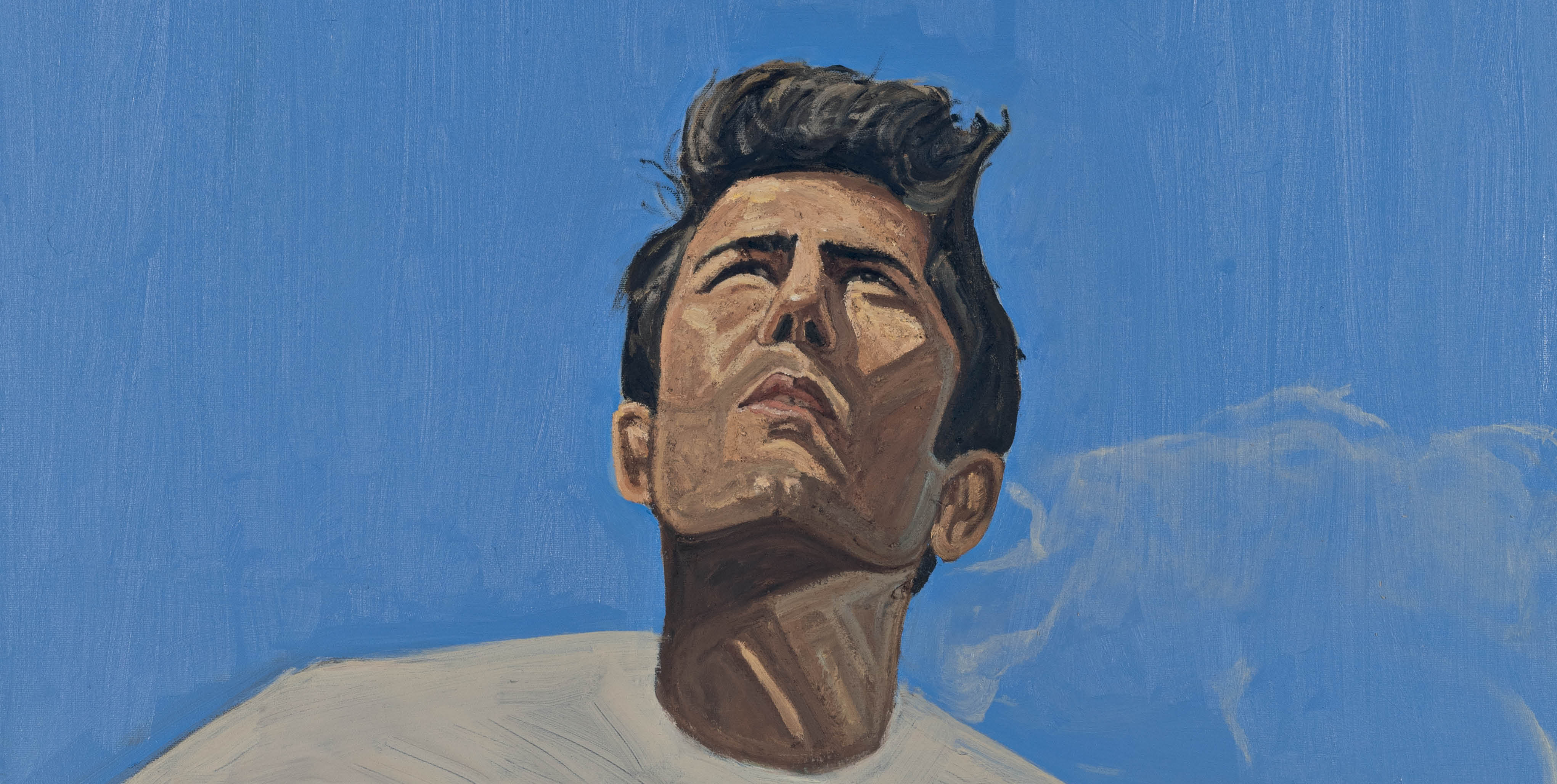
For Babbar, the human figure has been a lifelong inspiration—a theme he explored in the exhibition ‘Orchestrated Characters’, which ran at the Larsen Warner gallery till December 14 last year. Unlike his 2023 exhibition at London’s Nahmad Projects—a homage to memories of loved ones from his hometown of Rohtak (Haryana)—‘Orchestrated Characters’ reflected a shift in focus, capturing friends and acquaintances who shape his life as an artist in the UK.
Babbar’s visually arresting portraits often blend realism with romanticism and imagination but lately, he has been spending time with his sitters in his paint-splattered studio in Battersea, London—in an effort to “bring about a compositional focus to his sitter’s posing and highlighting London’s softened indoor lighting,” shares Lock Kresler from Nahmad Projects.
A large-scale human study, Komal in the Studio is one of his latest offerings that received much attention at the Larsen Warner gallery exhibition. It depicts the artist’s friend Komal Madar from a top angle. The floral motifs on her dress are reproduced meticulously, demonstrating both Babbar’s sharp eye for detail and his affection for feminine beauty.
Another painting in ‘Orchestrated Characters’ shows a demure Indian rural woman behind a sheer dupatta concealing and revealing herself at the same time. “I wanted to explore the paradox of Indian women’s fashion. There’s simplicity as well as complexity about it,” he explains.
Describing him as an “exciting young voice,” Darren Warner, director of Larsen Warner gallery, finds a contemplative aspect in Babbar’s subjects. “Raghav’s great skill lies in managing to present something beyond just the subject’s likeness,” he says, adding, “From ancient times to now, portraiture has told us fundamental truths about humanity and identity and Raghav’s work now sits in that lineage.”
Babbar's fascination with the human form is deeply rooted in his personal experiences and relationships with those in his life. No wonder then that he defines his art as “strongly autobiographical”. “My work can be classified into two distinct categories. One is about my journey in life and the world as I see it through the connections I have forged. The second aspect of my work is that it focuses on my desire to tell the world about the story of India, the beauty and diversity of our nation,” the artist elaborates.
You May Also Like: Weathered Walls: How Street Art Bridges Culture And Science
It’s no coincidence that Babbar’s most cherished paintings feature his closest family members. These works carry an even deeper emotional significance for him today, especially after his move to London in 2022. Before that, when the COVID-19 pandemic struck in early 2020, he was in Singapore studying art and working odd jobs to support himself. Like for many of us, it was one of the most isolating times in his life, a challenging period that deepened his yearning for family and home.
Babbar knew from a young age that he wanted to be an artist. “My father is a businessman and, one day, I happened to ask him, ‘Dad, why did you never oppose my career choice?,’ and he replied, ‘Because growing up, I didn’t hear anything from you besides your love for art.’ He said he would have been a terrible father if he hadn’t let me pursue my dreams,” says Babbar, who has painted his father many times later in his career.
In his trademark style that reflects the rich textural possibilities of oil paint and an expressive quality that combines tenderness with mystery, he has conjured human figures in a way that they end up “offering a direct pathway to understanding a person’s character and perhaps, for this reason, exist in the realm of the sacred,” notes Kresler, who first met Babbar through a mutual friend in London and has since worked with him closely.
You May Also Like: Art Beyond The Canvas: 5 Most Exciting Artists To Watch Out
Babbar’s creative process is meticulous and introspective, says Kresler. “Raghav builds his paintings layer by layer, often starting with faint figures that take shape as he imbues them with emotion. His work is methodical, demanding time and patience,” he says of Babbar, who, since moving to London, has also started sourcing some of his visual vocabulary straight from Bollywood, Bengali (particularly, Satyajit Ray) and Tamil movies, stills from which have inspired image elements and stylistic treatments in his work. In London, oil paint takes longer to dry, and the unpredictable English weather has “slowed him down and has allowed him to push his practice in different directions,” says Kresler.
The city inevitably became home to Babbar after he studied at the Royal College of Art from 2022 to 2023. It was also during this period that he became exposed to the traditions of the School of London. The artist admits that he makes regular trips to London’s prominent museums to learn directly from the masters of portraiture. Babbar misses India, but is thrilled to be a part of London’s vibrant art scene.
According to Kresler, the artist’s work evokes a spiritual connection to British figurative icons Lucian Freud and David Hockney. “Raghav’s brushwork, which emphasises the textures and surface of the skin, mirrors Freud’s profound engagement with flesh and bone while his application of oil paint, marked by geometric arrangements, also recalls Egon Schiele’s nervous energy and the rawness of human experience.”
Despite being relatively new to the fiercely competitive art scene, Babbar’s work has generated remarkable hype in Europe. In 2023, one of his paintings, The Coal Seller (2020) broke all expectations at a Sotheby’s auction. More recently, Business Insider India reported that in 2023, Babbar became “the eighth highest-selling Indian artist after totalling ₹12.1 crore in sales, providing a fantastic example that even youngsters can make money through art”.
You May Also Like: Man Cave: A Village Built This Home for V Sunil
Kresler reckons that Babbar's “deep connection to both his Indian heritage and Western influences make him a valuable figure of the contemporary art market”. Yet, for Babbar, art has never been about money or market value. “I am not good with numbers, actually, and I don't want to be either,” he says, adding, “I believe in working hard every day. I am in my studio from 9am to 9pm, and in those 12 hours I never think about the market.”
He considers the opportunity to share his story with the world as one of the most rewarding aspects of his job. “There’s nothing better than telling people about where you are from and how you see the world,” says the artist, who has shown his works in Singapore, Venice, London, Miami and Hong Kong. Next on the anvil is India and when that happens, it’ll represent the ultimate homecoming for the lad from Rohtak.
“That’s a dream I cannot wait to fulfil,” he says, with a conspiratorial smile, hinting that something special is in the works.