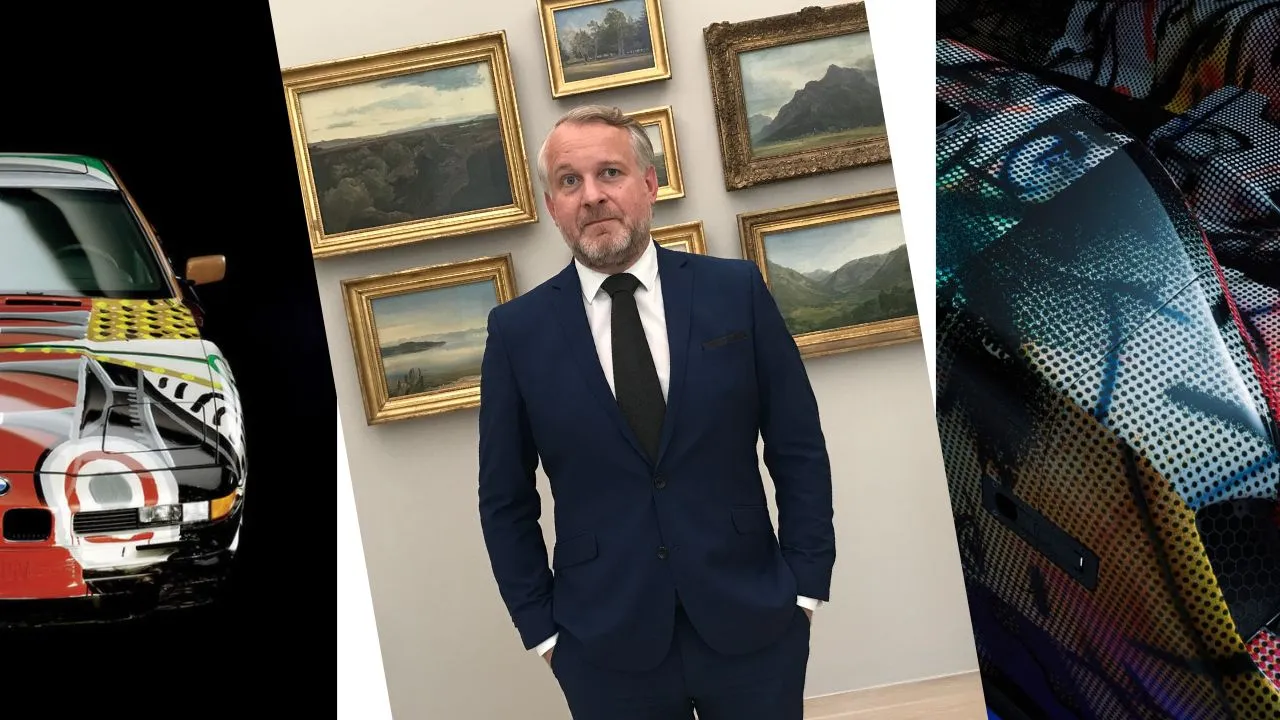
Art In The Driver’s Seat: A Conversation With Thomas Girst
We ride shotgun with BMW’s Global Head of Cultural Engagement, Thomas Girst, along the sidelines of the India Art Fair 2026
Today, you know the BMW M1 sits in the Art Car pantheon as something of a myth. Launched in 1978, this striking supercar was immortalised in a bevy of rushing, finger-swept strokes slathered across all of its body, denoting a sense of speed, by the iconic Andy Warhol.
The reason it looks so distinct and irreplicable of all BMW Art Cars is the unmistakable Warholian geometric splatter of unapologetically modern colours. Versions of the Art Car were produced by Jeff Koons, David Hockney, conceptual artist David Baldessari, contemporary painter Julie Mehretu and painter Matazo Kayama, among other generational artists and visionaries.
What began as an experiment in creative interference has, over five decades, become a cultural armature for the brand. The automaker’s renowned ‘The Future is Born of Art’ commission was conceptualised as an auxiliary progression in BMW’s association with the ongoing India Art Fair. In its 10th year now, the commission was awarded to the multi-media artist Afrah Shafiq, whose art work ‘A Giant Sampler’ a work that threads together the hidden histories of women’s labour through the language of textile craft.
Which is why we turned to the man shaping this universe for over two decades now—BMW’s Global Head of Cultural Engagement, Dr Thomas Girst, on the automaker’s long association with art, his personal vision and the commission. Excerpts:
From starting out producing high-performance engines for aircraft well over a century ago to providing patronage for design and art—what does BMW represent in that regard now?
BMW is a premium car manufacturer which provides the best solutions for individual mobility of today and tomorrow. We are leaders within the field of arts and culture and do not jump from event to event. What matters is the shoulders of giants that we stand on! Over 50 years of cultural engagement with hundreds of initiatives worldwide speak of the heritage, the tradition, and the history that we honour while looking firmly ahead. It is the creative freedom which is as important for our designers and engineers as it is for great works of art. This is the deep connection of a common root between technology, engineering and arts and culture: innovation!
Design starts off as pleasing on the sheer power of functionality and practicality that it brings. For instance, aerodynamism in automobile and aircraft manufacture. Art, arguably, involves a lot more emphasis on emotion. How do you reconcile the ethos of a technique and engineering-forward product with that sort of a sensory experience?
These feelings are complementing each other and are not mutually exclusive. Within a western European context, in pre-Socratic times, there was one word for great achievements both in the arts and technological advancement: techné! There is common thread, a trajectory we are aware of and mean to honour by intertwining those narratives.
Would you say there are any limitations to what you decide to commission or support?
Limitations are budgetary. We are a car manufacturer, not a cultural foundation. We strive to engage in meaningful endeavours and not add to the shallow bling-bling that defines much of the art world sadly today. We believe in creative freedom! Our focus is contemporary art, music and film. These are the coordinates within which we engage, aspiring to help great talents get off the ground!
How did your own background in art history and literature first interact with your work at BMW? Did such a thing as the commercial interests of the brand and its branding conflicting with the more liberal-arts sentiment of your education—ever happen?
Hahaha, indeed. In the beginning I thought I would have to justify myself for having wondered off to the dark side of the force, to speak in Star Wars terms. In my early twenties, I had written manifestoes castigating any influence of commerce and business within arts and culture. I think my art historical background, my teaching, and my academic writing plays right into my day job as I am very much aware of the sensibilities within the art world. And I have street credit. It helps to speak the same language!
Please tell us about the ‘Future is Born of Art’ commission and what you’re looking forward to at the India Art Fair this year.
Afrah Shafiq showcases ‘A Giant Sampler’ across the India Art Fair façade which should be amazing to behold. BMW Group India’s decade-long partnership with India Art Fair reflects our unwavering belief that culture, creativity, and innovation are inseparable pillars of progress. Through ‘The Future is Born of Art’ Commission and our presence at this vibrant platform, we celebrate the power of artistic expression to shape a sustainable and inclusive future. This year's commission is titled ‘Crafting in Continuum’, which is both true of what we do and what India’s amazing and multifaceted art scene stands for.
The world increasingly views with suspicion attempts by big corporations to support art and other such pursuits. What’s the core raison d’etre at BMW to do this?
For over 50 years the BMW Group has been active in the arts with hundreds of cultural initiatives worldwide. I started working at BMW in 2003. In my early twenties, I wrote manifestoes against any involvement of business in the arts. So I’m perfectly set up for this job! Now, I’m on the other side of the fence. And these fences used to be trenches, especially in Germany. For the Frankfurt School, taking their cues all the way back from Kant’s thoughts on culture, art was the very antithesis of materialism. However, I believe a rift has been created through this thinking, one that artists are now hurting from. Many of my students are still being told that they should produce art that cannot be sold. But what was once a trench has become a membrane. The business world and the art world absolutely can learn from each other. Which does not mean art has to compromise its criticality.
As the Global Head of Cultural Engagement, where would you say your loyalty lies more—with the art or with the brand and its vision for the art?
I am loyal to my employer, I am as motivated as I am ambitious as I love what I do. It is great that BMW put someone in charge of their global cultural engagement who is from the arts, who is aware of cultural sensibilities. Arts and culture is what I do. As an author, an art historian, a cultural manager, a journalist, an academic and a teacher. I tell artists to not lose their criticality when partnering with companies, we invite dialogue that differs from BMW’s. How else would we able to grow?
In a dream scenario, which Indian artist—contemporary or from the past—would you have on a BMW Art Car?
The Art Car artists are being decided upon by an international independent jury of museum directors in which BMW does not have a say. As for Indian artists, I love Jitish Kallat’s work, we know each other well. We have also worked with Sudarshan Shetty on the side of Rolls Royce before. Anita Dube is fabulous and I deeply appreciate the important work of Shilpa Gupta. Her work certainly doesn’t lend itself to creating a BMW Art Car yet I am moved by the layers of meaning and political significance embedded in her amazing oeuvre.