
- Entertainment
- Style
- Lifestyle
- Food & Drinks
- Tech & Auto
- Culture

Whenever, Joe, a devoted watch hoarder, has wanted to dive deeper into mechanics of a timepiece, he has gone about it in the usual ways. Read about it. Watch an explainer video on YouTube, attend every watch community event he can reach, squeezing in as much of the watchmaking world as his schedule allows. Or, he signs up for a course, if any, where the movement comes alive in front of him, assembled by his own hands.
One might naturally assume that this is enough. Add a film or two about watchmaking from a luxury house and surely the enthusiasm is fully fed. But Jaeger-LeCoultre, 200 years into its history, has found a newer way to draw a fresh generation of horologists into its world: play.
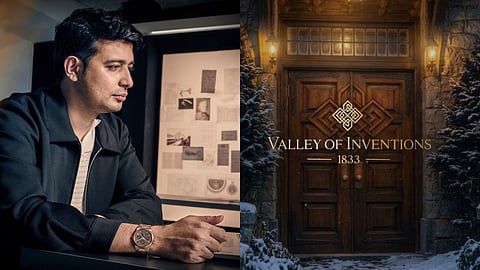
For its bicentenary, the Swiss manufacturer has released The Valley of Inventions, a video-game made exclusively for watch lovers by Goa-based game designer and writer Zain Memon known for SHASN and Trials of Maya as part of Jaeger- LeCoultre's MADE OF MAKERS programme. The game that dropped on November 17 and available to play starting November 20, is available to all and in seven different languages.
The Valley of Inventions reinvents the art of video games by turning the mechanics of watchmaking into gameplay, translating nine iconic complications and pioneering inventions into a series of enigmas and puzzles. The player builds an insider’s view of watchmaking through observation, intuition, logic and discovery – qualities that are common to both watchmaking and game design.
The story begins in 1881, with the death of Antoine LeCoultre, the manufacture's founder. The player steps into the role of his son, who must inherit the workshop and its secrets. To do so, he moves through a series of enigmas, each built around an iconic complication or pioneering invention. A world timer, a tourbillon and a perpetual calendar are no mere decoration; they are the instruments with which the locks are opened. Seven side puzzles fill in the history of watchmaking, and of the house in particular. The game will also travel as a physical escape game: a series of rooms at a watch exhibition in Hong Kong in February, a set of city-wide stunts in Dubai, and a masterclass-style challenge in boutiques.
It was not, Matthieu Le Voyer, Chief Marketing Officer of Jaeger-LeCoultre tells me, meant to be merely "addictive".
"We were looking for something that would create more depth and value", something that's not only culturally good but also a form of artistic expression that speaks to everyone. Hence video games that has evolved into an art form and with a designer better known for board games, which, as Le Voyer puts it, must hold people at a table for two hours.
Which brings us to Memon and his storytelling. The serial entrepreneur who grew up in Mumbai's Versova, is exactly the talent that Swiss watchmakers were on a hunt for, admired by his peers well beyond the reach of his own fame. Ahead of the release, Zain Memon got on a virtual call to share with Esquire India how a watchmaker's bench became a puzzle worth solving.
You've spent much of your career building games that make people question how they see the world. With The Valley of Inventions, you're turning that instinct towards watchmaking. What did you discover about this world that you couldn't have anticipated before starting the project?
You know, every artist, or they sort things that their medium and their process is the most precise, and they are the ones obsessed with the most amount of perfection. And again, be it musicians, be it game designers, be it filmmakers, or authors, but none of them have an objective benchmark. When you get into horology, if you don't do things perfectly, it shows on the face of the watch, and that allows the watchmaker to push their aspiration for perfection to boundaries that I've never experienced before.
I knew that it was a precise art form, but I didn't understand how much care went into each pinion, each gear that a watch this small has. And that was truly fascinating.
Watchmaking and game design seem to share an obsession with systems, precision and the relationship between the smallest detail and the larger whole. Did you find yourself thinking differently about your own craft after spending time with the world of horology?
So what happens is, when you're making a key, much like when you're making a watch, you are spending a lot of time building invisible things that only come into life when things don't go right. So what we had to do is to create a game where all permanent combinations, all behaviours of the player were captured for. But at the front value, when you play the game, everything seems simple, everything seems accessible.
And that's exactly how a watch works. You will have a watch, it will have a minutes hand, and a second hand, and a few more complications. But what you don't realise until you flip the watch over is the amount of work that goes into making that second so perfectly precise.
And that invisible craftsmanship, I think something that game designers and watchmakers share, and I had lots to learn from over there.
Games manipulate our experience of time in extraordinary ways. Minutes can feel like seconds, and seconds can feel interminable. When you're working on a game, do you think about time as something to be measured, or something to be experienced?
When I'm thinking of a game, I'm thinking of myself as a sculptor through time. I'm sculpting through time, simply because there are times where I want to make 15 minutes feel like four hours, because I want you to get the sense of what waiting for a go feels like. But at the same time, sometimes I want the four-hour game session to feel like five minutes.
So what we're constantly trying to do is make sure that people experience time in the way I, as an artist, want them to experience time. And it became particularly interesting and particularly difficult with this game because the idea was, 'how do we make someone envision a different kind of time and space while time and the watch face is front and centre?' So I want you to spend three hours on this game, but I don't want you to feel like it's three hours.
Well, I'm sure that you'll be very happy to know that when I started playing it-- my goodness, I did not realise how much time I'd actually spent solving the first puzzle alone. Now, coming to JLC's rich and vast history, what did you recognise in the Maison's history that felt familiar to the way you think?
That when you read your work with craft and you craft with care and with love, it shows there are hundreds of watchmakers all over the world, but there's only one watchmaker's watchmaker. And that's simply because there's an immense amount of love and care that each part of that process goes. And that's something I would take home with me.
I want to pour each amount of that love and care, and also build processes where every last member of the team is treating the project with same sincerity because their history is proof of the fact that if you do it like that, it shows. The audience knows, your clients knows.
Is there anything about watchmaking as an art and as a practise then that made you look at your creative process maybe a little bit differently?
You know, sometimes when you're making an art, especially when you're making something, there is a very fine line you draw between a person's real life and how they experience your art and they're two separate worlds. When you are making an art piece that is on people's hands throughout the day, when they're going out at night, when they're working, you realise that art can also be something that is very intrinsic to your day-to-day activity. And that's the question I've been asking myself; 'How do I create art that isn't just consumed at one point, but is consumed throughout the day and becomes a part of your life?'
The Valley of Inventions is accessible as an app for the public from November 17, 2026, and will be reproduced in phygital format to be offered by Jaeger-LeCoultre as a gift to selected clients and collectors.