
- Entertainment
- Style
- Lifestyle
- Food & Drinks
- Tech & Auto
- Culture
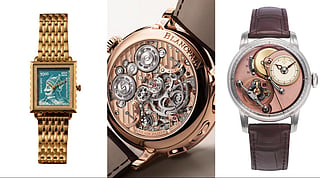
Most watches have two lives. There's the one it lives on a wrist, ticking through commutes and dinners, and the occasional glance during a boring meeting. And there's the one it lives in a glass case, lit from below, while strangers lean in close enough to fog the display.
The Grand Prix d'Horlogerie de Genève, or GPHG, is where the watch industry takes stock of itself. Often called the watch world's equivalent of the Oscars, it brings together the year's most significant releases. This year’s edition is also the competition’s biggest shake-up in years. The long-running Men's and Ladies' Watch categories have been replaced by Essential Watch and Complication Watch, a new Gemset category joins the lineup, and Wei Koh, founder of Revolution and The Rake, takes over as jury president.
Before only a handful go on to win, many of this year’s contenders stop in Mumbai, giving collectors and the simply curious a chance to see them up close. The shortlist is still to come, but the lineup is already coming into focus. A total of 320 watches from 194 brands have been entered this year, with Audemars Piguet, Chopard, IWC Schaffhausen, and Louis Vuitton each submitting the maximum six watches.
Last year's overall winner, Breguet, sits this edition out, while Tudor, Van Cleef & Arpels, Voutilainen, and Greubel Forsey are among the notable absentees. As Ethos chairman Yasho Saboo puts it, the exhibition is "a recognition of the country's growing importance in global horology."
Here are ten entries worth knowing before the exhibition opens:

₹20.1 crore (incl. VAT)
Blancpain is calling the Grande Double Sonnerie the most ambitious watch it has ever built, and the price backs that up. At roughly CHF 1.7 million, it's the single most expensive entry in this year's competition. It runs on a fully integrated grande and petite sonnerie movement, a striking mechanism that chimes the hours and quarters automatically, which is widely considered one of the hardest things in mechanical watchmaking to get right.
₹3.5 crore
Built to mark Audemars Piguet's 150th anniversary, Royal Oak one comes out of the brand's research and development pipeline, the same lineage that's produced its record-setting ultra-thin watches over the years. It folds a flying tourbillon and chronograph into the Royal Oak's famously slim case, which is a genuinely difficult engineering problem as thinness and complication tend to fight each other.
₹9.7 crore (incl. VAT)
Bvlgari built the Octo Roma Grande Sonnerie in titanium and gave it a grande sonnerie, the same rare striking complication as the Blancpain above. Titanium is a notoriously poor material for sound, so getting a clean, resonant chime out of a titanium case is as much an acoustic problem as a mechanical one.
₹3.5 crore (incl. VAT)
Inspired by the house's trunks, the Escale Minute Repeater uses an in-house minute repeater movement, meaning it chimes the exact time on demand at the press of a slide. Louis Vuitton doesn't get talked about as a serious watchmaker as often as it should, and entries like this one, built entirely in-house, are the reason that's starting to change.
₹3.5 crore (incl. VAT)
Built to mark the 30th anniversary of Chopard Manufacture in Fleurier, the L.U.C Grand Strike is the most complicated chiming watch the house has ever created. It combines a grande sonnerie, petite sonnerie, minute repeater, and tourbillon in a single movement developed entirely in-house after more than 11,000 hours of research and development. The watch's patented sapphire crystal gongs, machined as a single piece with the dial, give it a distinctive, exceptionally clear chime.
₹55.4 lakh (incl. VAT)
A 42-millimetre case in 18-carat 5N gold houses a perpetual calendar, a complication engineered to keep track of leap years and remain accurate for decades without requiring manual correction. Familiar on the outside and deeply sophisticated within, it's a watch that showcases IWC's strength in combining functional design with complex engineering.
₹1 crore (incl. VAT)
Piaget's Polo 79, originally released in 1979 and revived for the brand's 150th anniversary in 2024, gets its first stone dial this year: a deep blue sodalite, cut and set between the model's signature gold gadroons. It runs on the calibre 1200P1, one of the thinnest automatic movements in the world at 2.35 millimetres, and retails for roughly CHF 84,500. The original Polo 79 in yellow gold won the GPHG's Iconic Watch Prize back in 2024.
₹22.3 lakh (incl. VAT)
To mark the H08's fifth anniversary, Hermès has unveiled the H08 Squelette, the collection's first skeletonised model. Three years in the making, it's powered by the new in-house calibre H1978S, developed with Vaucher Manufacture Fleurier. Cased in black PVD-treated titanium, it has been tested to the equivalent of a decade of continuous wear, reinforcing the H08's credentials as a serious watchmaking project.
₹1.2 crore (incl. VAT)
The Inspiration One is the debut watch from a brand nobody outside the trade had heard of a year ago. It looks deceptively simple, an off-centre enamel dial with hours, minutes, seconds, and a power reserve indicator, but underneath is a patented mechanism founder Mathieu Cleguer calls the “Innate escapement”, a reworking of Breguet's natural escapement that restarts itself automatically if a knock interrupts the balance wheel.
₹49,400 (incl. VAT)
Two entries from the same young Jaipur-based brand made this year's field. The Maharana Pratap Stamp Watch is turning a historic Indian postage stamp into a functioning dial. Along with this entry, Jaipur Watch Company's Premium Baagh is also an official entry. But JWC is not the only Indian brand. Competing for a position are 3 more Indian watch-makers including Delhi Watch Company, Titan, and Bangalore Watch Company which makes a total of two Indian watchmakers on the competing list, a small but real signal about where independent watchmaking talent is starting to surface.