- Entertainment
- Style
- Lifestyle
- Food & Drinks
- Tech & Auto
- Culture
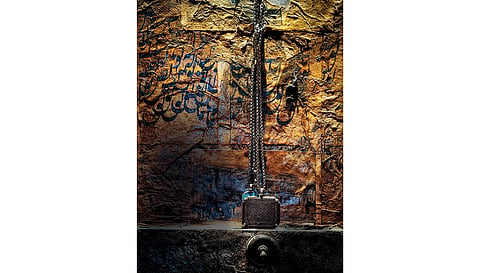
THERE IS ONE OBJECT THAT HAS travelled with renaissance man Muzaffar Ali through decades of cinema, friend ship, risk, triumph and doubt—a taweez he received during the making of THE film Umrao Jaan (1981).
“It came to me in Lucknow, at a time when I did not yet understand what it meant to make a film,” he recalls. “I knew the poetry. I knew the music. I knew longing. But I did not know the storms that gather behind a production—fragile egos, fragile finances, fragile faith.” Raja Sayeed Taqi Hasan of Salempur, a close child hood friend who stood by the filmmaker through every stage of preparation and shooting in Lucknow, placed the taweez in his hands. “He said simply, ‘Keep this with you; it will protect you from what you cannot foresee,’” Ali recalls.

Both lived in the Kaiserbagh Palace Complex, and their mothers shared a bond forged in their own childhood. After Ali’s mother passed away at a very young age, the loss deepened the emotional thread between the families and created an unspoken loyalty between the two boys. Hasan’s son, Rushdi, later worked as Ali’s chief assistant before going on to make his own film. “Such relationships are not footnotes; they are the spine of regional cultural history. When cinema is written about in terms of budgets and box office, these invisible scaffolds are rarely acknowledged,” Ali says.
The taweez itself is a work of extraordinary craftsmanship. “It is not fragile; it is a working stone. That durability feels symbolic,” he shares. The proportions of the piece have always fascinated Ali. Its aspect ratio resembles a film frame—balanced, contained, precise. Within it are inscribed the Ism-e-Azam—the ninety-nine names and attributes of Allah—etched with astonishing geometric discipline. Around these names runs the inscription of Ayat al-Kursi (Qur’an 2:255), one of the most revered verses in the Qur’an. The detailing is so fine that it borders on the impossible; days, perhaps weeks, of patient engraving by a master artisan. It is devotional art at its purest: geometry, calligraphy and faith fused into one, he explains.
“During the making of Umrao Jaan, the taweez hung close to my chest. I often found myself studying it between takes— the red agate glowing softly against fabric, the engraved names catching light. Its geometry seemed to echo the framing of shots; its balance influenced my own sense of visual symmetry," he says. “For days I would admire it, and something in me would reset. Beauty has a way of correcting distortion. When relationships became strained or circumstances turned harsh, its presence felt like an anchor—intimate, not for display.”
Small incidents reinforced its pecu liar guardianship. “I have an unfortunate habit of leaving it behind while travelling. Almost every time, the staff ends up on a determined hunt to retrieve it and it resurfaces. It is as if it refuses to be lost.” Ali believes it carries an aura that is difficult to explain. “The only other taweez of comparable intricacy I encountered was among the personal artefacts preserved in the museum of Rumi in Konya [Turkey]. That encounter strengthened my sense that such objects are not ornaments; they are vessels of continuity. They travel through time carrying intention.”
Over the years, the taweez has been present at many turning points for Ali— witnessing the birth of his Sufi music festival, Jahan-e-Khusrau, the preservation of his earlier works, and the completion of projects such as Zooni (1989). Forty-four years later, it rested against his chest as he and actress Rekha walked the red carpet at the Red Sea International Film Festival, where Umrao Jaan was honoured in 2025.
While his grandson has taken a shine to it—though it hangs too low for him to wear—Ali believes its passing down is not a matter of inheritance alone, but of readiness.
“Objects of this kind choose their custodians through alignment, not entitlement. For now, it remains with me; I am wearing it today. It dangles invisibly beneath other sacred threads, resting where it has rested for decades,” he says.
He values the craftsmanship, certainly. But beyond the material lies its true force— the convergence of friendship, faith and artistic resolve.
To read more stories from Esquire India's March 2026 issue, pick up a copy of the magazine from your nearest newspaper stand or bookstore. Or click here to subscribe to the magazine.