
- Entertainment
- Style
- Lifestyle
- Food & Drinks
- Tech & Auto
- Culture

AI generated summary, newsroom reviewed
A FRESH-OUT-OF-COLLEGE SABYASACHI Mukherjee was a middle-class boy with ambitions through the roof.
Set on building India’s biggest luxury house on his own terms, he turned down offers from some of the country’s top designers. An internship with print designer Georgina von Etzdorf in 2001, followed by a research assignment at the Victoria and Albert Museum in London, took him out of India for the very first time. He returned with a wealth of global exposure and research, but also with a startling realisation of how remarkably little the West knew about India’s long history of luxury and craftsmanship.
Five years later, in 2006, he made his New York Fashion Week debut with a collection titled ‘Snail’. But New York was far from smooth. It was a lesson in what happens when ambition gets there before power does. On the flight home from JFK, Sabyasachi made himself a promise that he would be back when the time was right. He showcased in New York again in 2009, but the bigger moment was still to come.
Nearly 17 years on, Sabyasachi returned to New York with a multi-seasonal runway collection and high jewellery created as part of a landmark collaboration with The Metropolitan Museum of Art. The multiyear partnership opens a long-term dialogue between The Met’s vast collection, spanning more than 5,000 years of art and culture, and Sabyasachi’s world of Indian craftsmanship.
The first chapter of this collaboration, ‘Bengal Byzantine Broadway’ brings three worlds—the grandeur of Byzantium, the energy of New York and the artistic legacy of Kolkata—into the same frame. Rather than treating them as separate references, Sabyasachi folds them into a distinctly Indian visual language.
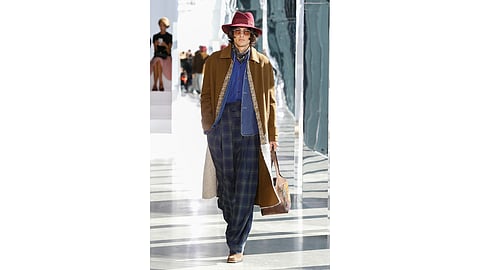
On the runway, abbreviated jackets and cummerbunds were worn with washed denim, gingham checks and workwear shirts, while the striking jewellery brought a more opulent note to the looks. Cowboy and Panama hats, silk scarves and oversized acetate sunglasses added to the mix, alongside sculptural handbags and metal-tipped shoes that gave the collection its distinctly urbane, nomadic character.
The jewellery brought together 18-karat and 22-karat gold with cabochons of garnet, tourmaline, jade, lapis lazuli, jasper, onyx and turquoise. Its references travelled from third-century Roman sculpture and Byzantine carvings to an 11th-century German book-cover plaque and a 17th century Islamic coin. Lions, zodiac motifs, carved animals and tiger claws appeared across cuffs, necklaces and earrings, bringing different histories into the same conversation.
Ideas, objects and traditions survive by being reinterpreted from one generation to the next. The Met’s 5,000-year-old collection is a record of that exchange, while Sabyasachi brings it into the present through Indian craftsmanship. Conceived in Kolkata and presented in New York, ‘Bengal Byzantine Broadway’ makes a case for culture that refuses to stand still. As the designer puts it himself, “For culture to be relevant, it needs to be dynamic.”