
- Entertainment
- Style
- Lifestyle
- Food & Drinks
- Tech & Auto
- Culture

AI generated summary, newsroom reviewed
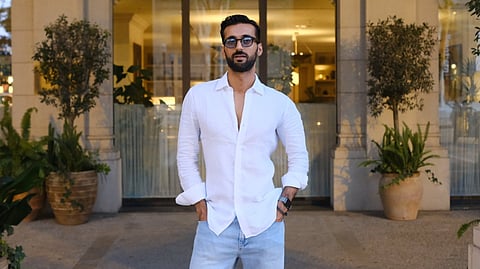
Mumbai-based lawyer Jai Hiranandani found himself face-to-face with a sartorial problem. He has been spending over ten years negotiating deals and legal disputes, but when the time comes to attend an event or travel, he finds himself at a loss for good clothes to fit the occasion.
With most of the fashion industry focussing on womenswear, good menswear, he realised, was so concentrated to a select few brands that the simple act of dressing up became a chore of its own. "Putting together the right outfit often means hunting across different corners of the city, sometimes even the country, and it becomes just another task on the list after a long day," he says.
FOLD is his answer to this problem.
Held at IFBE, Ballard Estate, on October 17 and 18, FOLD is India's first curated luxury menswear pop-up. Across two days, 26 brands across the country will open shop at the pop-up. The curation spans established labels like Rkivecity and 11.11, alongside emerging names like OSHIN, VIXII and Unscene.
Hiranandani's relationship with fashion predates his career in law and real estate. He traces his interest back to childhood, when experimenting with clothes came naturally to him, even when it wasn't popular for men to do so. His understanding of luxury, however, began to take shape in college. “I think I started appreciating luxury and quality just out of school in my first year of college in London. Some of those purchases still feel like a special moment to me,” he recounts.
There is a certain intimacy in the way he describes getting dressed. A garment, to him, carries a memory beyond the circumstances of its purchase. It is a feeling attached to the fit, the discovery of a label that speaks to you, or the satisfaction of finding something that feels distinctly your own. FOLD builds on this relationship with clothing, placing the experience of discovering a brand at the centre of its offering.
Given the circumstances that inspired FOLD, you woul expect Hiranandani's personal style preferences to dominate at the pop-up. "I would say a good 40% of my wardrobe is represented in the room," he admits when asked about it. More important than personal preferences, however, was the brand philosophy and the clothes themselves. “The curation was carefully handpicked with brands that don’t necessarily communicate through logos but more through the unique design elements that sets them apart,” he explains.
That said, he does not want to reduce the selection to pieces that you would wear on your soecial days. "We also have a segment of more lifestyle brands that would be required for an everyday wardrobe," he is quick to point out. In fact, FOLD takes the focus on the everyday wardrobes one step further. "One thing that was definitely not a part of the curation," he says, "was heavy or traditional Indianwear. Not because I don’t love it, it’s just because I feel there is enough and more to see in that."
Arriving at the final selection was considerably harder than the idea might suggest. Hiranandani approached upwards of 60 to 70 labels before settling on the eventual line-up of 26.
For all its emphasis on discovery, FOLD also addresses a more practical problem: the difficulty of shopping for labels that exist almost entirely online. A photograph can communicate a garment's silhouette, but it cannot tell you how a fabric feels against the skin, whether the proportions work for your body or how a piece moves when you wear it. For brands without a physical storefront, these questions can stand between a customer and a purchase.
FOLD gives many of these online-first labels a chance to meet customers in person. What about the more established designers? “The established designers who have trusted in the process have been kind enough to do so, probably also because they believed in the concept which is a menswear focused space,” Hiranandani says. “I think the one take-away for both is the varied interaction with a diverse community that Fold aims to bring together at large.”
The physical layout is designed to encourage precisely this kind of interaction. An open, department-store-style floor allows you to move between labels without following a prescribed route. At the Edit Floor, guests get a chance to find out how the fit looks in pictures, while an Experience Centre accommodates installations and product trials. The Grooming Room, meanwhile, will host workshops and testers with Truefitt & Hill. Just follow your curiosity and discover something beyond your original shopping list. And while you're at it, meet fellow fashion enthusiasts as well.
This community aspect is central to Hiranandani's ambition for FOLD. He sees the pop-up as a place where men can explore personal style without having to develop with a fully formed understanding of what they want before they pick up the cart. After all, saying "I don't understand fashion" should not take away from the joy of discovering personal style. FOLD may have been conceived to solve a practical inconvenience, but at its heart is a man who understands the pleasure of finding a garment that feels right.
So, who does Hiranandani imagine walking through the doors on October 17? “A man who is curious, wants to explore, adapt and feel his best self but doesn’t know where to start or is just too busy to work through all the noise,” he says. His hope is that the visitor leaves with “a little less confusion and a lot more confidence in what he’s wearing.”
There is a larger question embedded in the premise. Menswear in India has long been distributed across individual boutiques, multi-brand stores and digital platforms, often leaving independent designers to build audiences without a dedicated physical setting in which to present their work. Many dedsigners take the co-ed route to developing this audience, in the hopes that in search for womenswear, maybe a customer would check out the meswear section, too. Sure, a curated pop-up cannot resolve every limitation of the retail landscape, but it can bring designers and customers into the same room, making the process of discovering and understanding a label more immediate.
For Hiranandani, the first edition is a beginning rather than a finished proposition. He hopes to take FOLD to more cities and eventually beyond India, allowing the concept to develop through successive editions.
For now, however, the immediate task is to get men through the door. The clothes will do the rest, whether that means finding a new favourite label, discovering a better fit or simply realising that getting dressed need not involve a city-wide search. If Hiranandani has his way, FOLD will become the kind of place where a man arrives looking for one thing and leaves thinking about everything else he could wear.