
- Entertainment
- Style
- Lifestyle
- Food & Drinks
- Tech & Auto
- Culture

AI generated summary, newsroom reviewed
Have you ever seen or lest heard someone saw the Northern Lights in India? Finland, Scotland, Iceland sure.
The natural phenomenon displaying shimmering curtains of coloured light in the night sky is one of those rarest things to be witnessed in India. Unless, you happen to be lucky and in Ladakh or other high-altitude places.
Speaking of luck, there is a high chance that Indians will be able to spot auroras on June 8 in some parts of India. How?
Well, according to the US National Oceanic and Atmospheric Administration's (NOAA) Weather Prediction Centre, an alert has been issued for a G3 (Strong) geomagnetic storm watch following the eruption of a Coronal Mass Ejection (CME) from the Sun.
The geomagnetic storm is set to interact with Earth's magnetic field, potentially even trigger a vivid auroras across high-altitude regions and is expected to cause minor disruptions to the satellites, navigation, and radio communication systems.
While only a temporary disruption to the Earth's magnetic field, the sudden solar flare is directly headed towards our Planet and is expected to hit us between June 8 and June 9.
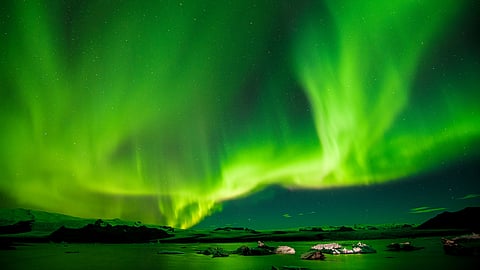
The rare natural phenomenon called Norther Lights, triggered as a response to massive eruption of plasma and magnetic fields from the Sun interacting with Earth's magnetic field, will show only in some parts of India including Leh and Ladakh in places like Nubra Valley, Hanle Dark Sky Reserve; in Tawang in Arunachal Pradesh; and Drass in Kargil.
Unlike the fluorescent green and purple colours that are often seen in the night skies over European skies, Aurora Borealis in India may be crimson or red in colour due to the country's location which is further from the poles. Moreover, people will be looking at a region of the sky where oxygen emissions glow red as atoms react directly to the incoming energy of the Sun.
For one to witness the magnificence of Northern Lights requires no light pollution. So, the best way to get glimpse of Aurora is to have clear, dark skies, high solar activity, and a long exposure camera setup.
The solar storm will begin before Monday midnight (June 8,2026) and will peak between 11.30 pm IST tonight to 2.30 a.m. IST Tuesday (June 9, 2026).
If the geomagnetic field is active, then the aurora will be brighter and further from the poles. Geomagnetic activity is driven by solar activity and solar coronal holes and thus it waxes and wanes with time. So, here are some tips to keep in mind, if you happen to be in high-altitude places across India:
Best aurora is usually within an hour or two of midnight (between 10 PM and 2 AM local time). These hours of active aurora expand towards evening and morning as the level of geomagnetic activity increases. There may be aurora in the evening and morning but it is usually not as active and therefore, not as visually appealing.
Go out at night, duh! This means you need to get away from city lights. The full moon will also diminish the apparent brightness of the aurora (not the actual brightness). One caveat that people often neglect to think of is that the high latitudes where aurora occur are also latitudes where it doesn’t get dark in the summer. So combining a summer vacation to the arctic with aurora watching usually doesn’t work. The aurora may still be there but it is only visible when it is dark.
Best spot for catch the natural phenomenon of Northern Lights is to find a place where you can see to the north ( or south if you are in the southern hemisphere).
Given the right vantage point, say for example on top of a hill in the northern hemisphere with an unobstructed view toward the north, a person can see aurora even when it is 1000 km (600 miles) further north. It should be noted that if you are in the right place under the aurora, you can see very nice auroral displays even with low geomagnetic activity (Kp = 3 or 4).