
- Entertainment
- Style
- Lifestyle
- Food & Drinks
- Tech & Auto
- Culture

AI generated summary, newsroom reviewed
Varanasi tends to dominate every conversation about spiritual India, and for good reason. But the country's sacred geography runs far wider than its most famous ghats. Scattered across forgotten hills, riverbanks and village lanes are pilgrimage sites that carry centuries of devotion without the crowds, the marketing or the mainstream attention. These places have not lost their sanctity. They have simply stayed out of the spotlight. Here are five spiritual destinations beyond Varanasi, that rarely make it onto the usual travel lists, from Unakoti, Maheshwar, Maluti to Rajim, each with a history and character of its own.
Roughly 180 kilometres from Agartala, in the forested hills of North Tripura, Unakoti holds one of India's largest collections of rock-cut sculptures. The name means ‘one less than a crore,’ after a legend that the hillside once housed nearly ten million carved deities. What survives includes massive Shaiva figures, among them a Shiva face nearly thirty feet tall, carved into the rock between the 7th and 9th centuries. There is no commercial buildup around the site. It remains an active Shaivite pilgrimage centre, drawing thousands of devotees each Chaitra, usually March or April, for the Ashokastami festival, when pilgrims bathe in the sacred tanks and pray to Unakotiswara Kal Bhairava.
In Dumka district near the West Bengal border, the village of Maluti was once known locally as ‘Gupta Kashi,’ or hidden Varanasi. It houses terracotta temples built in the 17th century under the Baj Basanta dynasty, local rulers granted the land as a tax-free fiefdom by the Sultan of Bengal. Of the original 108 temples, 72 survive, most dedicated to Shiva, with the largest devoted to Goddess Mauliksha, worshipped as a form of Durga. Since stone was scarce locally, artisans from Bishnupur built the temples entirely from terracotta, covering the walls with panels depicting the Ramayana, the Mahabharata and everyday village life. The Global Heritage Fund lists Maluti among the world's most endangered cultural sites, and restoration by INTACH and the Archaeological Survey of India is only just underway.
About 45 kilometres from Raipur, where the Mahanadi, Pairi and Sondur rivers meet, sits Rajim, known locally as the Prayag of Chhattisgarh. The town holds its own Kumbh-style gathering, the Rajim Kumbh Mela, every year from mid-February to Mahashivratri, drawing thousands of sadhus and pilgrims for ritual bathing at the Triveni Sangam. Its central shrine, the Rajiv Lochan Temple, is a Vishnu temple believed to date to the 7th or 8th century, built during the Kalchuri period. Local tradition places Rama here during his exile. Nearby, the Kuleshwar Mahadev Temple, dedicated to Shiva, sits on a small river island reachable only by boat.
About 70 kilometres from Agra, a stretch of the Yamuna riverbank was once lined with 101 Shiva temples. The site takes its name from Vateshwar Nath, one of Shiva's names, tied to a legend that he rested here beneath a banyan tree still standing today. Raja Badan Singh Bhadauria built the temples in the 17th century and is said to have redirected the Yamuna's course to protect them from flooding. Only part of the original complex still stands, but pilgrims continue to gather here through Shravan and for the annual Kartik Purnima fair, one of India's oldest cattle fairs. Bateshwar also holds Jain significance as the birthplace of the 22nd Tirthankara, Neminath.
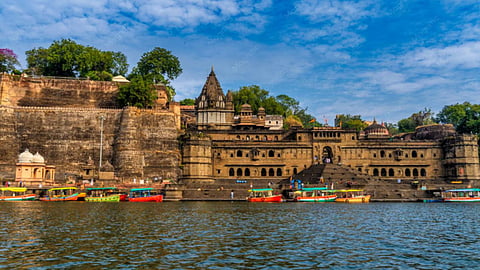
On the banks of the Narmada in western Madhya Pradesh, Maheshwar's history reaches back to the Mahabharata, when it was known as Mahishmati. Its modern spiritual character owes much to Rani Ahilyabai Holkar, the 18th century Maratha queen who ruled from here and rebuilt its fort, temples and riverfront ghats. The Ahilyeshwar Mahadev temple inside the fort remains among the town's oldest Shiva shrines, and a ritual she started continues daily: Brahmins shape thousands of small Shiva lingas from riverbank clay, worship them, and offer them to the Narmada. The ghats stay active with locals bathing and praying, drawing far fewer crowds than Varanasi's.
None of these five places compete with Varanasi in scale or recognition, and that is precisely what keeps their character intact. Unakoti, Maluti, Rajim, Bateshwar and Maheshwar each hold centuries of continuous worship, distinct architectural traditions and local rituals that have survived with little outside attention. For travellers looking to experience Indian spirituality away from the noise, these five are worth the detour.