
- Entertainment
- Style
- Lifestyle
- Food & Drinks
- Tech & Auto
- Culture

There’s a pedestrian bridge in Chongqing that leads nowhere. You step onto it thinking you’re headed to a metro station or a shopping mall, and somehow you end up at the third floor of a residential building, staring at someone’s laundry flapping like surrender flags in the fog. That’s Chongqing.
In a world of increasingly curated travel, where cities are softening their edges to fit the Instagram frame — polishing their grit, flattening their history, rearranging themselves for the algorithm — Chongqing is a refusal. Chongqing isn’t a city that performs for the camera. It’s not trying to be charming or easy or digestible. It’s a chaotic, vertical megacity stacked like a Jenga tower on steroids — an urban jungle so topographically absurd, even your maps app gives up halfway. Roads vanish.
You May Also Like: Why We Just Can’t Leave Forbidden Places Alone
Staircases lead to rooftops. There’s no such thing as “ground floor” — the whole thing feels like a living Escher painting built by caffeine-addled civil engineers with a god complex.
Which is exactly why the world can’t stop looking.
The city, known for its unfathomable vertical sprawl and dizzying architecture, is having a moment and has quickly turned into the unassuming star of travel’s social media spotlight. Suddenly, the internet can’t get enough of it. TikTok loves Chongqing. Instagram adores Chongqing. YouTubers are out here naming vlogs things like “IS THIS EVEN REAL?” as they film themselves gasping while monorails tear through buildings, and what looks like a footpath turns out to be the rooftop of a 40-floor megablock. It’s become a pilgrimage of sorts — not for serenity or sunsets, but for the chaos, the verticality, the pure audacity of a city that seems hell-bent on doing things its own way.
It’s hard to describe, honestly. Imagine Hong Kong, but on steroids.
You May Also Like: The Best Destinations for Adventure Travel
Google Maps is useless in Chongqing. It’s not broken, it’s just fundamentally unequipped to comprehend a city that lives in four dimensions. It’s the kind of place where up feels like down and vice versa. It’s also the kind of place where you can drop a pin and strut over in a straight line. You’ll think you’re ten minutes away—only to realise the café you’re heading to is 17 storeys above you, floating on a concrete skybridge that coils like a Mobius strip. It’s hallucination in high definition.
Rule one: ditch the map. Chongqing is not for the itinerary girlies or your hyper-curated Google Sheets travellers. It’s a place best tackled with curiosity, good walking shoes, and strong quads.
Give it at least 3-4 days, minimum. One day to be confused, one to recover from the stairs, and the rest to ride the chaos. Base yourself in the central Yuzhong district — a jumble of neon towers, narrow alleys, and mind-bending elevation changes.
Start with Hongyadong, the viral, mountain-hugging structure. It’s touristy, sure, but still a necessary entry point. Ride the Liziba metro line — yes, the one that crashes dramatically through a residential building. The crowd of influencers snapping selfies outside is now as much part of the attraction as the train itself.
Take the Yangtze River cable car at sunset. Get lost in Ciqikou Ancient Town, where centuries-old tea houses still hum with life (just avoid weekends, unless your idea of fun includes elbows in your ribs). Wander into the Great Hall of the People, which somehow feels both Stalinist and spiritual. And for the love of god, take a river cruise — not the luxury kind, but the clunky, local ferry with plastic stools and thumping C-pop. It’s perfect.
Let’s be clear: you’re here to suffer. In the best possible way. Chongqing doesn’t just do spice, it weaponises it. The city’s culinary culture is unapologetically aggressive, and hot pot is king. Not the tamed-down kind. The face-numbing, sinus-clearing, tears-of-joy-and-pain kind. Try Old Hotpot— the ones bubbling with chilli oil so thick it looks like lava. Locals dip everything in: duck intestines, lotus root, pork brain, tofu skin. Don’t overthink it. Just dunk and survive.
You May Also Like: The Places You'll Go: The Underrated List For 2025
But there’s more than just hot pot. Xiaomian— a humble bowl of spicy noodles — is Chongqing’s street food anthem. You'll find entire alleys dedicated to it. Skip the five-star restaurants. Go where the stools are low and the fans are loud. Where the spice hits before the bill. Where the beer is cold, the napkins are tissues, and no one speaks English.
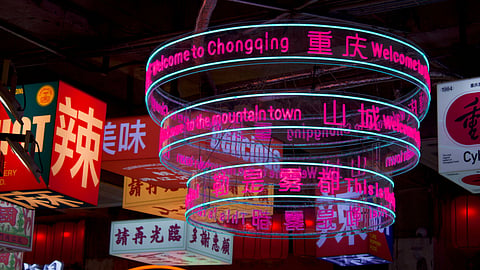
If Paris is for lovers, Chongqing is for people who like their cities slightly unhinged. The real charm lies in its visual contradictions — a Brutalist wet dream lit up in manga neon. For photographers, videographers, architecture nerds, or anyone just jaded by postcard-pretty cities, Chongqing is the anti-boredom city.
From a content POV? Goldmine. From an emotional POV? Surprisingly profound. There’s something oddly moving about a city so utterly engineered and yet so deeply human. In between the mega infrastructure and mega smog, you find a rhythm: uncles playing cards under overpasses, aunties dancing in synchronised formations on rooftops, kids chasing drones around futuristic squares.
And here's the kicker — Chongqing is a mood. Not a polished, posed one. But the kind that hits unexpectedly.
Chongqing isn’t for the faint of heart. It’s messy, mad, and hard to define. But that’s exactly why it’s worth it. In a travel world obsessed with pristine minimalism and “hidden gems” that all look the same, this Chinese megacity offers something far rarer — perspective. Both literal and metaphorical.