
- Entertainment
- Style
- Lifestyle
- Food & Drinks
- Tech & Auto
- Culture

Once upon a time, space was a holy place. A blank, unknowable canvas where only the best and bravest dared to go. A place for test pilots and astrophysicists. Now, it's where you go when you’ve already done the Met Gala, posted from Antarctica, and are looking for your next main-character moment.
Honestly, in the age of hyper-aspirational everything, it was only a matter of time before space became the ultimate status symbol.
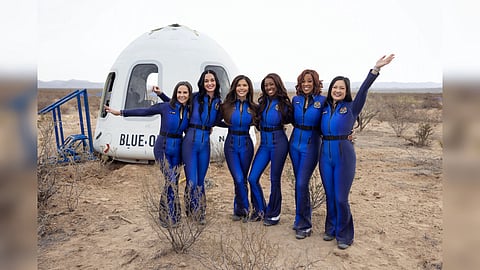
On Monday, as we scrolled through tariff reels and late-stage capitalism headlines, six women – including pop star Katy Perry, CBS anchor Gayle King, and Jeff Bezos’s fiancée Lauren Sánchez — broke through Earth’s atmosphere aboard Blue Origin’s New Shepard rocket for an 11-minute suborbital joyride. Katy Perry floated. Gayle King kissed the Earth. Khloé Kardashian cheered from below. It was, in a word, surreal.
Right, so here’s what happened.
The launch happened in West Texas. The rocket shot up to about 105 km above sea level — just past the Kármán line, the boundary of space. Once there, passengers got a few minutes of zero-gravity weightlessness before parachuting gently back to Earth.
You May Also Like: The Return Of The Dire Wolf
It was Blue Origin’s seventh crewed flight. Not particularly dangerous, but symbolic. Lauren Sánchez, Bezos’s fiancée and the mission’s lead passenger, framed it as a “historic” moment: the first all-woman crew on a Blue Origin flight. (But, historic for what, exactly?)
Well, it doesn’t come cheap. The barrier to entry isn’t training or merit or even bravery — it’s net worth.
Blue Origin has kept the bookings open for everyone and anyone on their website. The only requirement for filling out the form is that the applicant must be 18 years old or older. So yeah, you can book a trip to space on a Blue Origin flight, albeit you have deep pockets.
It’s not like space tourism is an accessible joyride for civilians. There are only three private companies that offer space tourism currently: Blue Origin, SpaceX, and Virgin Galactic – the holy grail, but make them the capitalistic devil.
There are two types of trips on offer: suborbital and orbital. Suborbital flights, like the one Katy Perry and five other women recently took aboard Blue Origin’s New Shepard rocket, last around 11 minutes and just cross the Kármán line—the internationally recognised boundary of space, roughly 100 km above Earth. Think of it as space’s front porch. Orbital flights, on the other hand, are much more intense—days or weeks circling the Earth at over 1.3 million feet. Those are rarer, riskier, and astronomically more expensive.
You May Also Like: Why We Just Can’t Leave Forbidden Places Alone
As for the price tag? A seat on a Virgin Galactic flight goes for around $200,000 to $450,000. Blue Origin hasn’t made its full pricing public, but securing a spot reportedly requires a $150,000 deposit. And that’s just the down payment. You'll also need to pass a two-day training camp, covering safety drills, zero-gravity prep, and how not to freak out mid-air.
With the space tourism market projected to hit $6.7 billion by 2030, this isn’t a one-off stunt. It’s an industry. Blue Origin, SpaceX, and Virgin Galactic are all vying for a slice of the luxury astro-tourism pie, and they’re happy to use celebrities as ambassadors. But unlike Earth-bound luxury, the environmental cost here is planetary. Every rocket launch injects pollutants into the upper atmosphere—exhaust that doesn’t just vanish but lingers, warming the climate and thinning the ozone layer.
Blue Origin touts its “green” hydrogen-fueled engines, but scientists caution that even water vapour in the stratosphere can destabilise climate systems. It’s a future-forward paradox: To chase the stars, we may damage the sky.
The New Shepard mission was a media triumph. It was also, arguably, a missed opportunity. Instead of advancing the frontier of science, it advanced a lifestyle—curated, exclusive, and floating just above the atmosphere.
That’s not to say it didn’t matter. For young girls seeing a pop star and a journalist cross into space, it might spark dreams. But let’s be honest: this wasn’t a revolution. It was a ride. Empowerment without access isn’t equity.
Yet, it should be argued that maybe this wasn’t entirely frivolous. That’s the complicated part. It was a feat of engineering. It was symbolic. It did show the potential of reusable spacecraft and commercial access to space. But the symbolism feels skewed. Less about the future of humanity, more about what a rare few can do when they’re bored of private islands.
You May Also Like: The Best Destinations for Adventure Travel
There’s a word for this: aesthetic transcendence. Not spiritual, not scientific. Just the curated visual of becoming untethered — literally and metaphorically. In this context, space becomes the final vibe. Microgravity becomes a mood board. The rocket ship becomes a soft launch for a tour announcement.
And maybe that’s what makes this moment so uniquely 2025: It’s not that space travel has lost its meaning. It’s that it’s been rebranded. From Armstrong’s boot print on the moon to a butterfly floating next to a pop star. From human achievement to content creation.
To some, it’s dystopian. To others, it’s the future. But either way, one thing is clear: Space is no longer the great unknown. It's a luxury experience, available for a price, and coming soon to a reel near you.