
- Entertainment
- Style
- Lifestyle
- Food & Drinks
- Tech & Auto
- Culture

IF YOU WANT TO UNDERSTAND THE NEW INDIAN man, don’t look in his drinks cabinet. Head to the kitchen counter instead. Next to the air fryer and the long-dead sourdough starter sits an arsenal for one pursuit: the perfect cup of coffee.
The burr grinder stands like a totem of seriousness. The gleaming espresso machine—Italian, preferably—or a pour-over setup looks like something Jony Ive designed. The beans, of course, are never pre-ground.
This is coffee not as instant gratification but as ritual. It’s precision. It’s pleasure. And for a certain kind of man, it’s identity.
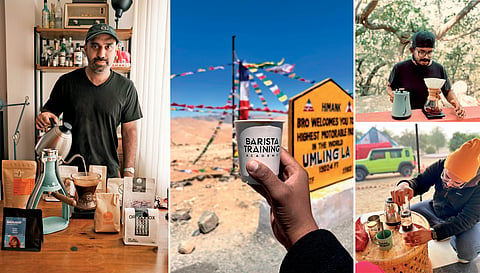
Take Aneesh Bhasin, for example. The 40-yearold entrepreneur and co-founder of Svami Drinks approaches coffee the way an audiophile approaches vinyl—with a respect bordering on the fanatical. His kitchen stash holds beans from Thailand, Hong Kong, Australia, Vietnam and India. Nothing about his process is accidental.
A cappuccino in Venice, at 21, after a night in a train station, was the sip that started it all. The coffee had no sugar, and the bittersweet hit of a well-made cup made him realise, ‘Oh? So this is what coffee tastes like’. “That moment changed a lot,” he says. “It tasted different. Really, really good. I had two or three more cups and was completely wired.”
Meanwhile, Rahul Mehra, founder of Stranger & Sons gin, fell for coffee the way some men fall for cars—by tinkering. “I’ve always been a liquids guy,” he says. Coffee was his first love, long before gin. He remembers cold brews, then boredom, then a hunt for more complex methods. The lockdown pushed him to a full espresso setup. “Even that’s getting a bit boring,” he says, adding with a laugh, “I don’t know where to go next after that.”
Across India, that curiosity is scaling fast. According to a recent report by Ken Research, India’s coffee machine market—valued at $298 million in 2024—is expanding steadily, driven by a growing consumer shift toward home-brewed coffee and the desire to recreate café-style experiences at home. Work-from-home routines have turned kitchen counters into cafés, while rising disposable incomes are fuelling investments in grinders, manual espresso machines, smart brewers and
accessories once reserved for commercial baristas.
Add to that a generation of Indian men travelling more, discovering global coffee culture and importing its rituals. If golf once had the chokehold on male leisure, coffee now wears the weekday crown.
These are men for whom pulling a perfect 25-second espresso shot at home carries the same cultural capital as showing off a well-stocked wine cellar. Men who own tampers more expensive than gym memberships, who’ll judge you for ordering a Frappuccino, and who don’t believe in Starbucks pit stops. Instead, they obsess over the perfect water temperature (Bhasin admits he cooled off after a phase of chasing half-degree increments) or, like Binny Varghese, educator and self-titled “coffeeologist”, champion coffee’s wild, endless plurality.
Varghese’s journey kicked off in roadside kitchens in Kerala, where coffee was oil-roasted with ghee, then blended with cinnamon and clove—the antithesis of pretentious café culture, but, as he’ll tell you, just as transformative. His years criss-crossing India and Nepal, teaching both baristas and regular Joes, convinced him coffee is “work and feeling.” At home, he’s shamelessly pragmatic—drinking only instant coffee. “I don’t mind it,” he says, nonchalantly. “It’s like when Anthony Bourdain says he eats instant noodles. You can appreciate the art and still enjoy the lowbrow stuff.”
While Varghese’s kit isn’t dripping with flashy accessories, he’s an exception to the rule. High-end coffee equipment has the same effect on men as turntables on DJs or carbon frames on cyclists. You can go minimalist—a moka pot and hand grinder—or you can go full Formula 1 pit crew with PID-controlled espresso machines, scales accurate to 0.1 grams, and milk pitchers shaped to improve latte art microfoam.
Bhasin, who enjoys the ritual of a pour-over more than the fuss of an at-home espresso, has a set-up that includes a Clever Dripper and a Hario V60 Switch—“cheap, last you a lifetime, and impossible to go wrong with.” Yet his dream machine is the Decent Espresso, a compact Hong Kong–made marvel that lets you adjust temperature mid-shot and store entire brew “recipes” in an app.
Meanwhile, Mehra’s workhorse is a “regular Italian espresso machine”. He collects tampers, trying different weights and shapes just to see how they change the shot. He’s flirted with novelties, like a stainless-steel coffee chiller ball you freeze before brewing to cool espresso without dilution, but admits most of these experiments end up forgotten in a drawer.
Coffee rewards precision and curiosity in real time. Change your grind size by half a notch, alter your water temperature by a degree and you’ve got a completely different cup. It’s science you can drink. Ask anyone who’s fallen down the rabbit hole, and they’ll tell you the same. “You start out thinking you just need a good machine,” Bhasin says. “Then you realise you need a good grinder. Then a better tamper. Then a scale. Then you start looking at water filters. And before you know it,
you’re adjusting mineral content in your brewing water.”
He laughs, but he’s not joking. The Specialty Coffee Association actually publishes ideal water chemistry guidelines. Men like Bhasin read and follow them.
That kind of devotion isn’t rare, it’s practically a requirement. And while their gear game may differ, what unites these men is an understanding that coffee gear isn’t just functional hardware—it’s the invisible architecture of the cup. Whether it’s Bhasin’s switchoperated dripper, Verghese’s steadfast burr grinder, or Mehra’s curated lineup of tampers, each piece is chosen with precision and respect for the drip.
They also all agree on the one tool that can make or break your coffee: the grinder. It’s non-negotiable. “Moving from pre-ground to whole beans is the entry point into better coffee,” says Bhasin, while Varghese, whose day job is demystifying coffee, calls a good burr grinder the best piece of equipment you can buy. Anything less than `40–60,000, and you’re not doing justice to your beans.
For many, their coffee ritual has become a language. For Bhasin, it’s connoisseurship. For Verghese, cultural anthropology. For Mehra, the real indulgence is time. “It takes 10 minutes, but I know exactly what I’m doing for 10 minutes,” he says. “It’s cathartic.” Whatever the language, in a country built on chai, coffee isn’t just the new ritual. It’s the power move.
To read more stories from Esquire India's November 2025 issue, pick up a copy of the magazine from your nearest newspaper stand or bookstore. Or click here to subscribe to the magazine