- Entertainment
- Style
- Lifestyle
- Food & Drinks
- Tech & Auto
- Culture

Let’s just get this out of the way: if you’re still buying pre-ground coffee, you’re drinking a memory of what your coffee could have been. The ghost of flavour. The phantom limb of a coffee bean. Real coffee people—yes, the ones who scoff at pods like they’re microwave dinners—will tell you that a grinder isn’t just a coffee enthusiast’s splurge. It’s probably the most essential coffee tool, a fine line between ‘meh’ and magnificent coffee. It’s the thing that makes or breaks your brew. You can buy Himalayan hand-picked-single-origin roast with the tasting notes of caremelised fig, but if you grind it wrong, it’ll taste like office sludge.
But fret not, if you’re the kind of person who’s reading this guide to coffee grinders, you’ve already made a few decisions in your life. You’re chosen to grind your own beans. And that alone puts you in a demographic that enjoys flavour and control.
So, let’s get serious. Here’s a very simple guide to picking out the perfect coffee grinder.
Coffee is 98 percent water and 100 percent details. And the grind is arguably the most important detail of all. Freshly ground beans retain oils and aromatics that pre-ground coffee loses faster than you lose interest in small talk at brunch.
Once the coffee bean is ground, its soul – its flavour profile, its nuance, its character will start to evaporate. Secondly, more than just freshness, a grinder determines grind consistency and that affects extraction. Too coarse and your coffee is underwhelming. Too fine and it’s too bitter. Get the grind’s size right, and you really unlock the bean’s potential like a caffeinated Goldilocks.
There are two main types of grinders.
Blade grinders are basically blenders for your beans. A spinning metal blade hacks away at your coffee. Now, there’s a reason you’ll find blade grinders in most homes: they’re cheap, available and easy. Unfortunately, so are bad decisions.
However, if you’re dipping your toes into the coffee world or you’re on a budget, this should do the job. However, it can give you an inconsistent grind size, which can obviously affect flavour. Also, the high-speed blade generates heat, which can cook the bean a bit (ew).
But are they completely useless? Well, no. If you’re brewing with a French press, or you’re new to the coffee world and don’t care that much, go for it. But don’t pretend like it’s doing anything nuanced.
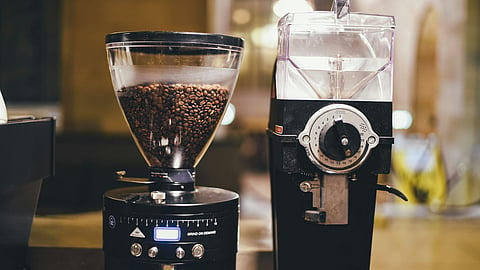
On the other hand, the real connoisseurs use burr grinders. Burr grinders crush beans between two abrasive plates—either flat or conical. This means you get consistent particle size, which is key to even extraction and better flavour.
A quick TL;DR on Burrs:
Flat Burrs: Precise, fast, but louder and more expensive. They’re loved by cafes and espresso nerds.
Conical Burrs: These are more common for hoe use. Quieter, easier to clean, and very consistent.
Now, the advantages of burr grinders are that they let you exercise precise control and give you excellent consistency. They’re ideal for espressos, pour-over, and AeroPress.
However they are more expensive and bigger, and take up a lot of counter space. So you better be dedicated if you’re splurging here.
But, hold on, it gets a little more complicated.
Ha, you thought we were done? So soon?
You think this is a cheap hobby?
So, if you’ve made it so far, ask yourself: do you want to break your swear or just press a button?
This is the equivalent of making your pesto with a mortar and pestle (what are we, plebians?) vs. making your pesto in your NutriBullet. However, one must accept: there’s a romance to doing it manually. You’re involved. You’re present. You’re owning that grind. Manual grinders are portable and often cheaper. They’re great for travel as well. However, they’re slow and tedious. Also, they’re not great for multiple cups…unless you want to get an arm workout in.
But if you romanticise handwritten letters, go for it.
Meanwhile, electric grinders do the heavy lifting while you sip water and contemplate life. They’re fast, efficient, have many grind settings, timers, and dosing control. But yes, they’re noisier and are definitely more expensive.
Still, manual grinders have their place. Many of them, like the ones from 1Zpresso or Timemore, offer burr-level consistency in a travel-friendly form.
Espresso: Fine, almost powdery.
Pour-Over/AeroPress: Medium-fine (you want the water to flirt, not rush).
Drip Coffee: Medium.
French Press: Course, big chunks, full body.
Cold Brew: Extra coarse, like sea salt.
Picking the right coffee grinder is less about what the internet says is “best” and more about what fits your lifestyle. If you’re just getting started, a basic blade grinder will do—just know its limitations. If you’re inching toward coffee nerdery, a mid-range conical burr grinder will change your coffee game.
But be patient, it takes time to get it right.