
- Entertainment
- Style
- Lifestyle
- Food & Drinks
- Tech & Auto
- Culture
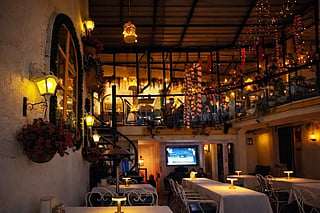
Ask anyone who has grown up in Delhi and you'll get a small speech, unprompted, on why Delhi's food is practically doctrine. They're usually right or, at the very least, their restaurant recommendations rarely miss.
The seven restaurants here are the reason: rooms built around a banyan tree older than the neighbourhood, a chef who spent years learning recipes in the villages they came from, a haveli with the Qutub Minar sitting outside the window. Here is the list we came up with, in no particular order:

Chef Shri Bala spent a decade travelling through the villages and temple towns of the peninsula before she ran a professional kitchen, and Nadoo is what that decade looks like when it's translated into a restaurant. The space, designed as a nod to co-founder Sahil Sambhi's childhood home in Bengaluru, leans on rammed-earth walls, brass inlays, and a swing at its centre instead of the usual marble-and-mood-lighting formula. It's the rare Delhi restaurant that treats south Indian food as five distinct states rather than one flattened cuisine, and the room is built to match that specificity.
Housed at Ambawatta One with the Qutub Minar for a backdrop, Mi Piaci is the result of a team that grew up in Italy and brought its very best back home. The dining room is deliberately unshowy, all white walls and restrained interiors, because the focus is the open kitchen where pasta is made fresh every day and a wheel of Parmigiano is rolled tableside. It opened without a single celebrity endorsement and was booked solid within a week, which tells you something about what a restaurant built on craft can do in this city.
Architect Anurag Dania built the space around a 500-year-old banyan tree and a design language borrowed from Geoffrey Bawa, so the courtyards blur indoor and outdoor in a way few Delhi restaurants attempt. You arrive by golf cart, coconut water in hand, and the noise of the city recedes. Inside, the menu draws on Sri Lankan staples such as the banana-leaf-wrapped lamprais and street-food mainstays like kotthu. Delhi has worked with Sri Lankan flavours in pockets, but Zetu is the first restaurant here to commit to the cuisine's full range rather than a few borrowed dishes here and there.
Sevilla has been Delhi's go-to for candlelit, tapas-and-Sangria romance for long enough that it's institutional at this point, and a recent overhaul under a new Spanish chef has kept it from calcifying into a nostalgia act. The alfresco setting, tucked slightly apart from the main hotel building, is still the draw: outdoor cabanas, live music, and a curated wine list.
Positioned as the intimate sibling to Delhi's Call Me Ten, She's Here works a Japanese-Italian hybrid the industry calls Wafu, inside an 80-cover space designed by Renesa Architecture. Terracotta brick, timber panelling, and a teppanyaki grill at the far end give the room a warmth that its parent restaurant doesn't go for.
Cafe Dali began as a pandemic-era delivery brand run out of a founder's basement, which makes its current life as a chandeliered, library-lined homage to Salvador Dali and Surrealism a fairly dramatic upgrade. The interiors go all in on old-world Florence: vintage portraits, deep wood shelving, candlelight giving the room all of its intimacy.
Mia Bella sits inside Hauz Khas Village proper, away from the market noise, with a terrace that looks straight out at the old monument and the lake beside it. The décor takes its cues from an old Portuguese villa rather than committing fully to the Italian name, all ochre and green and hand-painted detailing that makes the room feel lived-in. Despite HKV's reputation for getting louder and more commercial by the year, Mia Bella has held onto a slower, terrace-drink kind of pace.