
- Entertainment
- Style
- Lifestyle
- Food & Drinks
- Tech & Auto
- Culture

There's a cocktail at Vietnam-ease Càphê that contains actual pho broth. Not a pho-inspired bitters, not a vague gesture toward star anise — the real broth, the one they simmer for six or seven hours, poured into a glass with sake, a splash of chardonnay, and a tangle of crispy pho noodles on top. It's called Pho Real, which is exactly the sort of pun that should be unbearable and somehow isn't, because the drink earns it. The first sip is savoury and a little confusing. The second one settles. By the third, you’re literally asking for another drink.
Vietnam-ease Càphê opened its first proper home in September 2025, on the ground floor of Global Foyer in Gurugram's Sector 43 — a two-storey space with warm lighting, wooden tables, a private dining room, and a corner of books. But the restaurant is really six years old. It just spent most of that time without a roof of its own.
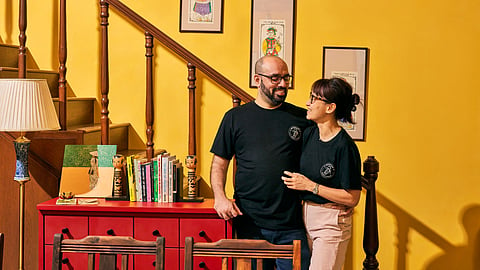
It began in a basement. Specifically, the basement of Dhruv Kalra's house, with rented tables and plastic chairs and, for a long stretch, no chairs with backrests at all. Dhruv handles the hospitality side; his wife, Trang Nguyen, is the chef. In 2019, they started inviting strangers over for a four-course, three-hour dinner, mostly to find out whether anyone in India wanted what they were offering.
"Once we decided to invite strangers to our table, there was no more time for doubts and fears," Trang told me. People came. Bookings grew. A family of twenty turned up at once. Then the pandemic hit, and they shifted to delivery out of Dhruv's parents' house, where Vietnamese food got cooked next to Punjabi meals and the kitchen staff met fish sauce for the first time.
The fear, for Dhruv, was never that people wouldn't show up. "The fear was that they would come and leave thinking Vietnamese food wasn't for them," he said. It's a specific kind of dread, and it explains a lot about how they've built the place since.
The two of them met by accident. In 2015, Dhruv was helping a friend run a guesthouse in Manali when some friends from Delhi arrived with a girl they'd met on the bus. That was Trang, who'd grown up between Vietnam and Germany. Dhruv had fallen for Vietnamese food years earlier in Canada, where he did his MBA and discovered that a bowl of pho was the most reliable cure for cold weather and homesickness alike — he'll happily tell you that, like Anthony Bourdain before him, all he really wants out of life is a good bowl of soup. He and Trang started cooking obsessively together, put their plans on paper in 2018, and took a long trip through Vietnam. On a walk near Hoan Kiem lake in Hanoi, they decided the turtle — courage, longevity, heritage — would be their symbol.
Six years on, I asked Dhruv whether the turtle had survived contact with the realities of running a restaurant. It had, and it earned its keep in the worst stretch. "The turtle became most meaningful during COVID," he said. "Then we weren't thinking about growth, we were thinking about survival. The turtle reminded us that progress doesn't need to be fast, it just needs to continue."
What I ate would have convinced me on its own. The thing to order, and I'll be annoying about this, is the Vietnamese rice paper pizza: crispy grilled rice paper, minced meat and prawns, and caramelised onions that made me unreasonably happy. Then the bánh mì, rightfully their most popular thing — BBQ pork, smoked pâté, Vietnamese pickles, sriracha mayo, all packed into airy, crackling baguette-style bread. The pho is Trang's family recipe, the broth simmered for hours until it lands somewhere both simple and deep. There were fresh summer rolls heavy with herbs and prawns, a bún trộn noodle bowl with lemongrass chicken, a mild and comforting Vietnamese cà ri scented with lemongrass and coconut, and bánh khọt — crispy little rice-flour pancakes you wrap yourself, which is exactly as fun as it sounds.
The hosting helps. Dhruv and Trang still work the room the way they must have in that basement, drifting over to your table to tell you what a dish is, where a drink came from, why the broth tastes the way it does. You leave with a meal and a fair amount of Vietnam attached to it, which is plainly the intention.
None of it is dumbed down, and that turns out to be the whole point. A good chunk of the menu is hyperlocal — dishes most Indian diners have never encountered — and I wanted to know what they'd refused to soften for the sake of selling more.
"The thing we refused to compromise on wasn't the food," Dhruv said. "It was our belief in diners." He's allergic to the assumption that everything has to be louder and spicier to work here. "We always believed people are far more adventurous than the industry gives them credit for."
Which brings us back to the bar. The cocktail menu is called Ký Ức Trong Ly — Memories in a Glass — eight drinks mapped north to south across Vietnam and built from sake, soju, beer and white wine. It would be easy for a list like this to tip into novelty for novelty's sake. It doesn't, because the drinks are made of things that already live inside Vietnamese cooking. Hanoi Old Quarter pairs soju and rosé with citrus and edible camphor, and tastes — weirdly, wonderfully — like the way a temple smells. Imperial Hue goes the other direction entirely: fish sauce, peanut, raw papaya pickle, chenin blanc and beer turned into a kind of shandy, with the fish sauce rounding the whole thing off and the sour papaya pulling you back for another sip. Da Lat Highland closes the map with coffee, condensed milk foam and robusta, basically a dessert.
So I asked Dhruv where the line falls between honouring a place and turning it into a gimmick. His answer was the cleanest thing anyone said all evening. "If you're using fish sauce in a drink because it belongs there, that's respect," he said. "If you're using fish sauce as an ingredient because it sounds good for Instagram, that's a gimmick."
Meanwhile, Trang is the reason any of this tastes the way it does, and she carries her two countries into the kitchen on purpose. Vietnam gave her instinct and discipline; Germany, where her family were immigrants, gave her something blunter. "Curiosity and nostalgia — those were my first ingredients," she said. "Germany added one more thing: be honest and direct, even with yourself. There's always room to grow." She cooks, by her own cheerful admission, everything — sauerkraut, kimchi, roast chicken, churros, hotpot, dog biscuits for the many dogs at home. "Even they deserve quality and delicious food," she said.
Being the chef also makes her the unofficial translator for an entire country's cuisine, which is a quiet sort of pressure, particularly in a country with very few Vietnamese people in it. She told me about a guest from Hanoi who left a note calling her a "good chef." "Translated in our Vietnamese scale of excellence, that means pretty good," she said, and you can hear the pride. The dish that earned it was bún chả, plated by a team she's trained to attempt something most Indian kitchens never have: Vietnamese flavour built without the usual aromatics, through technique and time instead.
Ask her which dish tastes most like home and she stalls, because there are at least five. "My all-time favourite is Phở," she said. "Growing up in Germany, every Sunday was Phở Sunday. It's what I crave when I'm homesick." Bánh cuốn, the silky steamed rice rolls, she keeps for her younger sister, who loves them.
There is also the matter of being married to your business partner. The best part, Trang said, is getting to build and live their dreams in the same place. The worst is switching off. "By the end of the day, we're not just business partners — we're soulmates," she said. Dhruv described the same problem from the other side: "The hardest part is learning when to stop being co-founders and start being husband and wife again."
Selling Vietnamese food to Gurugram is still, by any honest measure, a bet, and I asked Dhruv what the most expensive lesson had been. It wasn't what I expected. "Growth can be a distraction," he said. "Every time we moved away from what made us special, we paid for it" — whether that meant stretching the menu too thin or chasing a trend that was never theirs.
So they've stayed small, specific, and a little stubborn, which is about the most flattering thing I can say about a restaurant. Six years ago, Dhruv said all he needed to be happy was a good bowl of soup. I asked if it was still true. "Give me a few quiet minutes alone with a hot bowl of Phở," he said, "and I'm still happy." On the evidence of everything else on the table, he isn't the only one.