
- Entertainment
- Style
- Lifestyle
- Food & Drinks
- Tech & Auto
- Culture

In the outskirts of Bengaluru, on a 37-acre farm where mango trees yield both fruit and cooking fuel, chef Johnson Ebenezer and co-founder Kaushik Raju have cultivated something as rare as it is resonant: a culinary philosophy that transcends trends. Recently honoured with the prestigious American Express One To Watch Award—a recognition that spotlights dining establishments with exceptional potential—Farmlore represents the culmination of Ebenezer's 28-year journey through kitchens from Chennai to Malaysia, one where he nearly abandoned his vision before finding validation in the most organic of ways.
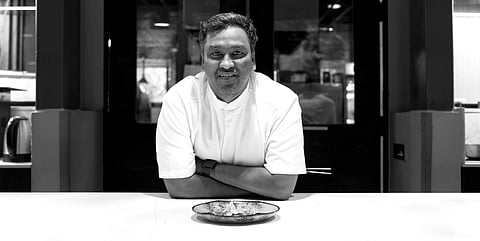
But Farmlore is more than just a future contender for the 50 Best List. At its heart stands Ebenezer, a Chennai-born chef whose career arc from Michelin kitchens to this 18-seat farm restaurant reveals a restless creative mind. His vision for Farmlore is both radical and reverent: dishes that don’t just feed but provoke thought. Consider Seataphor, his meditation on ocean pollution rendered in Kochi snapper, edible plastic, and charcoal oil: his cuisine challenges diners to engage, reflect, and, above all, savour.
"For me, cooking is about exploration," Ebenezer tells Esquire India in an exclusive conversation, revealing how a pandemic-shuttered city restaurant concept evolved into this more intimate, profound experiment—one that, after four years of quiet evolution, has now captured international attention.
Excerpts from a conversation.
Farmlore has been recognised with the American Express One to Watch Award. How do you feel about this—both personally and professionally?
Personally, I think this award is a testament to something I’ve been working towards for years—28 years, in fact. There was a point when I almost wanted to give up. Not give up on cooking, but on the idea that being fully organic, putting yourself out there, and staying true to your philosophy would ever get the recognition it deserves. But then, when the call came in, I was elated.
You May Also Like: Chef Gresham Fernandes’ Tech-Driven Food Table
Professionally, it means a lot as well. I’ve always been very honest in my approach—how I cook, how I’ve been brought up in the industry. The one person who believed in me and supported me all the way was my co-founder, Kaushik Raju. I owe it all to him.
What was the moment you knew you wanted to build something like Farmlore?
I’ll be very honest—initially, it was going to be a restaurant in the city. We were going to call it Lore because I’ve always loved telling stories through food. The idea—of using food as a medium for storytelling has always been at the back of my mind. Kaushik and I had decided on the name Lore, and he was fully on board with the idea of building a dining experience centred around storytelling. But then COVID happened, and Lore never took off.
That’s when we started thinking smaller—more intimate. Kaushik had this farm, and one day he showed it to me. It already had mango trees, coconut trees, and all sorts of fruit-bearing plants. There was an existing ecosystem in place. And that’s when it clicked—why not build something here? The name Farmlore came naturally, blending the essence of folklore with the farm-to-table concept. And that’s how the journey started—about five years ago.
Every dish at Farmlore tells a story, but is there one dish that is particularly personal to you?
I’ve never really believed in the idea of a signature dish. For me, cooking is about exploration—what I want to create today might be different from what I want to cook tomorrow. So, I’ve never held onto a single dish as my defining creation.
That said, there are certain ingredients and dishes that hold deep meaning for me. One in particular is Seataphor. It’s a dish that serves as a metaphor for how we contaminate the ocean with oil spills and plastic waste. I wanted it to be more than just food—it’s a statement, visually mimicking the pollution that threatens our waters, a conversation starter.
Farm-to-table is a widely used term, sometimes a buzzword. What truly defines it, and how does Farmlore go beyond the label?
Many misuse farm-to-table, especially in India, where it’s reduced to aesthetics sometimes. For us, it’s a way of life. When we started, the land had mango trees, and pruning them left us with tons of wood. That sparked an idea—what if we cooked solely on firewood? No gas, no stoves. Cooking on mango wood changes everything—the flavour, the technique, the discipline.
Beyond cooking, we built a self-sustaining ecosystem. Kaushik installed solar panels, and now the restaurant runs entirely on solar energy. Farm-to-table isn’t just about local ingredients—it’s about aligning everything, from cooking methods to energy, with nature.
You May Also Like: Chef And Author Sadaf Hussain On Masalas, Memories And A Man’s Kitchen
There’s a strong sustainability focus on the farm as well.
Absolutely. Kaushik introduced hydroponics to ensure a year-round supply of fresh produce. We now have 13 drip-irrigated pods growing tomatoes, leafy greens, and essentials, alongside traditional soil-based farming for carrots, beets, and onions.
We also have 22 free-roaming cows that sustain our ecosystem and provide fresh milk. Out of respect for them—and due to beef’s high carbon footprint—we chose not to serve it at Farmlore. It’s a small but intentional step toward sustainability.
You change your menus monthly. How do you keep that creativity flowing while maintaining consistency in your food? Is that challenging at times?
Not really, because I focus on teaching my team the right techniques. Once they understand the techniques and the science behind them, they can replicate dishes consistently, without second-guessing. I don’t confine myself to a single philosophy or cuisine—I consider my approach eclectic. I draw inspiration from around the world, then adapt those influences using local ingredients and techniques. It’s a blend of creativity and science, and when you understand both, execution becomes much easier. At the same time, I think after 28 years in the industry, you develop an instinct for these things.
So what’s next for you? Have you thought about expansion plans or any new exciting new plans for the restaurant?
Over the past four years, Farmlore has been an 18-seater restaurant. But just last year, we expanded the space, and now we’re introducing a new concept—a private dining space where we tell stories through food. It’s going to be an immersive, sensory-driven experience, allowing us to control the narrative in a more intimate way. That’s the immediate expansion.
On a personal and professional level, I feel like I’m just getting started. I might be a late bloomer, but this is where the real journey begins. I’m excited to explore stories from across India, take our philosophy of storytelling through food to a global stage, and collaborate more widely. For the last four years, Farm Lore has been contained within its space, but now you’ll start seeing us cooking beyond our own walls. We’re ready to explore.
Lastly, what are your favourite restaurants in India?
O Pedro in Mumbai, La Loca Maria in Mumbai, and Southern Spice, where I started my career, will always be special to me. Lastly, Kopitiamlah in Bengaluru.