- Entertainment
- Style
- Lifestyle
- Food & Drinks
- Tech & Auto
- Culture

Sci-fi is where philosophy meets popcorn. Where existential dread gets dressed up in spacesuits. Where we reimagine humanity’s best and worst impulses, just with more tentacles or time-travel rules. Sci-fi isn't just about aliens, laser swords or black holes—though, let’s be honest, that helps. It's about asking the big questions in the most cinematic way possible. What makes us human? What if we weren’t? And, more urgently, what if Jeff Goldblum had to hack an alien mothership using a 1996 MacBook?
You May Also Like: The Best Comedy Movies Of All Time
So, in true Esquire fashion, we’ve cobbled together the perfect list of sci-fi gems. Some are cerebral, some are chaotic, some involve Keanu Reeves dodging bullets in a trench coat. These are the films we keep going back to—because they entertain, yes, but also because they quietly (or not so quietly) whisper to us about who we are, and what we might become. Or maybe we just like seeing things explode in zero gravity.
Either way, here’s our definitive sci-fi starter pack.
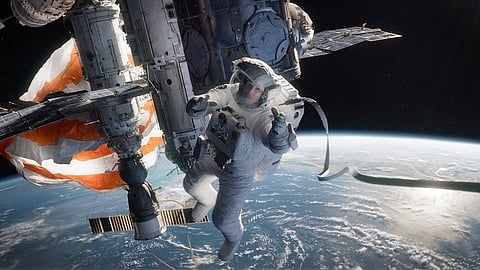
The opening shot alone is worth the price of admission: a slow, 13-minute continuous take that drops you right into the abyss. Alfonso Cuarón’s Gravity isn't just a technical marvel—though it is that, and then some—it's a claustrophobic anxiety dream set in the infinite openness of space. Sandra Bullock floats, spins, gasps, and survives as Earth looms ever out of reach. Forget aliens; the real terror here is isolation, silence, and the smallness of human life. It's weightless, yet heavy. Space opera, without the opera. One of the most visceral cinematic experiences of the 2010s—and best watched in pitch dark with your phone off.
This is not a drill. Will Smith knocks out an alien with a single punch and says, “Welcome to Earth.” It’s everything good and ridiculous about ’90s blockbusters in one go-for-broke explosion-fest. Independence Day doesn’t pretend to be anything but fun—Roland Emmerich’s shamelessly overblown alien-invasion flick is full of macho speeches, Jeff Goldblum being Jeff Goldblum, and a level of destruction that made the White House blow-up scene instantly iconic. It’s sci-fi as disaster porn, unapologetically camp and patriotic. You don’t watch it for nuance. You watch it because it makes the apocalypse look cool.
A cabin in the woods. A reclusive tech genius. A robot who might be smarter—and more manipulative—than both of them combined. Ex Machina is sleek, eerie, and uncomfortably intimate. Alex Garland’s directorial debut traps you in a minimalist hellscape of cold glass and colder intent, where Domhnall Gleeson’s naive programmer plays Turing games with Alicia Vikander’s uncannily human AI. Meanwhile, Oscar Isaac drinks, dances, and destroys. It’s Black Mirror by way of Bergman: all heady ethics and tight, clinical tension.
Imagine if The Hunger Games was set on a train built by climate apocalypse billionaires. That’s Snowpiercer: Bong Joon-ho’s delirious class-war-on-wheels. The last of humanity is crammed into a perpetually moving train, where carriages double as socioeconomic tiers. Chris Evans leads the rebellion from the grimy back to the decadent front, where Tilda Swinton chews scenery like protein blocks. Violent, weirdly funny, and deeply political, it’s sci-fi that lurches between comic-book surrealism and real-world rage. Bonus points for featuring the most anarchic sushi scene in cinema.
You May Also Like: 6 Indian Films That Never Released In India
Stanley Kubrick didn’t just make a film—he made a cinematic monolith. 2001 is both science fiction and sacred text. It spans from the dawn of man to the rebirth of the star child, with a healthy dose of AI paranoia and space ballet in between. HAL 9000 is cinema’s most chilling robot, and he doesn’t even move. The film is slow, yes, but purposefully so—each frame composed like a religious painting. It’s baffling, brilliant, beautiful, and oddly prophetic. Not a casual watch, but then, neither is enlightenment.
Michael J. Fox rides a time-traveling DeLorean back to the ’50s and almost erases his own existence by accidentally flirting with his mum. That sentence alone should sell the film. Back to the Future is a paradox playground, but it never gets bogged down in its own cleverness. Robert Zemeckis’ sci-fi comedy is pure pop filmmaking—tight, bright, endlessly rewatchable. The rules of time travel may be nonsense, but they’re fun nonsense. Hoverboards, flux capacitors, and Doc Brown’s hair all included.
Is Deckard a Replicant? We still don’t know, and honestly, that’s the point. Ridley Scott’s Blade Runner is moody, melancholic, and soaked in neon noir. It’s a detective story wrapped in existential dread, set in a future Los Angeles where it always rains and everything is slightly broken. Harrison Ford’s stoic blade runner hunts down rogue androids who want more life, dammit. Rutger Hauer gives the performance of his career, delivering a death monologue that still haunts sci-fi lovers decades later. Beautiful, brutal, and forever bleeding into pop culture.
The lightsaber duel. The snowy battle of Hoth. “I am your father.” Empire is the darker, deeper, more emotionally resonant second act of the original trilogy. It expands the Star Wars universe, not just geographically, but psychologically—Luke’s Jedi training becomes a spiritual journey, Han and Leia’s flirtation turns real, and Vader becomes a tragic, Shakespearean figure. It’s still pulp, but elevated pulp, full of mythic weight and model work that still holds up. Less hopeful than A New Hope, but infinitely cooler.
You May Also Like: Best Animated Movies Of All Time
What if the world around you is a simulation, and reality is just lines of code? The Matrix asked that question—and changed cinema forever. The Wachowskis’ cyberpunk classic fuses kung fu, philosophy, hacker culture, and leather trench coats into something impossibly stylish and deeply subversive. Keanu Reeves becomes The One, dodging bullets and questioning everything. Beyond the bullet-time spectacle lies a surprisingly tender and queer-coded narrative about transformation and truth. It's the rare sci-fi that launched a thousand think pieces and Halloween costumes.
Aliens land. But instead of war, we get linguistics. Arrival is a slow-burn marvel that swaps spectacle for subtlety. Amy Adams plays a linguist tasked with decoding the language of heptapod visitors, only to realise that communication might alter the very structure of time. Denis Villeneuve directs with elegance and restraint, building a mood of hushed awe and quiet devastation. It’s a film about language, grief, and what it means to understand another being.
It’s 2029, and consciousness is code. In a society run by vast electronic networks, humans wear cybernetic suits that digitise their very sense of self — the “ghost” in the “shell.” But Ghost in the Shell is less about slick futurism and more about slippery philosophy. What makes us human? Is identity just a string of memories waiting to be copied and pasted? With its noir aesthetics, haunting choral soundtrack, and a protagonist who’s more philosophical than heroic, this Japanese anime became a cornerstone of cyberpunk, influencing everything from The Matrix to Westworld. Moody, meticulous, and mesmerising, it's a film that feels like a dream you half-remember — or maybe just a file left open on your mental hard drive.
Frank Herbert’s epic was long considered unfilmable — too dense, too weird, too full of space worms. And yet Denis Villeneuve pulled it off with a kind of cinematic swagger rarely seen in sci-fi. This Dune isn’t just a film; it’s an atmospheric juggernaut. The ornithopters roar, the sandworms rise, and the score (Hans Zimmer on full blast) rattles your bones. Yes, the plot is a heady mix of messianic prophecy and interstellar colonialism, but Villeneuve never panders — he trusts the audience to keep up, or at least be swept away. It’s a visual and sonic experience first, a political parable second, and a reminder that blockbuster cinema doesn’t have to compromise on ambition.
You May Also Like: Highly Recommended Movies To Watch Based on True Events
If you didn’t cry watching E.T., you may be legally classified as a robot. Spielberg’s suburban fairy tale about a lonely kid and a marooned alien is peak '80s movie magic — BMX bikes, glowing fingers, John Williams making your heart swell like a balloon. But beneath the Reese’s Pieces and alien hugs, it’s really about growing up, letting go, and feeling a little lost in a world that doesn’t make much sense. E.T. doesn’t say much (his vocabulary’s mostly limited to “home”), but he doesn’t need to. The bond is the whole thing. It’s soft sci-fi — more about emotion than explosions.