
- Entertainment
- Style
- Lifestyle
- Food & Drinks
- Tech & Auto
- Culture
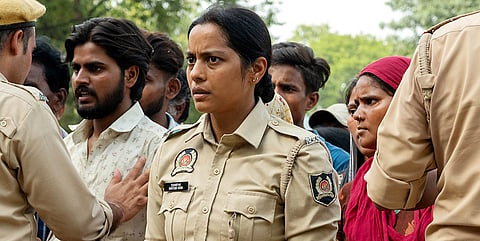
The recent uproar surrounding the stalled release of the Shahana Goswami-starrer, Santosh, has reignited a debate that’s been simmering for quite some time. If a film is created in India, about India, but isn’t allowed to be viewed in India, who exactly are these rules meant to protect?
When a movie gets silenced, is it out of fear that it might stir up chaos, or is it because it could provoke thought? You come across a film like Gandu (2010), a black-and-white fever dream filled with rebellion and rap, and you can’t help but wonder, "How come I’ve never heard of this before?" Or perhaps you catch wind of Unfreedom (2014), a film so controversial that the Indian censor board didn’t just cut it down, they refused to let it see the light of day in the country.
You May Also Like: New Movies Releasing In April 2025
And here’s the twist—these films weren’t just obscure indie projects lost to time. They found audiences overseas, sparked underground conversations, and made a comeback through streaming platforms. But in India? They were shut down before they even had a fighting chance.
Take, for instance, Monkey Man (2024). Dev Patel's directorial debut, while not an 'Indian' film was certainly set and about India. Yet, despite winning laurels across the globe, the film never found a release in the country it's set in.
With all the recent buzz surrounding Santosh, where the creators had to battle just to preserve their film’s political message, let’s explore some of the other notable films that were considered too ‘risky’ for Indian viewers.
You May Also Like: Made in China: The Films You Must Watch
Directed by Q (Kaushik Mukherjee), Gandu tells a raw, nihilistic story about a young man who feels trapped in the dullness of his life, finding solace in his rap dreams.

While it gained acclaim at international film festivals, it was deemed so controversial in India that even underground showings sparked outrage. Ironically, it eventually found its way to Netflix, reminding us that while censorship might delay art, it can never truly erase it.
Anurag Kashyap’s Paanch was meant to be his big directorial debut. This crime thriller, which draws loose inspiration from the infamous Joshi-Abhyankar serial murders, was unapologetically violent, chaotic, and filled with drugs, moral decay, and absolutely no redemption in sight.
Naturally, the censor board had a meltdown over it. They believed it glorified violence and drug use. Kashyap stood his ground, but despite several edits, the film never made it to theatres.
You May Also Like: New OTT Movies And Shows Releasing In April 2025
Raj Amit Kumar’s film, Unfreedom, weaves together two powerful narratives—one exploring a lesbian relationship and the other delving into Islamic extremism.
When India’s censor board got a glimpse of it, they didn’t hold back; they banned it without a second thought. They claimed it would “incite violence.”
Sridhar Rangayan’s The Pink Mirror was among the first Indian films to shine a light on trans identities. Yet, rather than receiving the recognition it deserved, it faced a ban for being labeled “vulgar and offensive.”
The film gained popularity overseas and became a hit at film festivals. Unfortunately, back in India, the very individuals it aimed to represent were left without the opportunity to watch it.
You May Also Like: Classic Films Every Man Must Watch
This Punjabi film tells the story of the men who took the life of Indira Gandhi. Unsurprisingly, it was considered too controversial and ended up being banned completely.
Some people say it glorified the assassins, while others think it was just trying to present a piece of history. Regardless, India never had the chance to make its own judgment on the matter.
Drawing inspiration from Ismat Chughtai’s powerful short story that delves into the theme of repressed desires within a patriarchal society, Lihaaf has found a warm reception at international festivals.
However, it has mostly flown under the radar in mainstream Indian cinema. Even now, with its scarce screenings, many Indians remain unaware that a film adaptation is out there.