
- Entertainment
- Style
- Lifestyle
- Food & Drinks
- Tech & Auto
- Culture

Vidya Balan in Tumhari Sulu and Jalsa. Shefali Shah in Jalsa. Bhumi Pednekar in Daldal. And now, in his new Netflix release, Maa Behen, Madhuri Dixit-Nene and Triptii Dimri. There is a very obvious question here waiting to be asked of the man that is known to cast some of the most capable women performers of our times in some of the finest feminist films of the last decade.
And Suresh Triveni doesn’t disappoint, clapping back with “You left Subedaar out,” referring to the lone man-fronted listing in his recent filmography. “As a filmmaker, you just reflect upon your own experiences. I look back and see one of my favourite filmmakers, Sai Paranjpye, doing a Chashme Buddoor (1981). You have someone like Zoya Akhtar, directing Zindagi Milegi Na Dobara (2012). I have a problem with this conversation around women telling women's and men telling women's stories. Yes, we need a lot more women filmmakers, but what’s more important is that more stories with women as protagonists need to be told,” he says.
But Suresh Triveni is a ladies' man.
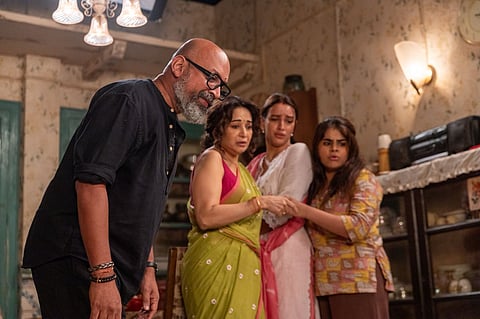
Maa Behen, a comedy following a middle-aged woman and her daughters in the nosy neighbourhood of an Indian town, has rekindled the conversation around everyday sexism and female objectification in India. A single mother (Dixit-Nene) and her daughters (Dimri and Dharna Durga), assailed endlessly with small-town-style slander, slut-shamed and witch-hunted in the most casual manner. What Triveni, and writer Pooja Tolani’s script, do exceptionally well, is puncture the inactionable theory with frothy feminine irreverence. The rage is delivered with the pointed end of the butter knife that’s Dixit-Nene’s comic timing.
“I was greedy to have Madhuri Dixit back, centre and lead, because I think she’s one of the finest talents we have burdened with a lot of superstardom,” Triveni says, reluctant to comment on whether his lead star playing mum to a current actor could show a light to her male contemporaries on the art of shining in age-appropriate parts.
Dixit-Nene’s character wears a sleeveless blouse in the film, an object that has accumulated considerable shock appeal in the realm of Indian domesticity. An online take dismissed it as a “lazy way to stage conflict”, and Triveni, who reflects actively on the kind of things that are said about his work, suggests that the blouse be seen as a metaphor for “choice”. Simply because in most outcomes of sexism and patriarchy, that is what women are most often denied.
“It’s a tool in the film, and it serves as one at a crucial moment in the film. And elsewhere, it really stands for a choice and is nothing literal,” he adds.
Since Tumhari Sulu, Triveni's men have been constructed with a flawed humanism, be it Subedaar or Maa Behen. In his newest film, a quartet of male actors provide robust support to the female leads, each with his own tics and character maps. His brief to Shardul Bhardwaj, who plays Dimri's slovenly husband who sleeps with eyes wide awake, was to be a reptile.
“He actually crawls in each scene. My inspirations for him were two characters—Annu Kapoor in Chameli Ki Shaadi (1986) and Fahad Faasil in Kumbalangi Nights (2019). In fact, in the chappal scene, Triptii shines also because of the terrific job he's done.”
The third pillar of the lead trio of the film is Dharna Durga, the content creator known for her comic sketches from middle-class life, playing a character very close to herself. Triveni's perspective on casting creators is a fresh one, and he states it quite vehemently. “She's a terrific actor. You cannot slot things in that manner right now when the world is blending this way. It's not their crime they have followers. And I didn't even need followers—I have Madhuri Dixit in the lead. I have Triptii Dimri, I have Ravi Kishan. I have Netflix backing me.”
While on the subject of choices, Triveni makes quite a few interesting ones in Maa Behen, such as deploying a saturated colour palette and mise-en-scène that’s very obviously a set. He tells me it comes from the world of Hindi and Malayalam magazines for women. “I could have done this in a real space and all, but I wanted a distinct character for my film to stand out personally. I come from the school of Hrishikesh Mukherjee and Gulzar—the world of Angoor. That was why I wanted a distinct personality to my own film. That inspired the imagery and dialed-up tonality of my film.”
And then, there are the self-implicating flashback scenes, upended later by Rashomonic expositions, exaggerated in a comic-book manner because they are all about rumours. “And rumours hardly have details. The absurdity you notice is a physical manifestation of all that exaggeration.”
This Gulzar-directed classic is a compulsory listing in the comedy-of-errors canon. Two pairs of identical twins, switched at birth, go on to create chaos—mistaken identities, wronged wives, baffled servants—in what remains the gold standard for Hindi farce.
Literally, ‘Mahesh’s Revenge’. Beaten up by an outsider after attempting to resolve a brawl in his own town (gorgeous Idukki), studio photographer Mahesh vows retribution, in this masterful Dileesh Pothan dramedy. Until that day comes, he vows to go shoeless!
A government employee stuck with the rubes in a nondescript rural hamlet is a premise you’re definitely familiar with. In this French indie directed by Dany Boon, a postal service official from the Riviera is exiled to the Nord-Pas-de-Calais, a region his southern countrymen regard with horror. The joke, eventually, is on him.
The Coen Brothers’ body of work is all about the reinvention of comedy. Bumbling CIA agents, Russian spies, stolen information and the ones stealing it—a pair of not-so-smart gym employees—Burn After Reading is wacky, screwball fun.
In this KS Ravikumar black comedy, Kamal Haasan is Ram, a playboy pilot whose marriage falls apart due to one misunderstanding after another. His friends hire an escort named Maggie to help him get over the wife, but they land in a soup when she ends up dead.