- Entertainment
- Style
- Lifestyle
- Food & Drinks
- Tech & Auto
- Culture

I was a mere, wide-eyed teen when I decided to watch the ‘Lord of The Rings’ trilogy. And oh boy, I didn’t just watch the trilogy. Nuh-uh. I watched the extended, four-hour long, director’s cut version of all three movies.
Sure, I lost three days. But what did I gain?
Let’s face it — Peter Jackson’s Middle-earth saga is a lot. Six films. Nineteen hours. Entire forests of dialogue about rings, kings, and second breakfasts. But somewhere between the Oscar glory of Return of the King and the bloated CGI chaos of The Battle of the Five Armies, the franchise went from groundbreaking to a permanent cult. Some are masterpieces of myth-making, and the Lord of The Ring trilogy and The Hobbit are a few of them. The Peter Jackson-directed Lord of the Rings trilogy didn’t just raise the bar for fantasy—it redefined what modern epic filmmaking could be.
We love the trilogies. We do. Viggo mortensening his way through Mordor? Iconic. Gollum talking to himself like a cracked-out method actor in a cave? Cinema. But it’s also fair to say not every film in the saga holds up like Mithril under pressure. Peter Jackson’s ‘Lord of the Rings’ and ‘Hobbit’ trilogies gave us everything—big battles, tiny hobbits, Oscar sweeps, meme gold, and enough fake endings to last a lifetime. But when you lay them all out, some entries are clearly the Gandalf-tier greats, and others… well, they’re just there for the ride (or the ride of the Rohirrim).
You May Also Like: 19 Classic Films Every Man Must Watch
So here it is: the definitive ranking of all six Middle-earth films — from the ones that changed fantasy forever to the ones that should’ve stayed in the Shire.
You don’t win 11 Oscars and walk away quiet. Return of the King isn’t just a finale—it’s a victory lap. A coronation. The moment Middle-earth officially entered the halls of cinema’s greats. Sure, the multiple endings may have tested the average bladder, but they also allowed Peter Jackson to wrap up every narrative thread with care. Frodo and Sam’s withered trek through Mordor is still the emotional backbone—raw, quiet, and impossibly human in a film otherwise stacked with fireballs, elephants, and ghost armies.
The Battle of Minas Tirith remains unmatched in scale, and Howard Shore’s score swells like it knows it’s about to make you cry. Aragorn finally steps into his kinghood. Samwise becomes the unsung hero of the entire trilogy. And Frodo? He doesn’t win in the way you expect. He suffers, and that matters. This is myth-making at its most ambitious.
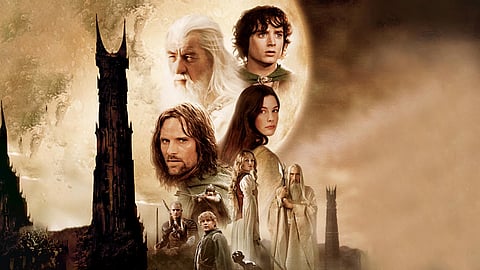
The one that started it all, and somehow still feels the most personal. Fellowship doesn’t need to be the loudest or most action-heavy—it wins you over with warmth, patience, and world-building so rich you want to live inside it. From the rolling hills of the Shire to the terrifying depths of Moria, Jackson lets us feel the weight of this world before he ever throws us into battle. It’s cozy until it’s not. And let’s talk casting: McKellen as Gandalf is legendary. Mortensen’s Aragorn is the template for reluctant-but-noble heroism. Elijah Wood’s wide-eyed Frodo makes the impossible quest feel intimate. When Boromir dies, you feel it. When Gandalf falls, you mourn. It’s rare to find a fantasy film that’s both technically stunning and so deeply, achingly human.
You May Also Like: Your Ultimate Sci-Fi Movie Starter Pack
This is where things get messy—and glorious. The Two Towers has to do the heavy lifting of deepening character arcs, expanding the world, and delivering on the fantasy warfare promised in Fellowship. It does all three—and throws in Gollum for good measure. Andy Serkis’s performance changed motion capture forever, but more than that, Gollum complicates the morality of the story. He’s a tragic foil to Frodo, a mirror of what obsession can do. Then there’s Helm’s Deep. A siege so visceral, it redefined how fantasy battles are staged. The rain. The buildup. The slow, painful hope. It’s Jackson at his most kinetic and mythic. While the narrative splits and occasionally wanders, the emotional throughlines hold strong—Sam’s speech at the end still feels like the thesis of the whole trilogy. Hope, even in the dark.
Finally, the Hobbit trilogy starts cooking here. The pace tightens, the stakes rise, and we finally meet Smaug—a talking, flame-belching dragon voiced with slithering menace by Benedict Cumberbatch. Is the film bloated? Sure. Does it have an elf-dwarf love triangle no one asked for? Also yes. But Desolation hits the sweet spot between Jackson’s penchant for spectacle and his understanding of Tolkien’s heart.
Bilbo is finally allowed to be clever and courageous here—his verbal chess match with Smaug is a standout. Meanwhile, the Dol Guldur subplot offers the most direct tie to the larger Lord of the Rings mythos, giving Gandalf something to do beyond vague hand-waving. And Ed Sheeran’s “I See Fire” playing over the credits was a full vibe back in the days. This is as close as the Hobbit films get to the grandeur and intrigue of the original trilogy—and it’s pretty damn close.
You May Also Like: The MCU Rewatch Guide
If Jackson had trimmed the fat (and the 48fps experiment), this could’ve been a tight, whimsical romp. Instead, it plays like Fellowship-lite, stretched over nearly three hours. That said, there’s still magic here. Martin Freeman is pitch-perfect as Bilbo, balancing fussy charm with a quiet courage that creeps up on you. The dinner scene in Bag End is gold. The Riddle Game with Gollum? Iconic. Howard Shore’s score still soars, and there’s a nostalgia that hits when the camera sweeps over New Zealand-as-Middle-earth once again. But the tonal juggling—between slapstick dwarven hijinks and Sauron-lite dread—feels uneven. It wants to be both a kids’ adventure and a dark prelude to The Lord of the Rings, and ends up caught in tonal purgatory. Still, it’s the most grounded of the Hobbit trilogy, and carries just enough heart to keep you watching.
By this point, the trilogy is running on fumes—and CGI. What should’ve been the emotional and moral climax of Bilbo’s story is buried under a 45-minute digital punch-up that feels like watching a video game cutscene on loop. Thorin’s descent into madness is conceptually rich but feels rushed and undercooked. And Bilbo—the actual hobbit of this saga—is sidelined in his own movie. There are flashes of brilliance: a few poignant beats between Bilbo and Thorin, Bard trying to protect his people, and that closing return to the Shire. But mostly it’s spectacle for spectacle’s sake. It’s Jackson trying to force Return of the King-level grandeur into a story that was always meant to be smaller, stranger, and a little sillier.