
- Entertainment
- Style
- Lifestyle
- Food & Drinks
- Tech & Auto
- Culture

Her expressive eyes reveal little of the steely resilience she channels as Chandra, a vampire, or yakshi, from Kerala folklore known as Kalliyankattu Neeli in Lokah Chapter 1: Chandra. It’s a warm, considerate actor I meet now, who squeezes in time during her commute to a film set to chat with Esquire India, politely asking if she may switch off the camera. “I get car sick,” she tells me as she adjusts her bright red cap.
Thirty-two-year-old Kalyani Priyadarshan is in the midst of a seminal moment in her film career, with Lokah now the highest-grossing Malayalam film of all time. Featuring an ensemble cast led by Priyadarshan, the movie has turned into a pan-India phenomenon, surprising many, including the actor herself.
“Without a doubt, we are all surprised. Every day we wake up thinking the ball’s going to drop, but it just keeps getting bigger and bigger,” Priyadarshan says. “We wanted to make a good film. We felt we did that. But it could have gone either way… This just shows that we assume too much of the audience. It also shows how much the audience is capable of love.”
The sensational success of Lokah stands in sharp contrast with Priyadarshan’s own modest beginnings, when she debuted in 2017 with Hello, opposite Akhil Akkineni. Things really took off after Varane Avashyamund (2020), where she starred opposite Dulquer Salmaan, who has also produced Lokah.
While most of her past roles have been rooted in emotional or romantic dramas, Lokah sees her take up something far stronger and unconventional. Praised for its world-building, storytelling, smart use of visual effects and an engaging musical score, director Dominic Arun’s Lokah achieves what many big-budget Indian superhero films have aspired to for years. In fact, it now holds the distinction of being India’s first female-led superhero film. And at the centre of it all is Priyadarshan.
Talking about why it’s so hard for anyone to imagine female superheroes headlining an Indian movie, she says, “It is just purely our assumption that the audience will not like it. We need to stop making assumptions in cinema and about our audiences.”
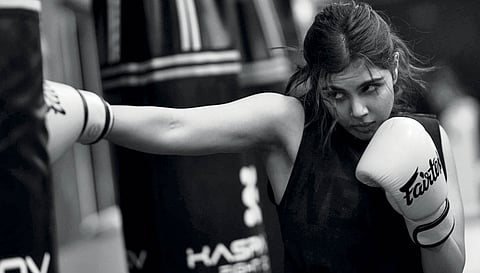
Priyadarshan’s only other performance as a solo female lead came in Sesham Mike-il Fathima (2023), where she plays a young Muslim woman from Malappuram who dares to go up against unjust hurdles and a conservative upbringing to achieve her dream of becoming a football commentator. She admits that Chandra has probably been her toughest role so far. Not just emotionally but physically as well. From gruelling Muay Thai sessions to performing her own stunts, Priyadarshan pushed herself to her limits, unlearning a lot about herself along the way for the role. “I’ve never been athletic,” she says. “But Chandra is a fighter. It was one of those things where people will know if you’re punching or hitting someone for the first time. Our training was incredibly intense.”
Emotionally, too, she says, the character is very closed off. “She's someone who has lived for hundreds of years. She's always wearing different masks and identities. So that was quite difficult for me to emotionally access, because as a personality, I’m very different. As a performer, it was a very fulfilling process,” says the actor, whose other big release in 2025 was Odum Kuthira Chaadum Kuthira, alongside Fahadh Faasil and Revathi Pillai.
A STUDENT OF ARCHITECTURAL DESIGN FROM New York’s Parsons School of Design, Priyadarshan always knew she wanted to work in cinema. “I didn’t know if I had the confidence to be in front of the camera,” she confesses. “I studied architecture because I knew that set design was something I would be interested in.”
Having worked in set design for two years before pursuing acting, including a stint as an assistant production designer on the Hindi superhero film Krrish 3 (2013), the actor says those learnings have made her “a lot more empathetic” to everything that happens on set.
Filmmaking is hardly unfamiliar territory for the actor, who is the daughter of filmmaker Priyadarshan and actor Lissy. And much like her bold on-screen presence, she doesn’t shy away from the nepotism debate. “I have always embraced this as a world that I grew up in and the reason for my existence. I would not have been born if my parents didn’t meet on a film set,” she says, matter-of-factly. “I can’t control the circumstances in which I was born, but I can use those opportunities that I get responsibly.”
She’s very aware of her privilege. “If someone ever looks at me and says: ‘This is a nepo product who does not deserve to be here’, I agree with the first part. I do not agree with the second part. I work just as hard and have just as much passion as the other person,” she states.
Lokah’s reception and performance have set the groundwork for more female-led stories in Indian cinema. That ‘responsibility’ is something Priyadarshan does not take lightly. “If it can open the door up a little bit wider for women-led stories and women-led action stories, it means we’ve done something,” she says. She acknowledges her own effort but adds, “If it wasn’t for Dominic’s vision and Dulquer’s backing, I don’t think this could have worked out the way it did. I’m not going to discount my work. But I’m not going to take this win away from my team.”
With the excitement of Lokah’s success gradually settling, Priyadarshan is equally focused on her future projects, which include Marshal with Karthi. She also makes time for travel but is also a self-professed ‘homebody’, cherishing her time with her niece and her dogs. “I’m two extremes, actually. But my favourite place to always be is on set.” As her X handle aptly sums it up: “Everything cinema all the time always (for those that get the reference).”