- Entertainment
- Style
- Lifestyle
- Food & Drinks
- Tech & Auto
- Culture

This year in cinema has felt like a tug-of-war between creative risk and corporate repetition. For every unexpected gem, there’s been a remake nobody asked for.
Originality has been traded for IP. Franchises are overstaying their welcome. So, when a big-budget film like Lokah Chapter 1: Chandra hits the seen, it obviously finds itself followed by a curiosity ? Will another Indian superhero movie attempt fail?
Surprisingly, the Malayalam-language superhero film is a breath of fresh air that proves ambition and authenticity can still coexist on screen and without terrible attempt at VFX.
Directed by Dominic Arun and produced by Dulquer Salmaan under his Wayfarer Films banner, Lokah Chapter 1 that released in the last week of August has stood out confidently. Combining mythology, horror, and speculative science fiction, the film is a moody, mythic origin story that introduces India’s most compelling new cinematic universe with atmosphere and intent.
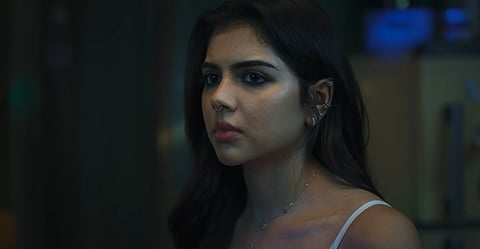
Starring Kalyani Priyadarshan in a breakout performance, the film follows Chandra, a young woman whose spiritual and ancestral inheritance sets her on a path far beyond human comprehension. Priyadarshan brings both intensity and vulnerability to a role that could’ve easily veered into abstraction. Instead, she grounds the film emotionally as it explores themes of destiny, death, and cosmic legacy.
Critically, Lokah Chapter 1 so far has refused to chase pan-Indian accessibility. It stays rooted in the Malayalam language and cultural references, and yet — perhaps because of that — has struck a global chord. In just four days, the film has grossed over ₹63 crore worldwide, surpassing the lifetime earnings of Drishyam (₹62 crore).
Its domestic take stands at ₹28.4 crore, while overseas markets, particularly North America and the Gulf, have contributed a remarkable ₹35 crore ($4 million). On Sunday alone, the film earned ₹10 crore, marking a 280 per cent jump from its opening day. But we all know statistics don't always account for entertainment. So, is the superhero film Lokah Chapter 1 worth watching?
Unlike the usual masala spectacle attached to superhero films in India, Lokah Chapter 1: Chandra delivers a homegrown superhero film that finally sidesteps the clichés of both spectacle and Marvel mimicry. Directed with eerie precision by Dominic Arun and produced by Dulquer Salmaan, the film is an atmospheric, slow-burn origin story that favours mood and mythology over CG-laden bombast.
Arun’s directorial approach is defiantly non-commercial as the story unfolds less like a comic book arc and more like an ancient prophecy unraveling in real time. It’s not so much about saving the world as it is about understanding one’s place in it. Long stretches of quiet tension, symbolic imagery, and elliptical storytelling create a tone closer to arthouse horror than superhero spectacle. That will likely divide audiences.
But for viewers willing to lean into its pace and ambiguity, Lokah offers something rare: a superhero film that actually trusts its audience to pay attention.
The film opens with ominous signs and quiet dread. There's a dark entity lurking in Bengaluru, where illegal organ trafficking and unexplained deaths hint at a deeper, more metaphysical threat. The story revolves around a character Chandra — enigmatic, powerful, and clearly not from here.
Dominic Arun cleverly avoids dumping exposition early. Instead, he lets the mystery simmer, trusting the audience to piece the narrative together as the characters do.
Where Lokah excels is in its mood. Visually, the film is a triumph and Priyadarshan as Chandra handles action sequences with impressive ease, though her emotive range could afford a bit more nuance . Even so, she commands each frame with measured intensity.
She brings physical command and emotional restraint to a character caught between cosmic destiny and earthly entanglement. While not traditionally emotive, Priyadarshan’s presence is magnetic. She doesn’t speak much, but she owns the screen when she moves, fights, or simply stares into something beyond our realm.
Cinematographer Nimish Ravi and art director Subhash Karun craft a tactile, elemental world where every frame feels soaked in myth — monsoon rains, flickering oil lamps, and half-seen shadows lend the film a textured, ritualistic quality. The production design, too, leans heavily on native motifs and lived-in spaces, grounding the supernatural in the familiar.
The atmosphere is richly layered with deep reds, shadow-drenched corridors, rain-lashed rooftops. In a way, the city becomes a character in the film, too.
Arun leans into the horror-fantasy territory, not unlike Don’t Look Now or Pan’s Labyrinth. There are moments of psychological tension that are rare in Indian superhero fare. When the action does arrive, particularly in the tightly choreographed first showdown , it lands with impact not because it’s loud, but because it’s earned.
While Priyadarshan anchors the film with emotional clarity, the ensemble cast including Naslen, Sandy, Vijayaraghavan, and Nishanth Sagar give solid support without overshadowing her. Arun Kurian and Chandu Salimkumar shine in particular, offering layered, often ambiguous characters that hint at larger roles in future chapters.
Where Lokah stumbles slightly is in its narrative cohesion. The pacing can feel glacial, and certain character arcs (particularly those in the second act) remain underdeveloped. There are moments when Arun’s commitment to atmosphere comes at the cost of clarity. Still, the film’s visual and emotional strengths far outweigh its structural looseness.
Commercially, the film is already a phenomenon.
More importantly, Lokah reaffirms the potential of regional cinema to break new ground not by imitating the West, but by doubling down on its own rich storytelling traditions. It proves that a superhero film doesn’t have to look or sound a certain way to connect on a massive scale.