
- Entertainment
- Style
- Lifestyle
- Food & Drinks
- Tech & Auto
- Culture

Long before Alisha Chinai’s Made In India launched him into the stratosphere of public fame and adulation, Milind Soman was a national level sportsman.
In fact, he counts his swimming days as his first foray into public life. “From the age of nine till the age of 23, when I was national champion in my event,” he recalls. “And then I suddenly started modeling. I didn't even know it was a profession.”
It was a very different direction. “Somebody just came and offered me a job,” continues Soman. “And I said, no, because I don't like being photographed.”
So what changed? “They said: but we'll pay you. And I thought: Okay, that's interesting.”
But even after modelling took off, and a career in film knocked at his door, Soman wasn't convinced. “I couldn't really speak Hindi well at that time. And also, I was very shy and I didn't see any benefit in it.”
It wasn't until 1995, when Doordarshan made A Mouthful of Sky, India’s first English language series, that he seriously considered acting. Soman’s debut role was Akash Bhandarkar, an MBA graduate turned novelist, in the Mahesh Bhatt directorial on the lives of youth in a liberalised India. “The producers came and said, now this is in English, so you don't have an excuse. I agreed, and I did it, and I enjoyed it. So I started doing more. I started my own production house and produced my first Hindi series called Margarita; I started acting in other languages. And it's all fun.”
His latest venture, national award-winning director M. Manikandan’s Tamil-language suspense thriller Kaattaan, sees him playing Sivettan, a mentor figure to the protagonist Mutthu, played by Vijay Sethupathi. Slated to release on March 27, it chronicles the life of the polymath Mutthu, as the police search for his body after his severed head is found in a field.
“The relationship that we, Mutthu and Sivettan share was almost like a father-son kind of relationship,” adds Soman about his character. “I’m the mentor and I’ve kind of changed his life in many ways.
“The whole backdrop is also interesting. Maybe I’m associated with the mafia, or maybe not,” he laughs “but there’s a lot of drugs and a lot of black money and smuggling involved. But we don’t really show any of that. There’s also violence, but it’s not gratuitous violence. It’s not just there for the sake of it,” and here he lights up, “I was in a fight scene, so that’s how I know. But it was fun to work with.”
“For me these are the three most important things: The story should be interesting, the character should be something I want to explore, and I should like the people I’m working with.”
Beyond the three conditions, he looks for characters that are vastly different from what he's played before. “If it's something that I've done before, or even a little bit similar, I say that I'm not interested.”
Referring to his role as the Maratha royal Ambaji Pant Purandare in 2015’s Bajirao Mastani and the transgender humanist Boris in the 2020 Zee5 show Paurashpur, he adds, “a lot of people come to me and say, if there's a king, then will you play the king? Because they think that I fit the image. I said no for six or seven months.”
But then something caught his eye. “Then when they were developing the story, and they came and showed it to me again. I asked about the role of Boris. They were surprised. They said: we want you to be the king, and you want to play the eunuch? But for me, that was much more interesting.”
Soman has never believed in a rigid career path. “I never planned anything in my life. I like to see it as opportunities are all around you. And whichever ones you find interesting at that time, you should explore, or I should explore. And that's how my life's journey has happened.”
What's he working on next? “Whatever comes up. Something surprising. I like surprises.”
But doesn't the freedom of not knowing what's next get disorienting? Especially in today's world, when more and more men are confused about how to be like, how to go ahead with life, and what a man should act like?
You eventually figure it out along the way, Soman thinks, as long as you're willing to experiment and find out what works for you. “Young men have always been confused. It's nothing new," he offers.
“I was confused when I was seventeen or eighteen. Girls are confusing. Money is confusing. Jobs are confusing. I studied engineering even though I never wanted to be an engineer. You have to choose some stream, and I chose it just because I had to. And then I also went to work in a hotel. I worked for a whole year - I worked in the kitchen, I worked in housekeeping; I worked in the front desk, just to see whether I liked working in hospitality. It was awful. I was also swimming side-by-side so that was actually my focus, but there was no clarity till I was offered this job as a model when I didn't even know that modeling was."
“It’s normal to be confused. But everybody - not just when you're young - as you progress in life you need to ask yourself this question about where you want to be. Where do you see yourself? What kind of person do you want to be? What kind of life do you want, and are you moving in that direction? Whichever choices, big or small, that you make, are you moving away from that vision? Once you're clear about where you want to go, you will be less confused as you move in that direction.”
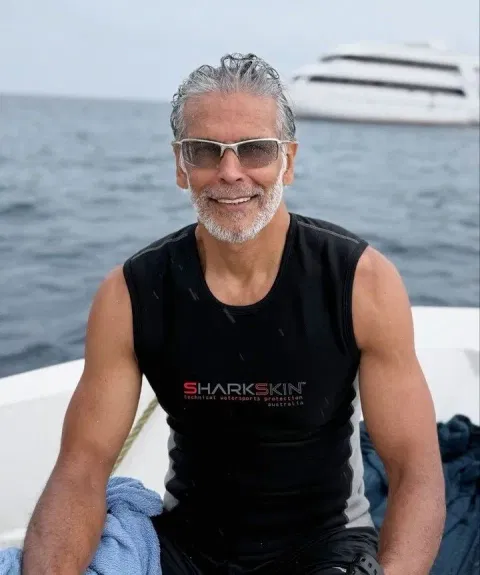
True to his advice, Soman has continued his lifelong tryst with athletics. In 2012, the actor founded Pinkathon, India's biggest women's run to promote breast cancer awareness. On his social media handles, one can often find him posting about his workouts and fitness routines. Just this March, he swam fifteen kilometres in Goa for Holi. For many, these feats at his age are almost impossible, and putting in the work behind it is nothing short of impressive, but it's just another Tuesday for him.
“People talk about a lot of work and all that. But I don't know what ‘work’ is. If I was training for the Olympics, there would be a lot of work. There was a lot of work when I was swimming even, but I didn't see it as work. I don't think even athletes see it as work; they enjoy it, and if they didn't enjoy it they wouldn't do it, you know?
“I would say, unless you're pushed by your parents or pushed by somebody and that becomes a thing that you don't like, but otherwise it's you exploring your potential. It's the same when you run a marathon or you do the Ironman or anything else; you're exploring your potential because you love it. Finally when you do it, and even while you're preparing for it, you just love the transformation that is happening, so I don't really see it as work.”
“I've enjoyed every moment of everything that I've done. What people see today is a culmination of all of those things: the way I think, the things I've done, I mean all of it.”
As we close, I ask him about the one thing that changed his life.
“Not listening to people,” is the swift reply.