
- Entertainment
- Style
- Lifestyle
- Food & Drinks
- Tech & Auto
- Culture
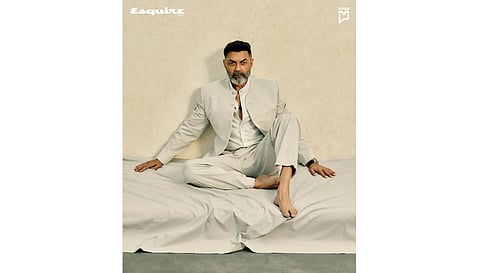
Bobby Deol is basking in the glow. Quite literally. At a studio in Bandra where I’ve come to meet him for the Esquire India shoot, he studies himself in the vanity mirror for a second longer than necessary before turning toward me. Then he smiles, warm and disarming, and pulls me into a hug.
We’ve met before. In early 2017, before this resurrection—when Deol seemed destined to become a relic of the ’90s, interesting only when seen through the prism of millennial nostalgia—I had met him on the terrace of Sunny Super Sound, the family’s Juhu office, for a HuffPost profile that would later ricochet across the internet.
He had a small film, the Shreyas Talpade-directed Poster Boys, on the horizon, and spoke with a candour that felt almost unfashionable in an industry built on delusions and denial. He addressed the rumours that had calcified around him: that he was difficult, that he insisted on leading roles, that he lacked flexibility. What he asked for, instead, was simpler: to be considered, regardless of screen time, money and prejudice.
Now, I don’t know if there’s a correlation, and Deol is generous with his praise, but within months of the story’s publication, the industry seemed to respond. In mid 2018, he appeared in Race 3, and in 2019, resurfaced with Housefull 4. Then came the Netflix show Class of ’83, ZEE5’s Love Hostel and MX Player’s Aashram, before he stormed back into the conversation—only in the way a wounded hero from a ’90s film could—with Animal.
“That was the beginning of everything,” Deol says of the time. “Poster Boys didn’t do well but I didn’t let that get to me. I was very close to spiralling back into the phase that I was trying to come out of. But I sort of enforced a kind of discipline on myself.” The discipline, among other things, was being diligent with the workouts and ensuring he looks like he’s taking care of himself. “I owe a great deal of thanks to Shreyas actually,” he says of the Poster Boys director. “Just spending time on the set made me look at acting in a completely different light. It told me that I don’t just have to chase commercial cinema; I have to chase roles that reflect my range as an actor. The work would follow.”
If you were a teenager in the early aughts, it was hard to escape just how popular Deol was—the iconic curls, the swag, the songs, the full package. From his launch in Rajkumar Santoshi’s Barsaat—one of the biggest hits of 1995 to Rajiv Rai’s Gupt (1997), a blockbuster with an album where composer Viju Shah absolutely cooked, Deol was catapulted to instant stardom. He also stood in contrast to the Khans, Akshay Kumar, and even Sunny Deol, his appeal not rooted in excessive bravado, but in brooding restraint. Soldier (1998), Dillagi (1999), Badal (2000) and Abbas Mastan’s Ajnabee (2001, a cinematic heirloom), kept him firmly in pop culture consciousness, if not at the very top. Part of the current creative restructuring, then, was dismantling the idea of being a “hero.” Such is the chokehold of stardom over those who’ve experienced it, stepping out of its glare feels like erasing a part of your glorious past.
“[Director] Prakash Jha’s Aashram was the show that made me do it. I was playing a baba who's a sexual predator, something I couldn’t imagine doing back in the day. And to me, it wasn’t just getting the role, it was adapting to a new sensibility. A new audience. So I put in the work. Unlike in the ’90s, when scripts would be written on set, we get the scripts much earlier now. I used that time to really, re-ally prepare. Learn and internalise the lines and get them out of the way so I’m focused on the emotional beats in the scene, not worried about missing my next dialogue.”
The other big change was his decision to give up alcohol. “For an actor, your body, your face, are the commodities that you’re selling. I cannot afford to mess with that,” says the star, who has previously spoken about a creeping dependency. “As I grow older, I feel tired faster than I would a few years ago. I need to take greater care of myself.”
Quitting completely a year and a half ago has altered more than just his physique. It has changed the atmosphere of his home. “I don’t miss it. In fact, I keep thinking, wait, it was this easy?” he says. “Two birthdays and two New Year’s have passed. And I haven’t felt the urge. That surprised me.”
He had watched his father, the late superstar Dharmendra, wrestle with it too—the fatigue, the slowing down, the gradual erosion. “I’ve seen what it can do,” he says, adding that he didn’t want that for himself. What sobriety has given him, he reveals, isn’t just clarity but presence: the ability to sit at a dinner table fully there, to wake up without regret, to show up for his sons without a haze. “It’s improved my relationship with my family more than anything,” he says. In a culture that sometimes romanticises the tortured artist seeking refuge in a bottle, he has found that restraint, and the very intentional act of taking care of himself, is the braver choice.
That change in mindset has also sharpened his view of the industry itself. One of the biggest differences, from the ’90s to now, is the shrinking tolerance for disrespect, no matter how big a star you are. “Nobody has time for all that anymore. Everything is so expensive—each day of shoot is such a cost—that nobody is going to put up with bad behaviour. Maybe once or twice they’ll let it slide, but if you’re going to be difficult, they’re just going to take someone else,” he says, adding, “There are certain actors, and I’ve come across some, who still are badly behaved, but I just feel really sad for them. I’ve seen this story before and trust me, at the end of the day, it will be them left wondering why things went wrong, why the phone stopped ringing and why they’re so lonely. You can’t just throw tantrums and expect everyone to be okay with it.”
***
In the years when work was yet to trickle in, the strangest feeling he felt was to look at himself through the eyes of his father. Despite having had a successful career, he still felt he owed it to his Dad to prove that he still had it in him—that the dip wouldn’t be the final chapter his father would remember. However, as is the norm between most Indian fathers and their sons, the conversations were monosyllabic, and the unspoken hung heavy in the air. “No matter how much you love each other,” Deol says in the present, his voice crackling, “you just don’t end up spending as much time as you should with your dad… you know? We get caught up in our own life and one day you wake up and wonder, where did all the time go? How did it go by so fast?”
He looks past me as he speaks, as if searching for something that can no longer be retrieved. The mention of his father, who passed in November, seems to bring a quiet ache to the surface. “There are all these days,” he says, before trailing off. “where I wish I had sat with him more. I wish I had asked him more questions.” He wistfully recalls his father once speaking about poems he had written, verses born out of his own regret at not having spent enough time with his father, Kewal Kishan Singh Deol. The inheritance, it seemed, was not just cinematic but emotional. “That really moved me,” Deol says softly. “But I suppose this is the cycle of life?”
In the months since his father’s passing, grief has rearranged his priorities. “Now more than ever, I’m mindful of being with my sons, my wife and my family. The box office, the reviews, the roles… eventually they don’t matter, man.” He pauses —not theatrically, but like someone measuring the weight of his own words. “Success is measured in how much time you can afford to spend with the ones you love. What’s the point of fame and wealth when there’s no one to witness it with you?” he reflects.
Deol recalls days when his father would sleep on sets, juggling three different shifts in a day. Others, when he’d come home only to collapse because of the strain of it all. While cinema gave them everything, it also took away many precious hours. They saw very little of him at home. One night, when he was just four or five, he had a fever that wouldn’t break.
Dharmendra got home after the shoot and looked at his son, shivering and sick. “I still remember, he was so tired, I could see it in his eyes… but he just picked me up, gave me a hug, and held me tight till I fell asleep. I don’t know why I'm missing that moment now… it’s my most beautiful memory of him. I wish I’d had a mobile phone then, I’d record his voice, his face, everything he did for me…”
Or perhaps, in an age where moments feel real only when documented, its absence has allowed the memory to stay purer, longer. “Perhaps. But the shift that most surprised me,” he continues, after a brief pause to gather himself, “is the one I’ve seen in both my sons, Aryaman and Dharam. There’s a sense of maturity that the passing of Papa has brought. Or perhaps they seem more aware of the fragility of life. We’ve been consciously spending more time together. I’ve even told them that I’m there for them, that I always want to be present.”
That instinct to hold family close is one that defines him, in many ways. In an industry where infidelities are traded like box-office trivia and on-set romances are considered occupational hazards, Deol has remained deliberately uninteresting to gossip items on Reddit, his marriage largely untouched by scandal. In nearly fifteen years of covering the industry, years that have yielded more than a few salacious whispers about almost everyone, I have yet to stumble upon anything remotely incriminating about Deol. What’s the secret sauce behind a steady Bollywood marriage?
Deol laughs. “It hasn’t been perfect,” he admits. “Of course there have been arguments, misunderstandings. If there wasn’t any kind of conflict, it’d not be real.” An actor’s career is defined by its ups and downs, and those fluctuations inevitably take a toll. “But Tanu [wife Tanya Deol] has consistently remained my strength, my backbone,” he shares.
At his lowest, when faith in himself had thinned to almost nothing, it was Tanya who nudged him back towards the work, quelling his anxieties and self-doubt and pushing him to act again. “That’s my wife. She’s always there, standing like a rock, not just for me, but for all three of us. It’s been thirty years and I just feel lucky to have Tanu as my life partner.”
Per him, the secret to marital success, if there is one, lies in something simple: not trying to change the person you chose, or edit their personalities to your liking. “I think a lot of marriages crumble when you expect your partner to change for your own happiness,” he says. “That’s unfair. You have to fully accept each other the way you are. That’s the key.”
***
It was his ferocious turn in Animal that handed Deol a renewed lease of life. While the resurgence in work is something he’s thrilled about and swears that there’s no other place he’d rather be than a film set, the battle he’s now facing is being type-cast as the bloodthirsty antagonist. “Now while a lot of things have evolved, some things haven't. One of them is actors getting typecast,” he says. Of his turn as Abrar Haque, he adds, “I’m consciously trying to choose characters that deviate from that now. While I understand the appeal, to me, it’s more fun when a character has complexity and isn’t just completely black.”
Among the experiments that pushed him into a new form of acting was working with Anurag Kashyap on Bandar, a film about a man being wrongfully accused of sexual assault. While the film’s May release has just been announced, tensions have reportedly flared between producer Nikhil Dwivedi and director Anurag Kashyap over the final cut. Deol, however, chooses not to wade into that conversation. Instead, he redirects the focus to Kashyap’s working style, which, he says, took him by surprise. “As an actor, I’ve never improvised in my life, I didn’t even know I had it in me to,” he says, “But Anurag works very differently and encourages you to go beyond what’s written. It was such a revelation for me. It made me realise that I’m capable of so much more than I thought. These new directors have a way of making you look at your own craft differently.”
Another director whom Deol was struck by was Aryan Khan. Khan’s Netflix debut, The Ba***ds of Bollywood, was sharply observed and unexpectedly self-aware without trying too hard. Deol played a powerful movie star whose daughter is on the cusp of a high stakes launch. The show explored vanity, nepotism, PR spin and the machinery of stardom with a confidence that felt far older than its maker, something a Farah Khan would pull off. Of his young director, he says, “Just the tag of being Shah Rukh’s son bears heavy on him; people assume he’s a spoilt, entitled brat when he's quite the opposite. Rarely have I seen a new director so in command of a set. He’s such a talent. If you want to be a filmmaker or an actor, other than a technical skillset, you need something else. You need to be level-headed, intelligent and have a warm heart. That’s what I saw in Aryan. He never lost his cool on set.” Now, Ba***ds could be easily accused of being a show that plays on Deol’s nostalgic appeal, but what drew him to it was Khan’s modern gaze and its absurdist streak.
On the subject of star sons, Deol is preparing his elder son, Aryaman, for what he knows will be an inevitable launch. Both his sons want to act—but this is not the 1990s, when lineage sparked curiosity, even admiration. Today, it invites some-thing much crueller: contempt. The scrutiny is instant and the verdict harsh, amplified by an outrage economy that doesn’t care about nuance. “Nepo babies,” an ugly shorthand that functions more as an indictment than description, are ripe targets for an audience that finds it safer to direct its rage towards Bollywood than at systems that shape their frustrations.
At this cultural flashpoint, how does he protect his boys from the privilege-shaming that feels inevitable?
“It’s insane today,” he says. “The full effect of these comments on people’s mental health is something we are yet to find out. It seems endless. And it’s very apparent that the nastier you are, the more traction and engagement you generate.” For younger people, like his sons, even hundreds of positive comments can be outweighed by a few negative ones. So he encourages them to stay off social media. “I’ve told them several times that they have to shut the noise out, keep their heads down, and let the hard work be a marker of their talent,” He admits it’s hard because they are a generation that has grown up online, and that actors, by design, are deeply affected by public opinion. So he puts up guardrails where he can, chatting them over a game of GenZs favourite sport—paddle. “And then, there are times when they sit me down and teach me how to navigate the internet too,” he says, all too familiar with the Lord Bobby Deol memes that have flooded our collective timelines.
While he is generous about the industry’s evolution, the one thing Deol admits to missing about the 1990s and early aughts is the music. “I don’t know what it is,” he says, almost apologetically. “I can’t put my finger on it, but something’s missing. There’s nothing that really stays with you anymore. Nothing that lingers. Or maybe I’m just getting old?” While Animal’s album, especially his entry, Jamal Kudu, exploded on our screens, it still feels like an outlier. And even that was a re-mixed Iranian folk track and not something entirely original.
“You know how it is—you grow up with certain songs and they become part of your consciousness.” I tell him that even for someone my age: a millennial in his early thirties, it’s still the ’90s and 2000s bangers that end up being the closing anthems of our house parties. He shrugs, conceding the point but widening the frame. “Maybe twenty years from now, some other generation will say the same about today’s music,” he says. True. Every era thinks its songs were the last great ones. “My dad used to feel that way about his time too.”
As we’re about to wrap, Deol’s mind drifts back to his father, as it often does. “You know, I keep watching his reels on Instagram,” he says, almost sheepishly. “He was so candid… so full of warmth. Sometimes it feels like he’s talking directly to me.” Fans, too, have become unlikely custodians of memory, sending him old photographs they’ve unearthed, images that arrive unannounced in his inbox and bring a smile on his face. For the preview of Sriram Raghavan’s Ikkis (his father’s last on-screen appearance) he wore one of Dharmendra’s favourite shirts. “He’d wear it everywhere,” he smiles. “So I took it out and wore it at the premiere. It felt like he was there with me.” Grief has also drawn him closer to his half-sisters, Esha and Ahana. “I feel we’re all dealing with it in our own ways. Sometimes you misunderstand each other because you’re hurting… everyone feels their pain is more than the other’s.” He pauses. “But you give it time. Let it heal… Loss has its own way of bringing a family closer.”
As his father’s health began to decline, Deol says he found a strange kind of solace in knowing that both he and his brother, Sunny, had carved their comeback in an industry that had defined their family. It felt, in many ways, like closing a circle. Dharmendra was never lavish with praise; affection in their home was often im-plied rather than spoken. So when I ask if his father ever acknowledged this second wind, Deol pauses. “Yes,” he says slowly, as if replaying the moment. After one of his final releases, Dharmendra walked up to him and said, “Ab tu khud ko pehchaan gaya.”
It was neither advice, nor applause. Just a father’s recognition that his son had finally come into his own.
Credits
Chairperson: Avarna Jain
CEO: Debashish Ghosh
Editor: Rahul Gangwani
Photographer: Nishanth Radhakrishnan
Cover story: Ankur Pathak
Styling: Rahul Vijay
Styling Team: Sejal Parulkar, Nandini Jain
Hair: Shahrukh from Team Hakim Aalim
Grooming: Siddesh
Location: Krome Studio
Cover Design: Azad Mohan Panwar
Editorial Mentor: Saira Menezes
Managing Editor: Sonal Nerurkar
Fashion Director: Vijendra Bhardwaj
Deputy Editor: Mayukh Majumdar
Bookings Editor: Varun Shah
Production: P Productions
Talent Management Agency: UNIWORLD BEING TALENTED (UBT)
Esquire India Editorial: Saurav Bhanot, Prannay Pathak, Nitin Sreedhar, Komal Shetty, Abhya Adlakha, Rudra Mulmule, Riti Ghai, Kashish Mishra
