
- Entertainment
- Style
- Lifestyle
- Food & Drinks
- Tech & Auto
- Culture
The first thing about Toxic is that it feels… artisanal.
The mainstream Indian action movie, as we currently know it, is not only about dumbing down the plot, but also about flattening everything in sight—from villain to dance step—in order merely to make the hero look taller. These films are designed to highlight the almightiness of their leading men, filmed with pornographic affection as they ascend a pedestal in slow motion. Story, character or logic matters less than the bombastic background score made to exaggerate screen presence. These are superhero movies without supervillains. Armed with implausible abilities and stupid punchlines, the hero surmounts problem after problem with ease, always having the upper hand. There is only enough room for one spotlight and it’s always—always—on his damned face.
Toxic changes this. This megabudget vehicle for Yash—referred to as “Rocking Star,” hero of the deafening KGF franchise and villain in the upcoming Ramayan—is directed by Geetu Mohandass, a move that undeniably sets it apart. It may seem clichéd to laud an action film simply because it has been directed by a woman, yet there is undeniably something distinctive about the film’s gaze. It is thrilling to see an arthouse filmmaker take on this swaggering, supersized film.

Mohandass’s films feature complicated characters, men with more questions than answers. Her first, Liar’s Dice, involves a missing husband and a deserter from the army. Her second, Moothon, is about a missing brother and a bullied boy made to wear women’s clothes. Toxic is loud and overlong and features a preposterous amount of slow-motion, and yet, sneakily enough, it is also a treatise on masculinity, on cycles of violence and generational trauma, all told through the genre’s language of blood and mayhem.
Toxic is about a boy with a violent and feared father who grows up to be a violent and feared father. It may sound familiar, and indeed it often appears to be a funhouse-mirror version of Sandeep Reddy Vanga’s infamous Animal. Yet look carefully. There is attentiveness and care and, most importantly, intent, behind Toxic’s sensationalism, bluster, even its unending ultraviolence. Its choices have a point, even if not immediately apparent. This is a fascinating pastiche that throws up fascinating questions (including “Who is this film for?” and “Is it even really their kind of film?” )
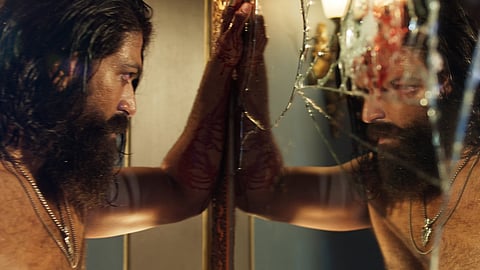
Yash is terrific. He has a smouldering screen presence, he is excellent at deadpanning the aphoristic Kannada dialogue, and he understands when to lean toward mischief or mayhem. I’m awestruck that instead of taking on something dumb and one-note, he took on this ambitious film, one that emphasises the thickheadedness characterising the genre, a film where the leading man becomes so far removed from being a hero that everyone he has ever loved begins to fear him, a film that is—ultimately—about introspection, and about ego. An I for an I makes the world blind. I concede that Toxic may have bitten off more than it could chew, but at least it bites.
The film’s visual references are as direct as they are ambitious. It starts out looking like Baz Luhrmann’s Moulin Rouge, all dazzling colours and neon circusry. There is an approximation of Quentin Tarantino in fight scenes, with limbs hacked off in unreal shower-sprays of blood. There is, equally, a sustained use of hard-contrast red light evocative of Wong Kar-Wai. I was reminded of the down-and-dirty but stylised action of Zack Snyder, particularly Sucker Punch, and Robert Rodriguez. The film is shot strikingly by the maestro Rajeev Ravi (who is married to Mohandass) and it’s curious to see her channelling these easily identifiable male filmmakers. This could be because the action genre—particularly when this loud and hardcore—is not only made mostly by men, but also watched primarily by them. It could also be because she has made a film that is less a celebration of masculinity than a critique. Both of toxic masculinity itself and of hypermasculine cinema.
Look at the women. Kiara Advani, Nayanthara, Huma Qureshi, Rukmini Vasanth and Tara Sutaria. They look, initially, to be playing supporting parts but look closer: each character is decisive and powerful, making choices and holding their ground. There is a sister doing all she can to fend for her brother, a daughter strapping explosives to herself for her father’s debts, a mistress holding an empire in place as she manipulates the hero against his beloved. A wife unwilling to settle; a lover unwilling to be demeaned. Their fierceness is not subtle.
This is a criminally misunderstood film. Even critics who claim to have liked it have mostly — in their urge to highlight the film’s climactic twist, itself evocative of the excessively misunderstood Fight Club — missed out on what else the film says. It is a wake-up call, for instance, for the gruff, all-conquering hero when Nadia, played powerfully by Advani, calls him out for being toxic. He grapples with the label and tries to do better. Unlike his previous conquests, he does not seduce Nadia with charm, songs or lies. He tells her the truth about his situation and desire, and she lets him in.
There is a lot of sex in Toxic, but none of it is vulgar or titillating. The women look great, but are not filmed in that softcore voyeuristic way we see so often in our movies, and the lovemaking scenes highlight the women’s satisfaction. Sure, the hero is a fixer-upper, but these women choose to roll up their sleeves and take on the task.
The problem is that Toxic tries to have its cake and eat it too—all while blowing up the bakery. There is inventiveness to the fight scenes and some visual flourishes, but the film bludgeons the viewer endlessly with blood-splattered set piece after set piece. These constant high-octane crescendos keep lowering the overall stakes, diluting plot and consequence and making it far harder to appreciate the film’s sly radicality. Without exaggeration, they should have sliced off an hour of running time.
It is a slippery conundrum. Do you make a clever film that alienates the fanbase by not slaking their bloodlust? Or do you make a film so enormously oversized that it actually leaves room to slip in something subversive? The problem with the first approach is that it preaches to the choir, the indie audience who already claim to know what you’re saying. The second approach, which is what the makers of Toxic have taken, risks alienating all audiences, including the ones who want more challenging fare. It’s a gamble, and it appears not to have paid off.
Hats off, regardless. At a time when mainstream cinema is playing safer and safer, appeasing stars and fans, Toxic has the testicular fortitude to call out its genre, its leading man and its audience. This is a foolhardy, unlikely, once-in-a-lifetime risk. It is the risk of a suicide bomber. No one here gets out alive.