- Entertainment
- Style
- Lifestyle
- Food & Drinks
- Tech & Auto
- Culture

Hollywood has always loved a spectacle. From the chariot races of Ben-Hur to the sweeping battlefields of Braveheart, the epic has long been cinema’s grandest flex—an assertion of scale, vision, and sheer audacity. But somewhere along the way, in the era of CGI-drenched superhero saturation, the epic faded into the background, outmuscled by franchises engineered for longevity rather than artistic ambition.
Until now.
You May Also Like: Add These Indie Gems to Your Watchlist
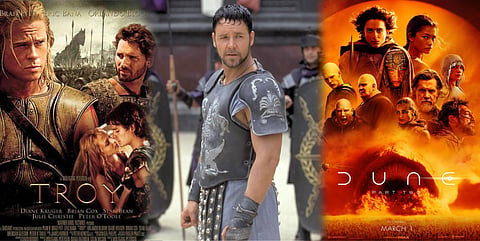
2024 marked the full-blooded resurgence of the epic film, a genre that once defined Hollywood’s most ambitious storytelling. Denis Villeneuve’s Dune: Part Two staked its claim as last year’s first true cinematic event, proving that audiences still crave the grandeur of an intricately built world and storytelling that unfolds like an ancient myth. Ridley Scott, the master of the historical epic, also returned with Gladiator II, a sequel that felt like it shouldn’t exist but, somehow, did surprisingly well at the box office.
And then came the most thrilling development: Christopher Nolan, fresh off the cerebral bombast of Oppenheimer, announced that he will direct The Odyssey.
As soon as Nolan announced his big-budget adaptation of the Greek epic poem, it felt like a moment. Not just because it’s Nolan—the modern master of cerebral blockbusters—but because it confirmed something cinephiles had been sensing for a while now: epics are back and ready to reclaim the throne.
Not that it ever truly went away. Over the last century, the genre has cycled through boom and bust, from the sword-and-sandal dominance of mid-century Hollywood to the post-Gladiator revival of the early 2000s. Now, with Gladiator 2, Dune: Part Two, Napoleon, and Nolan’s Odyssey all arriving within a short span, it feels like we’re in the middle of another grand revival.
There’s something about the historical epic that feels inherently cinematic. Sweeping landscapes. Massive battle sequences. Scores that pulse with triumph and tragedy. These are films designed to overwhelm the senses, to make you feel small in the face of history. That’s why, adjusted for inflation, Gone with the Wind remains the highest-grossing film of all time. It’s why Titanic and Doctor Zhivago remain beloved classics.
You May Also Like: New Movies Releasing In March That Should Be On Your Watch List
For most of the mid-20th century, the epic was Hollywood’s defining genre. The Ten Commandments, Lawrence of Arabia, Spartacus, El Cid—these were basically events, drawing audiences into the sheer spectacle of history. Then, in the ’80s and ’90s, they fell out of fashion. Studios were chasing different kinds of spectacle: sci-fi, action, and the rise of the modern blockbuster.
And yet, when Ridley Scott’s Gladiator arrived in 2000, it reignited a dormant fire. The film was a critical and commercial juggernaut, winning Best Picture and proving that audiences still had an appetite for large-scale historical storytelling.
Today, audiences, it seems, are tired of the same kind of blockbuster. The Marvel and DC universes are faltering. The multiverse—once a novel concept—now feels overused. The biggest surprise of 2023 wasn’t Barbie’s success (that was inevitable) but Oppenheimer’s. A three-hour, dialogue-heavy biopic about theoretical physics made millions of dollars.
That suggests a shift in what audiences crave: a return to stories that feel grand, weighty, and—crucially—real. There’s an appetite for historical narratives, for tales rooted in myth, empire, and legend.
Villeneuve’s Dune is the perfect case study. Here’s a film that refuses to spoon-feed its audience, trading quippy dialogue and rapid exposition for brooding silences, political manoeuvring, and a cinematic language that respects its viewers’ intelligence. And audiences responded. Dune: Part One was a critical and commercial triumph, grossing over $400 million despite pandemic-era limitations, and Part Two also proved to be an even bigger juggernaut.
And then there’s Nolan.
You May Also Like: Star Wars Watch Order: The Right Way to Binge
Nolan’s choice is fascinating. The story has been adapted many times, from the 1954 Ulysses (starring Kirk Douglas) to The Return (2024), which stripped away the gods and monsters to focus on the raw emotional core of Odysseus’ journey. But no filmmaker has ever fully captured the scale and totality of Homer’s epic.
But if there’s one director who could make Homer feel like an IMAX event, it’s Christopher Nolan.
For years, Nolan has been Hollywood’s most reliable auteur—one of the few filmmakers who can command enormous budgets without compromising his artistic vision. The Odyssey is, in many ways, his ultimate challenge. The story of Odysseus’ journey home from the Trojan War is the original adventure saga, a tale of gods and monsters, betrayal and resilience. If Oppenheimer was about man’s greatest intellectual triumph and moral reckoning, then The Odyssey is about humanity’s ability to endure.
You May Also Like: New Movies Team Esquire India's Really Looking Forward To In 2025
It’s also a film that could redefine how the epic is approached in the modern era. The challenge will be balance: does he lean into the mythological spectacle (gods, sirens, cyclopes) or the psychological grit of a man slowly unravelling on his journey home?
Whatever approach he takes, it will be a test case for whether this epic resurgence is a true trend or just a well-timed anomaly.
Ultimately, the historical epic has always been cinema’s great shape-shifter.
On a deeper level, epics resonate because they speak to something primal. They are, by their very nature, about human endurance—about individuals navigating worlds that are vast, dangerous, and indifferent. In a time of uncertainty—climate crises, political instability, cultural fragmentation—the stories of warriors, wanderers, and dreamers trying to carve out meaning feel more vital than ever.
If superhero movies were about escapism, historical epics are about legacy. They tell stories of rise and fall, of empires won and lost, of men who defy gods and history itself. And right now, maybe that’s exactly the kind of storytelling we need.