- Entertainment
- Style
- Lifestyle
- Food & Drinks
- Tech & Auto
- Culture

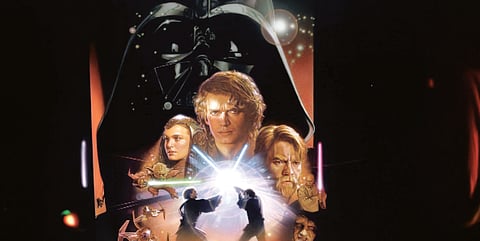
There's a moment—you know the one—when Darth Vader unleashes those five world-shattering words. It's cinema's greatest paternity revelation, a cultural touchstone so powerful that even if you've never seen a single frame of Star Wars, you probably know the line. Now imagine experiencing that gut-punch revelation after watching Anakin Skywalker whine about sand for two hours. The horror. The sacrilege.
In an age where streaming services have rendered chronology optional, there exists a peculiar modern anxiety: in what order should one watch George Lucas's sprawling space opera? After all, this isn’t just a matter of watching a few films. It’s an initiation. A rite of passage into one of the most enduring pop culture phenomena of all time. The question has spawned Reddit threads thousands of comments deep, severed friendships, and likely ended at least one marriage. Many have opinions on this. Strong ones.
You May Also Like: Why You Should Watch The Netflix Show Cassandra
Luckily for you, I’m here to settle it.
Before I take a dive into which order reigns supreme (and make a few of you really mad), I think it’s only fair to look at the options vying for your consideration.
This order simply means experiencing the saga as audiences did when the films originally hit theatres.
The order begins with Episodes IV, V, VI (A New Hope, Empire Strikes Back, Return of the Jedi), forming the original trilogy. The prequel trilogy comes next, starting with Episodes I, II, III (The Phantom Menace, Attack of the Clones, Revenge of the Sith). After this is the final sequel trilogy: Episodes VII-IX (The Force Awakens, The Last Jedi, The Rise of Skywalker).
This approach maintains the cultural and historical impact of the franchise, allowing viewers to experience major reveals exactly as they were originally intended.
Yes, George Lucas himself has stated that he prefers viewing the movies in chronological order – starting with the Phantom Menace (1999) and preceding with the timeline to end with The Rise of Skywalker (2019). Th argument here is seductive in its simplicity: the approach follows the in-universe timeline, presenting Anakin’s rise, fall, and redemption as one continuous arc before transitioning to Luke Skywalker’s journey.
You May Also Like: Movies Team Esquire India's Really Looking Forward To In 2025
It's what Lucas himself endorses, pointing to the saga as "the tragedy of Darth Vader," not "the adventures of Luke Skywalker." There's a certain symmetry to it—the rise, fall, and redemption of Anakin, followed by the temptation, resistance, and triumph of his grandson.
But symmetry isn’t always storytelling. Its appeal lies in narrative linearity, but it frontloads the saga’s weakest entries and dilutes its most powerful revelations. It makes logical sense in the same way that eating dessert after finishing your vegetables makes sense—sensible but joyless.
Conceived by software developer Rod Hilton (because of course it took a programmer to "optimize" cinema), he suggests watching Episodes IV and V, then jumping back to II and III as an extended flashback before returning to VI. Episode I gets cut entirely (hence "machete"). The logic here is that you preserve the Vader revelation in Empire, then flash back to see his corruption, before returning to Luke face the same temptations in Jedi. It's a narrative highwire act. It's clever. Too clever. Like a bespoke cocktail with seven ingredients when three would do just fine.
This is similar to Machete but keeps Episode I. Named for an early internet film forum user, it attempts to have its cake and eat it too—maintaining the structural advantages of Machete Order while appeasing the completionists. Its proponents argue that The Phantom Menace, for all its flaws, establishes crucial worldbuilding that pays off later.
The only problem with this is that it creates a narrative structure where you suddenly downshift from the high-stakes drama of "I am your father" to watching a 9-year-old Anakin yell "yippee!" It’s for viewers who can’t bear to skip anything.
This order recognizes the Star Wars universe has expanded far beyond the nine mainline films. This approach maintains the integrity of experiencing the original films as they were released, but strategically inserts spin-offs, standalone films, and TV series at narratively appropriate moments. The advantage is comprehensive immersion in the universe; the disadvantage is that it requires approximately 150 hours of viewing time.
There are a lot more viewing orders but let’s not get into that—these are the main ones you really need to know.
The verdict is in and drumroll please – the only correct order to watch this epic saga in is the release order.
And I come with receipts.
Firstly, it preserves the evolution of Star Wars. Star Wars wasn't built as a meticulously planned narrative. It evolved, sometimes gracefully, sometimes awkwardly. The original trilogy established a visual language and mythology that the prequels then expanded upon. Watching in release order lets you experience that evolution as audiences did—the wonder of 1977, the shock of 1980, the satisfaction of 1983, followed by the ambitious but flawed prequel experiment.
Secondly, it preserves the narrative impact. The "I am your father" moment lands with nuclear force when you haven't spent three films watching Anakin's descent. The Emperor's malevolence carries greater weight when he arrives as established evil rather than as the culmination of political machinations you've already witnessed. Context enriches only when it follows, not precedes. Plus, the prequels work best as elaborations on established themes, not as foundations for them. Palpatine's manipulations carry more weight when you already know his endgame.
Moreover, the release order maintains tonal coherence. The original trilogy's swashbuckling optimism sets the emotional baseline. The prequels' operatic tragedy then recontextualizes rather than establishes. The saga's fundamental hopefulness remains intact rather than being undermined by front-loading its darkest chapter.
Lastly, the technical progression makes complete sense. The original trilogy's practical effects give way to the prequels' CGI experiments, which evolve into the sequels' hybrid approach. Watching chronologically means starting with late-90s CGI, then jumping to 70s practical effects—a jarring downgrade in visual polish, even if the storytelling improves.
Now, like any agreement, there must be room for reasoned exceptions:
Rogue One can be watched immediately before Episode IV, creating a seamless transition that enhances both films. It's the rare chronological insertion that improves the experience.
Solo works best as a standalone diversion, consumed whenever you need a palate cleanser between trilogies.
You May Also Like: Shows To Watch While You Wait For The Next White Lotus Episode To Drop
The animated series (Clone Wars, Rebels, Bad Batch) and live-action shows (The Mandalorian, Book of Boba Fett, Obi-Wan Kenobi) should be saved for after completing at least the original and prequel trilogies.
There's something distinctly confident about recognizing when to respectfully disagree with authority. We modify classic cars to improve their performance while honouring their essence. We update family recipes while maintaining their soul. And we should watch Star Wars in release order—even if Lucas himself suggests otherwise—because that sequence created the cultural phenomenon in the first place.
This isn't mere nostalgia. It's respect for storytelling architecture while acknowledging the accident of creation. The saga was experienced in a specific sequence by an entire generation, each revelation and callback landing with precise impact. Rearranging these pieces doesn't create a better story; it creates a different one.