
- Entertainment
- Style
- Lifestyle
- Food & Drinks
- Tech & Auto
- Culture

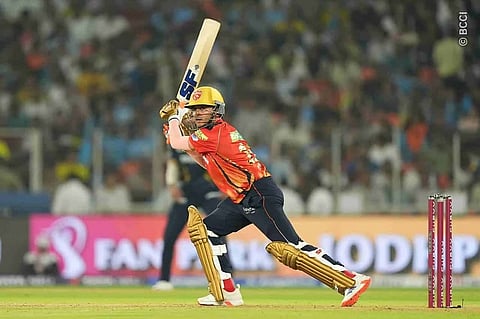
Priyansh Arya was unbelievable last night. Playing only his fourth IPL game ever, the 23-year-old Punjab Kings opener belted one of the most dominating hundreds scored by an Indian batter in the history of the league. Records tumbled as the uncapped Delhi lad took the second-fewest deliveries among Indians to get to his century.
What made it even more impressive was the form of two Chennai Super Kings bowlers in particular—Noor Ahmad and Matheesha Pathirana—both of whose defences have been impregnable this season so far. By the time he fell in the 14th over, Arya had already got to his hundred and taken only 39 balls to get to the mark. Pretty unbelievable, right?
You May Also Like: IPL Records That'll Probably Leave You Stumped
All the noise around the youngster’s heroics and courageous strokeplay, however, also points to the fact that the format and the league have probably got to a point where batting probably hasn’t remained a skill-based department. Yes, you heard me right—pitches over the past two years have been flatter than ever before, like the spate of 250+ totals scored during the last season showed.
During IPL 2024, the Sunrisers Hyderabad batting routinely made a mockery of opposition lineups, posting scores in excess of 270 and 280. The last three seasons of the IPL have seen progressively more sixes hit—2022 saw a record 1,062 maximums. The record was broken the following year, with 1,124. IPL 2024 took it even further, registering 1,260 of them. The same sort of progression has taken place in terms of hundreds scored in a single IPL season: 2022 featured eight and 2023 saw 12. Last year, 14 hundreds were scored in the league.
This is to take nothing away from what the Punjab youngster ultimately achieved against a traditionally dominant side on Tuesday. But watching Arya’s innings in the highlights package later (since watching anything live often blurs the distinction between chance and free will), it was quite evident that the left-hander constantly looked to play on the up, never mind the footwork.
You May Also Like: What's Next For The IPL?
Swinging at anything with a little bit of a trace of away movement, Arya took the offensive route right away, depositing Khaleel Ahmed for a six first ball of the game. Not too long after in the same over, he misjudged an outswinger and almost ended up losing his wicket caught and bowled.
Two more catches were dropped as Arya continued to flirt with danger, albeit attractively. It was, meanwhile, chaos at the other end as the rest of Punjab’s top-order collectively floundered around him. As wickets around him fell, Arya nonchalantly kept the attack plan on.
This instinct-led approach to batting (what Indian commentators now call “playing your natural game”—a term that’s somehow both vague and dogmatic) has already brought the opener comparisons with Virender Sehwag, the legend of the devil-may-care school of batting that did bring him eight-and-a-half thousand test runs at an average of nearly 50—and, like I saw on multiple IPL fan pages on Instagram, the burden of being the next Abhishek Sharma even before the latter himself has a proper chance to fulfil the vast promise many believe him to carry.
Earlier in the tournament, Arya started out strongly versus Gujarat, compiling a brisk 47 in his first-ever IPL game. In Punjab Kings’ last match, versus Rajasthan Royals, Arya got a taste of some high-quality fast bowling when Jofra Archer, desperate to prove a point after pummelings in the previous games, ran through his gates for nought.
You May Also Like: Could These Teams Finally Win The IPL?
Arya, who broke out in the Delhi Premier League, was paid ₹3.8 crore by the side in the IPL 2025 auctions in Jeddah, Saudi Arabia, last year. And he did play some outrageously gorgeous shots, such as when he rocked back into the crease to slap a straighter one from Ravi Ashwin over the fine-leg boundary and pulled Pathirana off the front foot for a six. Earlier, he carved a full toss from the awkward Sri Lankan pacer who’s been particularly impressive in the league, over the deep point boundary for six.
An uncapped Indian batter announcing himself with a sparkling T20 hundred on what’s arguably the world’s most glamorous cricketing stage isn’t new. Paul Valthaty (120 off 63 in 2011) comes to mind. In 2009, a 20-year-old Manish Pandey, fresh off success at the U-19 level, where he was Virat Kohli’s batchmate, scored the first IPL century by an Indian.
While both of those innings were debatably of the grafted and structured kind, the current climate of ‘see ball, hit ball’—as evidenced in Ishan Kishan’s opening salvo for Sunrisers Hyderabad in the first match of the league this season and now Arya's innings—has lost its dynamism and force-of-nature quality. For the record, Kishan—who blazed away to 106 off 47 balls in his new side’s first match against Rajasthan Royals, memorably sharing in the post-match presentation that he rightly guessed that his job as SRH’s new number three was to go after every ball—has managed scores of 17, 2, 0 and 2 since.
As for Arya and other talented players like him rising through the ranks and competing hard at the local T20 league level—even as columns continue to be written about them and fans and experts alike dub them promising prospects for the national side—T20s are fast losing excitement. A strike rate bias seems to be increasingly threatening the riveting nature of the format, where preference for higher and higher totals and individual scores has overruled every other aspect of the game.
You May Also Like: Players To Watch Out For In IPL 2025
Pitch prep, ball changes and boundary dimensions, all point towards it. Both of the Indian team’s highest team totals—283/1 and 297/6 came in late 2024—dwarfing in public memory the dizzyingly high string of scores teams had put up in the IPL the same year.
In the end, innings like Arya’s are not the problem—they are the inevitable product of a format that now rewards the spectacular over the sound. The game has been redesigned to entertain at all costs, even if it means scripting the rise and fall of young cricketers at warp speed. The all-round skills narrative is being flattened and drowned out by noise and expectations. And when the dust settles on any innings like this going forward in T20s and the IPL, what remains is the uneasy question: is it really that hard to bat anymore?