
- Entertainment
- Style
- Lifestyle
- Food & Drinks
- Tech & Auto
- Culture

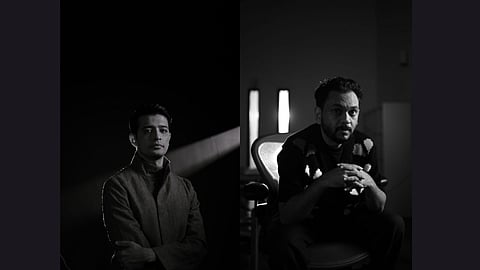
For the better part of the last decade, Anand Gandhi and Zain Memon have been quietly assembling a future. And the name of that future is MAYA.
You could call it a narrative universe, sure. Or, you could call it an act of civilizational memory. Or, as Zain Memon puts it, “an attempt at making a large-scale civilizational mythology for the new age.”
And what an attempt it is.
MAYA isn’t just a story. It’s an ecosystem. It stretches across novels (one of which is due to be announced soon), films, graphic novels, digital and tabletop games, speculative architecture, and collaborations with an international dream team of the best artists, scientists, geologists, biologists, really across the world. And the result is a story that wants to rewire the way we tell stories in the first place.
MAYA didn’t start with a product, but a provocation: What would Vyasa do if he was around today? What would Kabir be singing?
The answer was to build a mythos that confronts the 21st century’s most urgent questions: climate crisis, pandemics, existential risk, inequity, artificial intelligence. “These are serious and urgent priorities for the civilization,” says Anand.
“And if any of the great thinkers from Valmiki to Tolkien were around today, they would be creating fables addressing these challenges.”
So that’s what they did.
Over four years, Anand and Zain assembled minds from across disciplines—“geologists, biologists… the best”—to construct a universe where art, science, philosophy, and speculative futurism merge. The building blocks of this universe are not just characters and plotlines, but metaphors and myth-tech.
“Stories are software upgrades, and that’s how we ought to be using them,” Anand says. “We are offering solutions for the first time, we can’t be subtle about them. We have to speak them out.”
Perhaps the most quietly radical thing about MAYA is its geopolitics. Because while the rest of the world continues to binge-watch Western visions of the future, MAYA is unapologetically attempting to build one rooted in Eastern frameworks of logic, thought, and myth—without rejecting the West, but refusing to be defined by it.
“We wanted to make this incredible monologue that we have been on the receiving end of… into a dialogue,” says Anand. “As much as we know the differences between the history of speakeasies in Harlem and poetry readings in Bushwick, our peers in the West don’t know the difference between Borelli and Banaras.”
MAYA isn’t anti-West. It’s anti-monologue. Its goal is synthesis, not supremacy. “We hope to create a mythology that draws inspiration from the greatest ideas of India, the greatest ideas of the West, the greatest ideas that the world has to offer over thousands of years… and translate that into the language of a sprawling fable.”
As Anand puts it: “We asked ourselves, what are the most urgent questions of civilization today… and then convert all of that into the language of fable, because fable is the most powerful language that we have as a species.”
The first novel is almost here. The other formats will follow. But if you’re waiting for a neat, cinematic climax—you’ve misunderstood what MAYA is. It’s a narrative superstructure designed to grow, mutate, and evolve with the world it critiques.
And the dream? That one day, the stories coming out of South Asia won’t just be known—they’ll be assumed.
“The prize is for Africa to be economically self-sufficient…” Garrett Oliver once said of Pierre Thiam’s culinary ambitions. You get the feeling Gandhi and Memon are chasing their own antelope.
And this time, it might just look like a universe.