
- Entertainment
- Style
- Lifestyle
- Food & Drinks
- Tech & Auto
- Culture

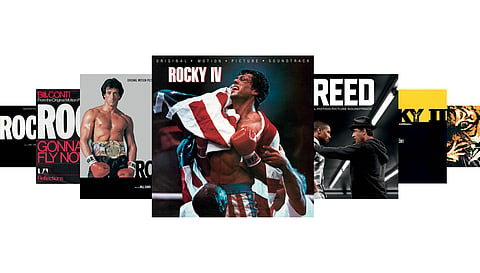
THIRTY WORDS. THAT’S ALL THE VERBAL FUEL THAT powers “Gonna Fly Now,” the theme song for Rocky(1976). Fifty years ago, the song gave a musical edge to a sports drama film about a small-time boxer and loan shark who gets an unlikely shot at the world heavyweight championship.
Written and directed by Sylvester Stallone, Rocky became a massive hit and spawned many sequels. It gave generations of viewers around the world two characters who stood the test of time: Rocky Balboa (Stallone) and his first nemesis, Apollo Creed (played by Carl Weathers). What began as a one-in-a-million chance became the ultimate rags-to-riches story, spawning a franchise that has even inspired a movie on the making of the film, in I Play Rocky (2026), starring Anthony Ippolito as Stallone.
What has remained constant, though, is the music. “Gonna Fly Now” was nominated for Best Original Song at the 49th Academy Awards but never won. The version of the song from the movie, performed by composer Bill Conti with an orchestra, hit number one on the Billboard Hot 100 chart in 1977. But the journey to find the musical soul for Rocky was almost a case of what if.
In The Steps, Stallone’s recently released biography, the actor reveals how during the movie’s editing and post-production phase, the editor and sound mixer had cut the fight between Balboa and Creed to “Purple Haze” by Jimi Hendrix.
Stallone was not happy. He wanted the music for Rocky to be “somewhat classical” so that it stood apart from other boxing films. “Rocky’s life was anything but classical, so this would make for an interesting juxtaposition,” he says in the book. His search for a “timeless sound that could help carry the movie for years and years” eventually led him to Conti. Stallone describes the composer’s arrival as nothing short of “divine intervention”.
Conti created a piece of music that relies on a heroic orchestral brass, driving percussion, rock instrumentation, while lyricists Carol Connors and Ayn Robbins provided the words. The track crescendos as Rocky sprints and climbs the famous Philadelphia Museum of Art steps and punches the air in glory.
For pro boxers even today, fifty years down the line, “Gonna Fly Now” is more than a song. It’s a call for resilience, stubbornness, an expression of perseverance or simply about never giving up. “The most beautiful bit is that the music made Rocky’s journey in the movie special. I have woken up to “Gonna Fly Now” as my alarm,” says Ajay Lalwani, 30, a professional boxer and fitness coach in Delhi. “You play this song at three in the morning and I will be up for a run in no time. Every boxer relates to Rocky’s training regime— the early morning run, the raw eggs. In the ring, you are alone. But when you hear the sound of Rocky, you feel like you can take on anything.”
On the screen, a raw and hungry Rocky Balboa matures into a seasoned boxer, film after film, year after year, fighter after fighter. The music progressed along the way too, finding different variations and additions.
In Rocky III (1982), for instance, Conti gave “Gonna Fly Now” a more disco-influenced feel and a sprinkling of the contemporary eighties energy. Rocky, defeated by the more ruthless fighter in Clubber Lang (portrayed by Mr T), turns to his first rival, Apollo Creed, to get his groove back. The famous beach sequence, in which Balboa and Creed race each other—two physical specimens of the highest order, thigh muscles flexing, their sweat-ridden bodies glistening under the California sun—became an enduring image of reinvention and fighting spirit. Training to a rousing anthem, the two men also discover a new friendship.
Rocky III also gave the world “Eye of the Tiger,” the hit song by American band Survivor. If “Gonna Fly Now” captured the exhilaration of an underdog rising to the challenge, “Eye of the Tiger” was about rediscovering that hunger once success had dulled it.
The film’s central premise revolves around a fighter who has lost his way. The death of his long-time manager and mentor Mickey Goldmill (played by the wonderful Burgess Meredith) sends Rocky into a downward spiral. Creed persuades him to hit the reset button, a return to the instincts that made him a champion in the first place. In one of the film’s most memorable exchanges, he tells Rocky: “Now, when we fought, you had that eye of the tiger, man; the edge! And now you gotta get it back, and the way to get it back is to go back to the beginning.”
The line became the song’s central idea, inspiring songwriters Jim Peterik and Frankie Sullivan to create an anthem about holding on to one’s dreams and confronting adversity. “It’s the eye of the tiger, it’s the thrill of the fight, rising up to the challenge of our rival…” the lyrics and tune were a perfect fit for Rocky’s journey, but its appeal went beyond the film.
Journalist Sunit Arora, 56, remembers how the Rocky soundtracks introduced something new to the musical landscape in that era, including Survivor’s hit. “The music scene in the late seventies and eighties was depressing. I’m wary of generalising, but even in terms of Hindi cinema, it was a synthesiser and chorus-driven thing,” says Arora. At the same time, he recalls how new sounds were emerging, punk was gaining ground and anthems were becoming popular. “‘Eye of The Tiger’ was a massive hit because it fitted into what we were listening to back then,” he says, adding, “The sports association also helped.”
But the music’s influence wasn’t limited to the sporting arena or the charts. For a generation of boys, Rocky offered something more personal: stories of men who were knocked down, struggled with loss and found a way to carry on.
Food and TV expert Rocky Singh, 58, was named by his father after the famous boxer Rocky Marciano, the only heavyweight champion to finish his career undefeated. “I lost my father in the 1971 war,” recalls Singh, who grew up in a part of Delhi that was sanctioned to war widows. “A large bunch of us grew up with only working mothers, no fathers. We looked at the world very black and white and believed in stories and characters more convincingly than anyone else.”
He remembers Rocky as an important film when it came out. He was 12 when he watched it in 1981. “When the music connects to a story, it becomes something else. In the case of Rocky, “Eye of the Tiger” had a huge impact: if you are beaten or down, keep your spirit up. I was a sportsman myself. I boxed. I played hockey for India. I found a lot of relief in the song. It really gives you hope when you are a young person. Young people are way more influenced by such simple yet positive stories with a powerful message,” he says.
As the franchise expanded, the music continued to evolve.
Conti had established Rocky’s musical identity, and a few bars of “Gonna Fly Now” were incorporated into musician and composer Vince DiCola’s famous training montage instrumental in Rocky IV (1985). This time, Balboa was preparing to face Soviet boxer Ivan Drago (Dolph Lundgren), who was responsible for Apollo Creed’s tragic death in an exhibition fight. The stakes were different, but the familiar musical cues carried the same message: keep going on, no matter what.
Conti went on to score Rocky V (1990) and Rocky Balboa (2006). Swedish composer Ludwig Göransson took the musical legacy forward with his music in Creed (2015) and Creed II (2018), the seventh and eighth instalments in the franchise where Rocky trains and mentors Adonis Johnson (Michael B Jordan), Apollo Creed’s estranged son. “Gonna Fly Now” also finds its way into I Play Rocky, indicating how embedded it has become in the franchise’s identity. In The Steps, Stallone writes that Bill Conti’s music gave the film its emotional power. “The man was a stone genius, ambitious savant brimming with creativity… His score gave the film its heart. It gave the training montage its motivational energy, the low points their sadness, and the ending its triumphal joyness. Without Bill, I knew in my heart the film would not have the emotional impact and heart it continues to have for so many people.”
Fifty years on, “Gonna Fly Now” and “Eye of the Tiger” continue to resonate beyond the films that made them famous. One gave an underdog his soundtrack; the other reminded a champion what it meant to fight. Both remain anthems for anyone who has ever had to summon courage. To think it all began with thirty words and the tune of a lifetime.
To read more stories from Esquire India's November 2026 issue, pick up a copy of the magazine from your nearest newspaper stand or bookstore. Or click here to subscribe to the magazine.