- Entertainment
- Style
- Lifestyle
- Food & Drinks
- Tech & Auto
- Culture

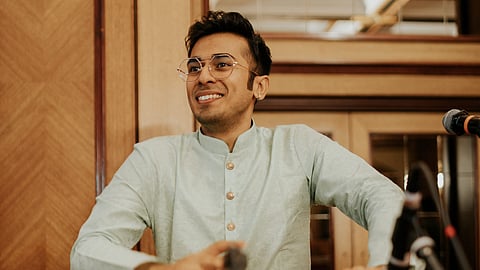
The story of a musician often begins with rebellion. But for Nikhil Paralikar, it began with boxes and wood. Cardboard cartons and wood tables in his childhood home that he drummed on until rhythm became muscle memory.
He was five when his mother noticed his inclination and steered him towards formal training. She asked him to pick an instrument. Drums, congas, the usual suspects. Instead, he chose the tabla. Not because it was cool—it wasn’t, not in schoolyard terms—but because he was instinctively drawn to its richness, its versatility, its sheer tonal weight.
Today, Paralikar is one of those Indian musicians who can sit comfortably in two worlds at once: the rigorous domain of Hindustani classical and the restless, hybrid soundscape of the global stage. A tabla virtuoso with 15 years of training, he has played to crowds in over 30 cities, collaborated with everyone from Red Bull to Sony Music, and amassed over 110 million views online. Yet his most striking achievement may not be the numbers but the sensibility. He treats the tabla not as a relic to be preserved, but as a living, breathing instrument that can converse with techno, EDM, Bollywood, or folk traditions without losing its essence. In his words, “fusion is nothing but mixing two things the right way.”
This is most evident in The Tabla Guy Collective, his ambitious new project that brings together nine musicians from Rajasthan, Maharashtra, Gujarat, and Hyderabad. Think Rajasthani folk singers against electronic pulses, Gujarati rhythms colliding with techno, tablas tuned across multiple surs forming entire melodic lines. The sets are sonically bold, visually lush, and unapologetically contemporary—designed as much for the festival stage as for the digital feed. But behind the spectacle lies a deeper mission: to show that the tabla is not just about rhythm, but emotion, narrative, and possibility.
Of course, the path hasn’t been simple. Fusion, in India, carries baggage—too often dismissed as a gimmick, too easily accused of diluting classical tradition. Paralikar’s approach pushes against that suspicion. His foundation is purist—steeped in bandishes handed down by his guru—but his instinct is experimental. In his hands, the tabla isn’t ornamental. It’s centre stage.
To him, the experiment is not dilution but translation, a way of showing that the tabla, tuned across different surs, can be as expressive as a piano or guitar. It is an argument for relevance, yes, but also for expansiveness—for allowing an ancient instrument to hold its own in the global soundscape without apology.
In a conversation with Esquire India, Paralikar talks about The Tabla Collective, his love for techno, and all things table.
Excerpts from a conversation.
Right off the bat, how has the journey been?
It’s been absolutely great, and good things are going on.
Tell me about the start. What’s the first sound of music you remember from your childhood?
Rhythm started when I was just five. I remember playing on random surfaces in my house, and my mother recognised there was some talent there. She introduced me to several instruments, but I don’t know why—I just found the tabla so fascinating. I think it was the tone of the instrument that really attracted me. That’s how I picked it up for myself.
That’s cool, because so many people of our generation usually go for the drums or guitar when they’re in school. How did people around you react when you wanted to pursue the tabla seriously?
To be frank, when I decided to take it up professionally, nobody believed it. It’s not a conventional career path, right? From parents to friends, everybody doubted whether I’d be able to make something of it. But eventually, as my career grew, they started believing in me. My parents especially—once I started earning from it, they really came on board. Parents don’t come from a bad space; they just want their kids to be settled.
True. Tabla is traditionally seen as disciplined, structured, rigorous. But your sound is playful, even rebellious at times. How did you decide to break away from that purist sense?
Actually, I haven’t broken away from it. I’m still very much connected to classical. What I play today is classical—I just infuse it with different genres. That’s the only difference. Instead of a traditional setup with a tabla solo alongside sarangi or harmonium, I might play tabla with techno coming out of a DJ console. Or with my collective, I bring in 10 other artists and fuse their sounds with mine. But I always make sure the essence of classical doesn’t go anywhere. I stick to what my guru taught me, just in a different style.
Were you always into techno? How did that interest come about?
In college, during my engineering days, I listened to everything—not only techno. But one day I was jamming to a Calvin Harris track, he’s still one of my favourites, and I just felt the urge to take out my tabla and play along. That’s where the interest grew. And it really clicked when I did it myself and realised how much I enjoyed it.
You studied engineering at VIT. Was tabla always in the background, or was there a moment you thought you might not take it so seriously?
Tabla was always there—sometimes in the background, sometimes in the foreground. Academics is a big part of life, so hobbies often get sidelined. But thanks to my parents, especially my mother, I never kept tabla as a second priority. I remember two months before my 10th board exams, there was an all-India competition in Odisha. My mother made sure I flew down to perform, even though boards were so close. She was a theatre artist herself, so she knew what it meant to support me.
Let’s talk about The Tabla Guy Collective. It’s such a first-of-its-kind project.
The idea has been there for the longest time, but I only brought it to life this year. We’re a 10-piece act doing genres like techno with Rajasthani folk, Indian classical with techno, Bollywood numbers, even English folk fused with Indian classical instruments. We’ve got something to entertain everyone—whether you’re 20 or 60. The idea is to reach across audiences in different forms. Right now, we’re also working on our originals. We released a few videos recently, and we’re already booked up for the entire season.
You’ve also got this identity as a crossover artist, even a pop romantic voice at times. Do you see these as different versions of yourself, or just one evolving identity?
I think it’s the latter. I’m evolving from one thing to another. I get bored easily—maybe even with myself—so I like experimenting every day. I work every single day, no exceptions. Music is vast. Nobody has reached the end of it, and each day is important. That’s how I keep evolving.
Success aside, I’m sure there are low points too—creative blocks, doubts, questions about whether it’s all worth it. How do you deal with those?
Honestly, I just take a trip somewhere. I shut myself down. Recently I flew to Sri Lanka for a show, and I stayed back three days to unwind and reset. I know I’ll hit another creative block in a couple of months, and when that happens, I’ll just fly somewhere else. It works for me.
Do you remember your first international stage?
Definitely. It was in Dubai in 2017, for about 1,500–2,000 people. At the time, that was huge for me. I was nervous, but I think nerves make me better on stage. Now bigger crowds feel like a habit, but that first show was very special. It felt like the beginning of everything.
Growing up in this discipline, what lessons have stayed with you that still guide you today?
I believe in always being a student. Every day you learn—sometimes from others, sometimes from your mistakes. Even in this conversation, I might learn something from you. That mindset keeps me grounded.
And the dream? A stage you want to play, a collaboration you’re hoping for?
I have a lot of dreams, but I can’t put them in a sentence. One day at a time, one milestone at a time. The collective itself was a dream—it took seven years to make happen. That’s done now. Soon, I’ll have another dream. And maybe then, we’ll talk again.