- Entertainment
- Style
- Lifestyle
- Food & Drinks
- Tech & Auto
- Culture

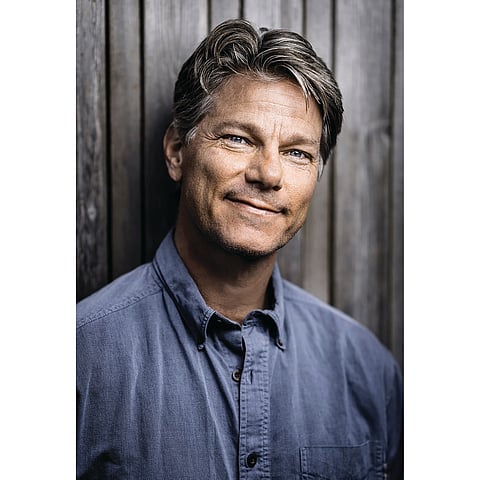
John Vaillant wants us to rethink climate change and how we live in the 21st century.
During his second session at the recently concluded Jaipur Literature Festival, Vaillant discussed his latest book Fire Weather: A True Story from a Hotter World —a 2024 Pulitzer Prize Finalist in General Nonfiction—and took a closer look at the complex relationship between humanity and the planet, while in conversation with historian Sunil Amrith and author Mridula Ramesh.
As we sit and talk on the side lines the festival, Vaillant points how it is an unusually hot day in Rajasthan. In other parts of the world, the impact of climate change has been visible with several environmental crises – the wildfires that decimated southern California and Los Angeles last month were the latest in a long line of examples. “You're feeling it in powerful and destructive ways that really impact the citizens,” Vaillant adds.
Vaillant, an author and freelance writer based in Vancouver, BC, has previously worked on books like The Tiger, a riveting tale of man-animal conflict set in the snowy forests of eastern Russia, The Jaguar’s Children, an intense tale about illegal immigrants, and The Golden Spruce, his first book, an environmental true crime story.
The writer says he went through multiple scientific journals extensively for his research work while working on Fire Weather, which dives deeper into man’s relationship with fire. “Nature is tremendous. Anything that I read anywhere else, I would want to see what Nature had to say about it, so that's kind of the backstop,” says Vaillant. “I think Scientific American has been helpful. Science, another American journal.”
Edited excerpts from an interview.
Esquire India: 2024 was the hottest year on record. In that sense, how important is 2025 in the climate change debate?
John Vaillant: We're on this trajectory right now. And, if you look at CO2, temperature, billion-dollar weather disasters, they are all tracking each other, rising steeply. El Niño, El Niña, various other planetary weather variations might influence 2025. But the general trend is only going in one direction, which is up.
So it will be, if not hotter in 2025, it will be hotter in 2026 than in 2024. A Romanian climate scientist, I can't recall his name, recently said on Twitter (the social media platform X) that something important to understand is this is not the hottest year in the past 100 years. It's the coolest year of the next 100 years.
That's the way we need to think about it.
ESQ: One of the biggest announcements in the climate change debate in the last few days has been US's decision to move out of the Paris Agreement. Countries like Indonesia are also mulling their participation. What do you think will be the global ramifications of this?
JV: It's a real reckoning for the willingness of global individual nations to take responsibility for our collective fate. What you see now is, frankly, moral cowardice and corruption ruling the decision-making process of the United States. But what is equally cowardly and corrupt is for other nations to say: ‘Well, the United States is bailing out, so that makes it okay for us. Then that almost guarantees that we will all go off the cliff together’.
What this is an opportunity for is for nations like India—emerging, very powerful entities with enormous populations, enormous amounts at stake, for China, for the European Union, for Latin America—to step up and fill the void left by the United States.
We have the gravest responsibility we've ever had right now, which is to manage our emissions in ways that will enable future generations to simply survive. The stakes have never, ever been higher in the history of Homo sapiens. You'd have to go back 2,50,000 years. This is beyond the bubonic plague. This is beyond the terrible famines that India and China have endured. This is a whole other order of magnitude, and it's going to take a global effort.
If important nations like Indonesia follow the cowardly, irresponsible, and immature example of the United States, I think it could doom us. If I was an aspiring, emergent nation, seeing the US willingly step back, it's my responsibility to say: 'Ok. Now's my chance and opportunity to lead in the way that feels consistent with the values and the hopes of our nation'. It seems like a great opportunity for India.
ESQ: Which brings me to the next question: what does India's role become in this situation?
JV: You have this huge population that is aspirational, full of talent, that wants to live, and many of whom want to live in a different way, in a more affluent way, to participate more fully in the 21st century. Unfortunately, the 21st century, as it exists, is not sustainable. There are roughly 2 billion internal combustion vehicles on the planet right now.
Again, just look at the CO2, look at the temperature, they go together. Rajasthan, this is an unusually hot day, in an unusually hot week, in what's going to be an unusually hot year. India is more vulnerable than many nations to climate change.
I think the goal for India is not to, 'we want to emulate the lifestyle demonstrated by the global north in the 20th century. We need to reinvent how we live for the 21st century'. That is going to mean a full-scale shift to renewable energies, a whole different regime of water management, of land management, of honouring the limits and the needs of natural systems, and returning to what is part of India's glorious heritage, which is a deep and profound and nurturing relationship to the land. You showed the rest of the world how to do it. It started here. William Dalrymple talked about that.
So, wouldn't it be amazing if India could recapture, regain that power and influence, and show us how to be a healthy and environmentally integrated 21st century?
It can't involve a lot of coal. It can't involve a lot of pet coke. It can't involve a lot of petroleum. That is an issue for India. That's probably one of its biggest issues. It's a cheap way to wealth that is blowing back on us with disastrous consequences. So, it's almost a cheat.
Petroleum has been a cheat to wealth. The real costs are CO2, and the interest on that is the heat. The debt is the CO2, the interest is the heat. To take the analogy further, the bank of nature is now repossessing. That's what every storm is, taking back the houses, taking back the cars.
ESQ: You mentioned in your session that nature is communicating with us; that something is out of balance. This is an unprecedented period, the last 10-15 years, even the last 20 years. How will history remember this time where maybe we could have done something, but we did not?
JV: It could be one of the most shameful abdications of responsibility in the history of our species. Or it could be one of the most heroic pivots and reinventions.
My guess is, it's going to be it's going to be a combination. Nothing is going to happen evenly on planet Earth. There's going to be pockets, and now we see the United States going backwards. It's basically running back into the 20th century, exploiting oil that we don't need, silencing climate action, stifling meaningful action on federal communications around climate and health.
The idea that you would be willing to endanger the health of your entire population in the spirit of draining the swamp is ludicrous and criminal. I'm an American citizen, by the way. I'm a dual citizen… It is surreal to see what's happening.
If you want to understand it, read Wildland: A Journey Through a Divided Country by Evan Osnos. He writes about politics for the New Yorker magazine, and it explains how we got to Trump in a very comprehensive way.
Another book I’d recommend is Less Is More: How Degrowth Will Save the World by Jason Hickel.