- Entertainment
- Style
- Lifestyle
- Food & Drinks
- Tech & Auto
- Culture
Picture sitting alone in a dimly lit café at midnight. Your cup of black coffee has been sipped to freezing. In the city, business goes on as usual. Someone you lost is on your mind. And amid peering vacantly at your phone screen, you check your scrolling.
Zindagi ek fann hai lamhon ko
apne andaz se ganvaane ka
(Life is the art of letting moments
slip away in your own style)
In all the silence of the world around, someone has said the words you couldn’t yank out of the depths of your heart. That is Jaun Elia for you, whose poetry isn’t one for speaking to the soul. It feels like a cold slap across the face. Somehow that was what you needed, too.
In the era of hashtag healing and self-love, Elia’s brutal truths defy comforting lies. With him, you will have no hope for hope. He will not tell you everything is okay, but look at you with unflinching eyes, hand you a mirror, and ask: “Are you really okay, or are you merely pretending?” As a curated digital universe expands at the speed of light, with its sanguine mottos of peace and happiness, one brush with Elia’s work will have you weighing if these are just myths that we devised to make it through the chaos.
It won’t be too difficult to label these patterns toxic in the modern-day, but Elia knew it better than anyone else that people are messy. Having lived through Partition and migrated to Pakistan from his native Amroha (modern-day Uttar Pradesh), the poet rejects the spiel that mere love must be the answer to our problems. His love was bitter, bruising and suffocating—as against the sugary and sentimental interpretations of it we’re accustomed to being fed. When he says, ye jo deewangi hai, wo mujh se bhi pyaari hai, (the madness that’s in me, is even dearer than myself), Elia revels in obsession. He accepts it and lets it breathe.
In the dark, there's light
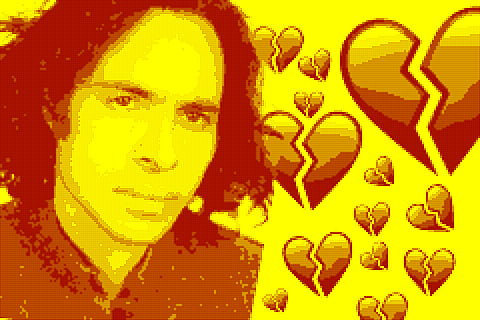
It’s this darkness and chaos that many others cannot tap into. And yet, it's this darkness that connects us with him in ways other poets could not. In a world of relationships where a person is a swipe away from a torrent of emotions, Elia’s verses truly validate loneliness, heartache and discomfort—it is with these emotions that we find ourselves truly seen.
Probably why the poetry of Jaun sahab has really caught on in the recent years is because of the wilful departure from the rose-tinted, curated world of Instagram and X (formerly Twitter) that he stands for. It's as if his words were created for this time, this era of oversharing and stuffy, illusory relationships that break hearts and then scroll through them like a hall of emotional wreckage. His poetry not only survived the shift from paper to pixels but came to thrive in the wasteland of the digital.
Social media is where we now let our feelings go out, but it is also the place where our deepest feelings are dug deep under filters and hashtags. Elia doesn’t blunt the pains his poetry ascribes to; instead, he invites you to sit within it, marinate in it and realize maybe that's all we have left to hold on to. That is what he means when he says, jisey tu bikhra samajh raha tha, waisa koi rishta nahin tha (the relationship you thought was falling apart, was never a relationship to begin with). What we think is love or loss might just be illusions we've conjured in our own minds, asserts Elia. He knows how we lose the best part of ourselves in this quest for love. Meri har shaam ki tarah, mujh ko raat bhi chali gayi (Like every evening of mine, I lost my every night, too). Elia speaks to that lonely corner in all of us that keeps waiting for something that never comes.

With more and more people on Instagram, Youtube and X discovering him, Elia’s work is being shared not as some obscure art form but as the raw, unapologetic voice of a generation that feels more broken than it ever has. The heartache he speaks of has nothing to do with the fashionable and aestheticised version of it posted by influencers. It runs deep, it smarts in your bones—for instance, when he says, jo tera tha, wo mujh se kab ka chhup gaya hai, par tu jeene ki baat kare, to har baar mar gaya hai (what was yours, has long since hidden from me, but whenever you talk about living, I die again).
Heartbreak as inevitable
The world is only just beginning to understand the emotional cost to all the relationships created on social media, flash connections and virtual loneliness. But Elia had already begun laying the groundwork for those conversations many decades ago. His nihilism was not just a sullen streak but a deeper understanding of how fragile and meaningless life often is. It was not a recognition of defeat but he knew heartbreaks were inevitable.
Ye jo khushbu hai teri, ye jo saans teri hai, Mujhe to yeh bhi lagta hai, tu bhi koi dard hai
(The scent of you, the breath of you, I feel as though you, too, are nothing but pain)
Elia’s words go beyond the “heartbroken” and “disillusioned” aesthetic that gets thrown around social media. His words probe us. They make us ask: “Is this heartbreak mine, or do I just play?” Elia's poetry was not the performance of grief; it was the living of it. Tum khush ho, to khushi ki baat hai, magar tum mere paas ho, toh yeh dard hi sabse pyara hai (If you are happy, that's your business, but if you are with me, this pain is the sweetest of all). These words don't just talk about love—they talk about obsession, self-doubt, the infinite pull of attraction, and the satisfaction of pain. He speaks for the rebels, the over-lovers, the over-givers. He speaks to us when we feel the least like belonging to a world of instant gratification.
The more people discover Elia's work, the more they will not be uncovering lines of poetry but pieces of themselves. So maybe the next time you scroll through your feed, pause at reading a line that speaks to your heart, it's not just coincidental. It's Jaun Elia reminding you that at times, solace can be found in acknowledging darkness, and maybe, just maybe, what keeps us from being false is heartache.