
- Entertainment
- Style
- Lifestyle
- Food & Drinks
- Tech & Auto
- Culture
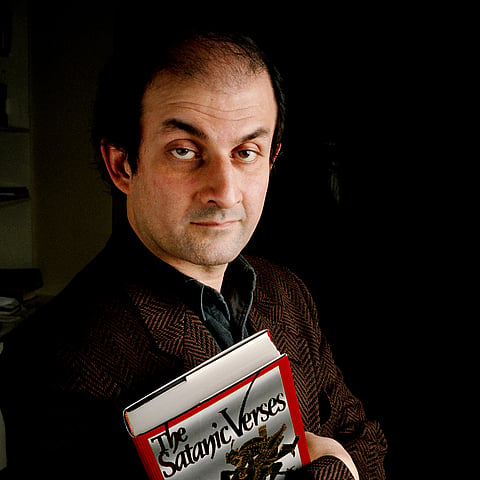
In the first year of my journalism degree, there was this literature professor who could take the most scandalous book and make it something you really must read. Once, while reading Midnight's Children to us, she stopped, leaned in and whispered as though she were letting us into a little secret: "But there is another book by Rushdie…one that has been banned, hunted, even cursed by governments." That book, so polemical and uproarious that it caused copies to be burnt across the Muslim world, and a fatwa issued against its author, was The Satanic Verses.
In the forbidden territory for so long, this literary artefact is now set to see the light of the day. It's not because of some overdue change of heart or literary reevaluation. Instead, a Delhi court recently ruled that India’s ban on importing the book had to be “presumed non-existent.” Why? Because authorities couldn’t produce the original paperwork that had banned it in the first place. Yes, the decades-old ban was undone by a simple missing document.
The new ruling is monumental not only because it technically opens the door for legally bringing The Satanic Verses back into India but also because it highlights how some lost paperwork can change the status of a work that’s been polarising for over 30 years. But, hold on—The Satanic Verses hasn't yet been re-released by any publisher. Even Rushdie's Indian publisher, Penguin India, hasn't spoken about an official reprint. But should you chance upon a dusty copy hidden among yesteryear paperbacks and bestselling pulp fiction, you must bring it back home and give it space on your bookshelves. If you're still not convinced, we'll give you five strong reasons.
1. Literary Merits That Stand the Test of Time
Salman Rushdie is the maestro of conjuring intricate worlds, full of elements both real and surreal. The Satanic Verses takes it one step further, blending magical realism with mythology, satire and history. It tells the story of Gibreel Farishta and Saladin Chamcha, movie stars whose ideals are inverses of each other, surviving a terrorist bombing that sets off a chain of supernatural events symbolic of transformation, faith and the immigrant experience. Rushdie's writing can't be described as casual or linear; it's full of cultural references and symbols that call for close reading. For anybody who is a literature lover who likes his books to give you something to think about, The Satanic Verses is gold.
2. A Symbol of Free Speech and Censorship
The Satanic Verses is not just another banned book. It was burned and broadcast out of existence in 1988 when it was first published, inciting official bans in governments across many countries—including Rushdie's own birthplace and country of descent, India. Its author received a global media blitz with Iran's Ayatollah Khomeini calling for his death as he lived under that threat for years. In 2024, the book represents the power of literature to provoke and challenge the status quo. The world is still squabbling over censorship of books, where movies and art continue to be challenged. And The Satanic Verses is a reminder of what is at stake when we let voices be silenced, and of the freedom to read, debate and disagree, that one mostly takes for granted.
3. Exploration of Identity and Belonging
For any reader who has ever found themselves stranded between worlds, or ever wondered about their place within multiple identities, Rushdie's portraiture of the characters in the book will be both relatable and revelatory. The Satanic Verses still rings with arguments in a globalised 2024, when migration is at its highest, and identity politics has never been more contentious. It delves into the complex emotional terrain of being an outsider. His take on the immigrant experience— full of humour and heartbreak—still rings with relevance.
4. The Excitement of Reading Something That Was Once Forbidden
Though the bans are officially revoked, The Satanic Verses is still “unofficially” hard to find in some countries. Yes, e-book versions abound, but possessing a physical copy is a special kind of a pleasure. Even if you aren’t able to do that for a bit yet, reading an online copy will feel like becoming part of a silent, decades-long conversation. And as you flip through the pages of a book that was once deemed too dangerous to print, you can almost feel the weight of its history.
5. A Complex, Nuanced Look at Religion and Faith
It's no secret that controversy around The Satanic Verses focussed mainly on its bold religious explorations, mainly into Islam. Yet, Rushdie approaches his faith both with reverence and critique, an approach that makes for rich, if complicated, reading experience. It doesn't intend to provoke but forces the reader to grapple with faith and with tradition. Perhaps one of the most famous dream sequences in the novel is when Rushdie reimagines events in the history of Islam that still represents a challenge to interpretation and provokes deep reflection for anyone who has wrestled with questions of faith. This contentious novel reminds the reader that faith, like literature, is selective and subjective.
Here are five more books by Rushdie that will take you on equally mind-bending and thought-provoking journeys. Because once you have entered the world of Rushdie, it is very hard not to crave more.
Midnight’s Children (1981)
This winner of the Booker Prize and Booker of Bookers is arguably Rushdie's best work. The novel follows a boy coming to terms with his age at the time of the country's full independence—a child born exactly when India gained freedom from the British.
The Moor’s Last Sigh (1995)
The multi-generational family saga in India is spread over colonial times through to modern India where lives, loves and conflicts are played in a very rich, complex tapestry of a family's life, fully infused with Rushdie's trademark humour and satire.
Shalimar the Clown (2005)
A novel set against the turbulent backdrop of Kashmir's politics, Shalimar the Clown is a love story, revenge story and identity story. Part thriller, part tragedy, this book vividly captures the Kashmir conflict like few other works of literature have so far.
Haroun and the Sea of Stories (1990)
A whimsical children's book, it tells the story of a boy on his way to recover his storyteller father's gift of storytelling. It's meant for children, of course, but each sentence had me thinking about freedom of expression and imagination, making it an able reflection that a lot of adults would relate to.
The Golden House (2017)
This story from modern-day New York takes its protagonist and readers on a journey that dredges up the caustic contemporary issues in America: identity politics, extremism and the nature of truth.
