
- Entertainment
- Style
- Lifestyle
- Food & Drinks
- Tech & Auto
- Culture

Great cities wait for nothing and no one. In that ceaseless spirit, The Only City, a collection of eighteen short stories from Bombay, zips through the metropolis like its reliable local trains, never overstaying in a single mood, mind or place. There is just enough of the postcard city, with its majestic shoreline and aristocratic Parsi bungalows, jostling against the infernal city, all cement grit, derelict squalor and unspoken crimes, forming the collection’s artful urban chiaroscuro. The Bombay experience always boils down to one question, “Which city is yours?”, and this book attempts to honour its invisible multitudes, dismantled and reconstructed in a never-ending cycle.
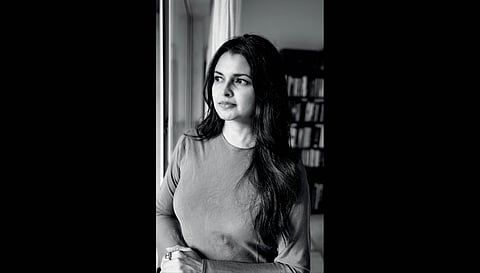
For author and journalist Anindita Ghose, who edited the collection and contributed a new story to it, the city demands abiding devotion. “It’s an impossible task to analyse love, it’s a feeling… my affection for Bombay is part of who I am,” says Ghose. She was raised here and, while she has intermittently been away to study in New York and work in Delhi, the city remains home. When Ghose left Bombay for the first time at 25, she carried another collection with her, Bombay, Meri Jaan, the 2003 anthology edited by Naresh Fernandes and Jerry Pinto. “That book was more of a curatorial exercise, because it had everything from Manto to Pico Iyer, put together retrospectively. This [anthology] is different… I did have a brief, but having a brief and then asking 17 other virtuoso writers to respond to the brief, I think, almost makes this a co-creation,” she says.
Ghose’s story Normal Neighbours, which she began noodling over during the pandemic, planted the early seeds of this collection. “I had started thinking about a story of couples in a Bombay apartment block during COVID... a Bombay COVID story. By the time I got around to writing it, I didn’t feel like revisiting the pandemic and it just became a Bombay story.” For a while, she mulled the possibility of a collection set in one building or complex, à la Rohinton Mistry’s Tales from Firozsha Baag. Soon, a conversation with a Peruvian writer about his short story collection set in Arequipa crystallised what she had to do next. “Bookstores in Arequipa championed that collection as an introduction to the city. I was thinking, where is that book about Bombay written today, which shows you Bombay in different colours by various writers? There are terrific recent books about the city but they are literary expressions by a single voice.”
The Only City lines up an impressive battery of modern fiction writers working in India: Shanta Gokhale, Jeet Thayil, Tejaswini Apte-Rahm, Prayaag Akbar, Lindsay Pereira, Manu Joseph and Namita Devidayal, to name a few. Some notable non-fiction regulars such as journalist Raghu Karnad and art critic and curator Ranjit Hoskote also make their fiction debuts here. In her foreword, Ghose calls the book “a collection of vignettes” and reading through its disparate shifts in literary tone, style and milieu is very much the point.
Karnad’s story Speedboat, about two different worlds colliding at the ferry pier in Alibaug, swarms with the kineticism of crowds and sensory details of the sea voyage to south Bombay. In The Storyteller’s Tale, Gokhale brings a playful irony to her light-footed tale of female friends in Shivaji Park. The titular caregiver of Nurse Shanti, one of the longest stories here by Apte-Rahm, is caught between duty and deception towards her charge, an aging, not-all-there Colonel Maneckshaw.
Cleaving the book along loose thematic lines are atmospheric black-and-white scenes of Bombay, by photojournalist Chirodeep Chaudhuri. “The early stories, I thought, appealed to questions in one’s head… class, caste, gender, morality, finding your feet. They are quicker reads. Then you get into stories that are set in worlds that are already fully formed. And then you move away from reality to magical realism, speculative fiction, to other geographies and realms… there’s some amount of worldbuilding. The book is meant to be read in these chunks,” says Ghose.
Amongst The Only City’s lores of love, lust, lament and loathing, the darker stories seethe with greater ferocity, especially Thayil’s Your Meat in My Hands, an unexpectedly genre-hopping piece in this collection and Shubhangi Swarup’s Snakeskin, inspired by the city’s foreboding real and phantasmal transformations. Bombay won’t be the city it is without this clash of imaginations and perspectives.
Ghose was in the middle of one such back-and-forth during an exchange to promote the book. When a panelist declared the city to be “masculine” because of the capital coursing through its veins, she countered that she viewed the metropolis as a young woman, running headlong into her dreams, concluding with confidence, “Bombay can become anything she wants to be.”
This meta-story, about a painter, his passion project and preserving his soul, time-lapses through Bombay’s shifting art history.
Two siblings hide their secret life in this unnerving vision of the city under tyrannical forces.
An impish farce about a young woman’s place in a wealthy and eccentric Parsi household.
A nameless railway vagrant surveys the city’s casual savagery in this devastating tale with a twist.